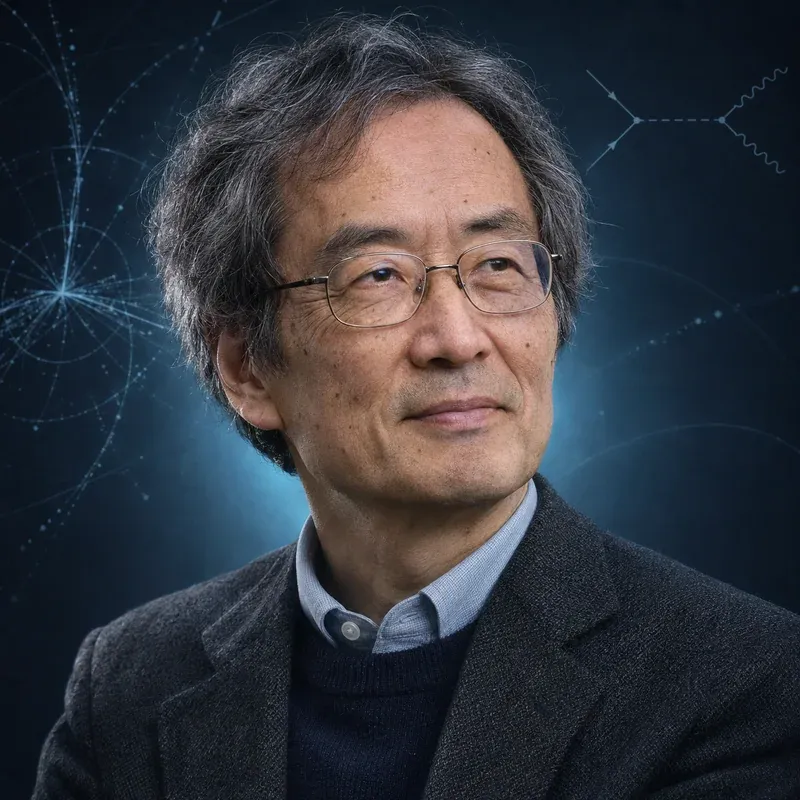
 Illustration
Masataka Fukugita
With Tsutomu Yanagida, Fukugita proposed leptogenesis in 1986: the out-of-equilibrium, CP-violating decays of heavy right-handed (seesaw) neutrinos generate a lepton asymmetry, which sphaleron processes convert into the observed baryon asymmetry. This links the origin of matter to neutrino mass and leptonic CP violation and is a main motivation for searching for CP violation in neutrino oscillations.
- Nationality
- Japanese
- Field
- Theoretical physics; cosmology and astrophysics
- Institutions
- Institute for Cosmic Ray Research (ICRR), University of Tokyo, Kavli IPMU, Institute for Advanced Study (visiting)
Career
Masataka Fukugita is a Japanese theoretical physicist whose work spans particle physics, astrophysics and observational cosmology. Much of his career has been connected with the Institute for Cosmic Ray Research (ICRR) of the University of Tokyo, where he was a professor from 1996, and with the Kavli Institute for the Physics and Mathematics of the Universe (Kavli IPMU), where he held a joint appointment as principal investigator and later a position as senior scientist. He has also spent long periods as a visitor at the Institute for Advanced Study in Princeton. In March 2012 he gave his final lecture at ICRR under the title 'From elementary particle research to astrophysics', a fair description of the path of his research.
The problem of the missing antimatter
The observable universe contains matter but almost no antimatter. The excess is small but definite: for every ten billion photons in the cosmic microwave background there are about six baryons. In 1967 Andrei Sakharov listed the conditions a theory must meet to create such an asymmetry from a symmetric start: baryon number must be violated, C and CP symmetry must be violated, and the process must take place out of thermal equilibrium (the Sakharov conditions). Through the 1970s the favoured explanation was baryogenesis in grand unified theories, driven by the decays of very heavy bosons.
In 1985 Vadim Kuzmin, Valery Rubakov and Mikhail Shaposhnikov showed that the electroweak theory itself contains processes, mediated by sphalerons, that change baryon and lepton number at high temperatures while conserving their difference B−L. At temperatures above about 100 GeV these processes are fast, and they would erase any asymmetry produced in grand unified models that conserve B−L.
Key contributions
In 1986 Fukugita and Tsutomu Yanagida, who had proposed his version of the seesaw mechanism in 1979, turned this problem into a solution. In their paper 'Baryogenesis without grand unification' in Physics Letters B they considered the heavy right-handed neutrinos of the seesaw. Because these particles have Majorana masses, they can decay both into a lepton plus a Higgs particle and into an antilepton plus an anti-Higgs. If CP is violated in their couplings, the two decay rates differ slightly. When the universe cools below the heavy-neutrino mass, the neutrinos decay out of equilibrium and leave behind a small excess of leptons over antileptons.
The sphaleron processes then convert part of this lepton asymmetry into a baryon asymmetry, roughly one third in the Standard Model. The mechanism, called leptogenesis, produces the observed amount of matter for heavy-neutrino masses of roughly 10⁹ GeV or more in its simplest form, close to the masses that the seesaw suggests for light neutrinos below one electronvolt.
Leptogenesis made the origin of matter a question for neutrino physics. It needs neutrinos to be Majorana particles and requires CP violation in the lepton sector. The CP phases relevant to the early universe are not in general the same as the phase δCP measured in oscillations, but a discovery of leptonic CP violation by T2K, NOvA, DUNE or Hyper-Kamiokande, together with an observation of neutrinoless double beta decay, would make the scenario considerably more plausible.
Other work
In the 1980s Fukugita also worked on numerical lattice calculations of quantum chromodynamics. His later research moved towards cosmology and astronomy. He helped define the five-band photometric system of the Sloan Digital Sky Survey (1996). With Craig Hogan and James Peebles he compiled 'The cosmic baryon budget' (1998), an inventory of where the ordinary matter of the universe resides, and with Peebles he later extended it to a full 'cosmic energy inventory' (2004). With Yanagida he wrote the textbook Physics of Neutrinos and Applications to Astrophysics (2003).
In 2012 Fukugita and Yanagida jointly received the Yoji Totsuka Memorial Prize, awarded by the Heisei Foundation for Basic Science, for leptogenesis.
Known for
- Leptogenesis with Yanagida (1986)
- Cosmological parameter and cosmic baryon budget studies
- Sloan Digital Sky Survey photometric system
Chronology
- 1986Leptogenesis paper with Yanagida
- 1996Professor, Institute for Cosmic Ray Research, University of Tokyo
- 2012Yoji Totsuka Memorial Prize (with Yanagida)
- 2012Kavli IPMU (specially appointed professor, then senior scientist)
Original papers
- M. Fukugita, T. Yanagida, Baryogenesis without grand unification, Phys. Lett. B 174, 45 (1986)DOI 10.1016/0370-2693(86)91126-3
Experiments
Connected people
Frequently asked questions
What is leptogenesis?
A scenario in which CP-violating decays of heavy right-handed neutrinos in the early universe create an excess of leptons, part of which sphaleron processes convert into the excess of baryons we observe today. See leptogenesis.
Has leptogenesis been confirmed?
No. The heavy neutrinos are far too massive to be produced in experiments. Indirect support could come from discovering CP violation in neutrino oscillations and from observing neutrinoless double beta decay.
Who proposed leptogenesis?
Masataka Fukugita and Tsutomu Yanagida, in a 1986 paper in Physics Letters B.
On the timeline
Mentioned in 16 pages
Milestones 3
Last updated: · Editorial standard
Cite this page
Text
Neutrino Atlas (2026). “Masataka Fukugita”. Retrieved 22 November 2026, from https://neutrino-atlas.com/people/masataka-fukugita/BibTeX
@misc{neutrinoatlas2026peoplemasatakafukugita,
  title        = {Masataka Fukugita},
  author       = {{Neutrino Atlas}},
  year         = {2026},
  url          = {https://neutrino-atlas.com/people/masataka-fukugita/},
  note         = {Accessed 2026-11-22},
  language     = {english}
}