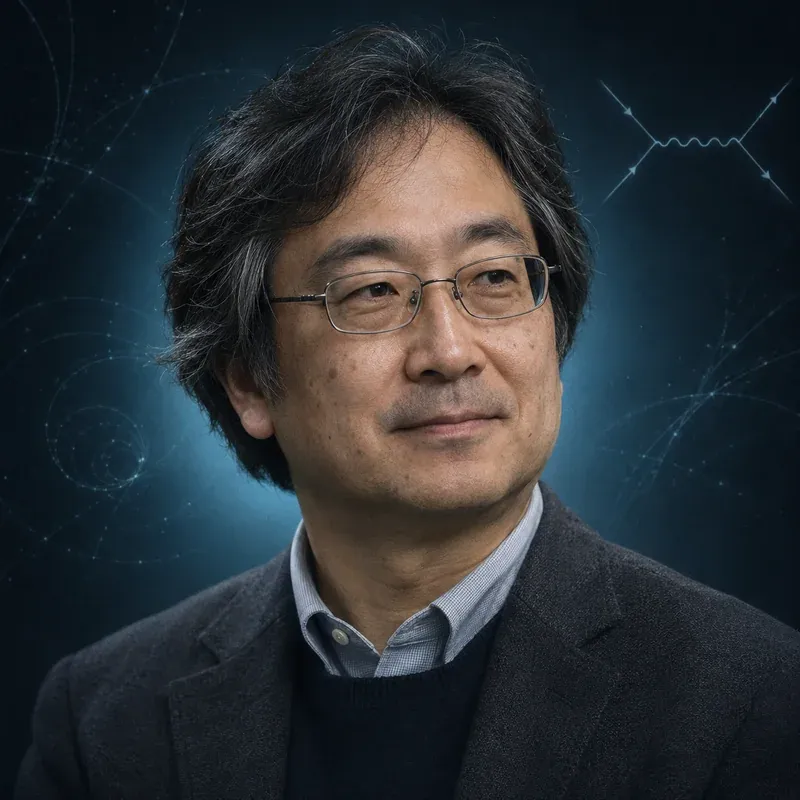
 Illustration
Hitoshi Murayama
In 2000, with Lawrence Hall and Neal Weiner, Murayama argued that the large lepton mixing angles need no special flavour symmetry: a neutrino mass matrix with random, structureless entries reproduces the data naturally. This 'anarchy' hypothesis became the reference against which symmetry-based models of the PMNS matrix are compared, and it favoured a sizeable θ13, measured in 2012. He has also worked on leptogenesis and was a member of KamLAND, which shared the 2016 Breakthrough Prize. As chair of the 2023 P5 panel he led the US roadmap that set priorities for DUNE and IceCube-Gen2.
- Born
- 21 March 1964
Tokyo, Japan - Nationality
- Japanese
- Field
- Theoretical particle physics and cosmology
- Institutions
- University of Tokyo (BSc 1986, PhD 1991), Lawrence Berkeley National Laboratory (from 1993), University of California, Berkeley (professor from 2000), Kavli IPMU, University of Tokyo (founding director 2007)
Career
Hitoshi Murayama was born on 21 March 1964 in Tokyo. He studied physics at the University of Tokyo, graduating in 1986 and receiving his doctorate in 1991. In 1993 he joined Lawrence Berkeley National Laboratory as a postdoctoral fellow, became associate professor at the University of California, Berkeley in 1995 and full professor in 2000. In 2007 he became founding director of the Kavli Institute for the Physics and Mathematics of the Universe (Kavli IPMU) in Japan, which he led for eleven years.
Neutrino mass anarchy
By the late 1990s atmospheric and solar neutrinos had revealed two large mixing angles, very unlike the small mixing of quarks. Many theorists explained this with an ordered mass matrix fixed by a flavour symmetry. In 2000 Murayama, Lawrence Hall and Neal Weiner turned the argument around: if the entries of the neutrino mass matrix are random numbers of similar size, large angles in the PMNS matrix are the typical outcome, and nothing needs explaining.
This anarchy hypothesis made a testable statement. Random matrices rarely give a tiny third angle, so anarchy favoured a sizeable θ13, whereas symmetric patterns such as tribimaximal mixing predicted zero. The measurement of θ13 ≈ 8.5° by Daya Bay and RENO in 2012 fitted the anarchic expectation and weakened exact-symmetry models, although the debate between the two views continues.
Other work and community roles
Murayama has worked on supersymmetry, including anomaly-mediated supersymmetry breaking (1998), on dark matter and on leptogenesis, and he was a member of the KamLAND collaboration. He chaired the US Particle Physics Project Prioritization Panel (P5), whose report of December 2023 set the American programme for the following decade, including recommendations on DUNE and IceCube-Gen2.
Known for
- Neutrino mass anarchy (with L. Hall and N. Weiner, 2000)
- Founding director of the Kavli Institute for the Physics and Mathematics of the Universe
- Chair of the 2023 US Particle Physics Project Prioritization Panel (P5)
- Anomaly-mediated supersymmetry breaking (1998)
- Member of the KamLAND collaboration
Chronology
- 1991PhD, University of Tokyo
- 1993Postdoc at Lawrence Berkeley National Laboratory
- 2000Neutrino mass anarchy paper; full professor at Berkeley
- 2007Founding director of Kavli IPMU
- 2016Breakthrough Prize as KamLAND member
- 2018Humboldt Research Award
- 2023Chairs the P5 panel
Original papers
- L. Hall, H. Murayama, N. Weiner, Neutrino Mass Anarchy, Phys. Rev. Lett. 84, 2572 (2000)DOI 10.1103/PhysRevLett.84.2572
Experiments
Connected people
Frequently asked questions
What is neutrino mass anarchy?
The hypothesis, proposed by Hall, Murayama and Weiner in 2000, that the neutrino mass matrix has no special structure; random entries naturally yield the large lepton mixing angles.
What is P5?
The Particle Physics Project Prioritization Panel advises the US Department of Energy and National Science Foundation. Murayama chaired the 2023 panel.
Last updated: · Editorial standard
Cite this page
Text
Neutrino Atlas (2026). “Hitoshi Murayama”. Retrieved 22 November 2026, from https://neutrino-atlas.com/people/hitoshi-murayama/BibTeX
@misc{neutrinoatlas2026peoplehitoshimurayama,
  title        = {Hitoshi Murayama},
  author       = {{Neutrino Atlas}},
  year         = {2026},
  url          = {https://neutrino-atlas.com/people/hitoshi-murayama/},
  note         = {Accessed 2026-11-22},
  language     = {english}
}