KamLAND
A 1-kilotonne liquid scintillator detector that saw reactor antineutrinos disappear over about 180 km.
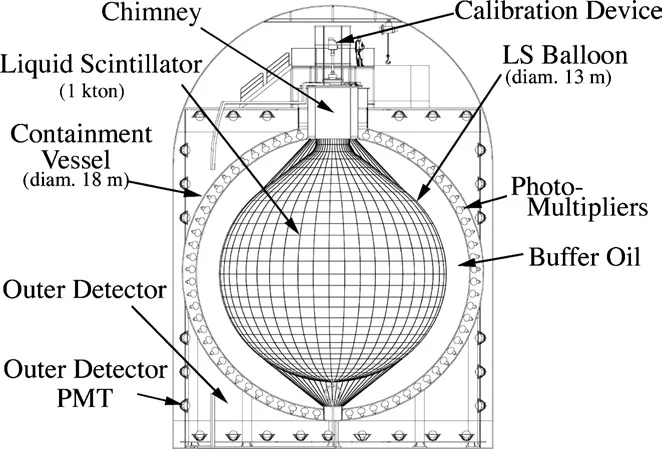
KamLAND detected ν̄e from dozens of Japanese reactors. In 2002 it showed a deficit, and later a spectral distortion, which singled out the Large Mixing Angle solution to the solar neutrino problem and gave the most precise Δm²₂₁ for two decades. In 2005 it made the first detection of geoneutrinos.
Compare all experiments → · World map →
In plain words
In 2002 Japan's nuclear power plants supplied about a third of the country's electricity, and many of them lay at similar distances, around 180 kilometres, from the Kamioka mine. KamLAND used this accident of geography as a giant oscillation experiment. If the solution to the solar neutrino problem was right, reactor antineutrinos should partly disappear over that distance, and they did.
How the detector works
KamLAND was built in the cavern of the former Kamiokande detector, about 1000 metres underground. A transparent nylon balloon 13 metres across holds about 1000 tonnes of ultra-pure liquid scintillator, surrounded by a buffer of mineral oil in an 18-metre stainless-steel sphere. The sphere carries 1879 photomultipliers: 1325 specially developed 17-inch tubes and 554 20-inch tubes reused from Kamiokande. An outer water Cherenkov detector with 225 tubes tags cosmic muons. Antineutrinos are identified by inverse beta decay with a delayed coincidence between the positron and the 2.2 MeV gamma from neutron capture on hydrogen.
Key results
- 2002: data taking began in January, and in December the collaboration reported that only about 61 per cent of the expected antineutrinos arrived, the first observation of reactor antineutrino disappearance.
- 2004 and 2008: a distortion of the energy spectrum and an oscillatory pattern in L/E, which excluded alternative explanations such as neutrino decay and pinned down Δm²₂₁ at about 7.5 × 10⁻⁵ eV².
- 2005: the first detection of geoneutrinos from uranium and thorium in the Earth, published in Nature, which later constrained the Earth's radiogenic heat.
- After scintillator purification, measurements of solar ⁷Be and ⁸B neutrinos.
Why it matters for neutrino physics
KamLAND confirmed with a human-made source what SNO had shown with the Sun: together they singled out the large mixing angle MSW solution. For nearly two decades KamLAND provided the most precise value of Δm²₂₁, a role now taken over by JUNO. Atsuto Suzuki led the experiment, and Kunio Inoue later served as spokesperson. Since 2011 the detector has also hosted KamLAND-Zen, a xenon-loaded inner balloon for the search for neutrinoless double beta decay.
Frequently asked questions
What happened to KamLAND after the 2011 Fukushima accident?
Most Japanese reactors were shut down, which sharply reduced the reactor signal. KamLAND used this period to measure backgrounds and geoneutrinos with less reactor contamination, while KamLAND-Zen continued its double beta decay search.
Why is the typical distance of 180 km important?
At reactor energies of a few MeV, the oscillation driven by Δm²₂₁ has its first maximum near this distance, so the disappearance effect is large.
Original papers
- DiscoveryK. Eguchi et al. (KamLAND Collaboration), First results from KamLAND: Evidence for reactor anti-neutrino disappearance, Phys. Rev. Lett. 90, 021802 (2003)DOI 10.1103/PhysRevLett.90.021802
- MeasurementT. Araki et al. (KamLAND Collaboration), Measurement of neutrino oscillation with KamLAND: Evidence of spectral distortion, Phys. Rev. Lett. 94, 081801 (2005)DOI 10.1103/PhysRevLett.94.081801arXiv:hep-ex/0406035
- DiscoveryT. Araki et al. (KamLAND Collaboration), Experimental investigation of geologically produced antineutrinos with KamLAND, Nature 436, 499 (2005)DOI 10.1038/nature03980
Related terms
People
- Alexei Yuryevich Smirnov
- Arthur B. McDonald
- Atsuto Suzuki
- Kam-Biu Luk
- Kōichirō Nishikawa
- Lincoln Wolfenstein
- Stanislav Pavlovich Mikheyev
- Takaaki Kajita
- Wang Yifang
- Eligio Lisi
- Gianluigi Fogli
- John G. Learned
- Kunio Inoue
- Yōichirō Suzuki
- Stuart Jay Freedman
- Gernot Eder
Latest research on this topic
- Neutrino Oscillations without Mass: A Re-analysis of KamLAND Data following the Dirac Equation in Curved SpacetimeHossain, Golam Mortuza, Kumar, Pushpit · 30 September 2026
- Search for Diffuse Supernova Neutrino Background in the Full KamLAND Dataset with Neural-network-based Event ClassificationKamLAND Collaboration · 28 June 2026
- Refined Global Fit of KamLAND Data and the Daya Bay Antineutrino Energy SpectrumHuang, Guihong · 16 May 2026
- Search for neutrinoless double beta decay to excited states of barium in KamLAND-ZenSong, Hasung · 2026
On the timeline
- 2002KamLAND sees reactor antineutrinos disappear
- 2004KamLAND observes the oscillation spectrum
- 2005KamLAND detects geoneutrinos
- 2015Breakthrough Prize honours five oscillation experiments
- 2024KamLAND-Zen's complete data set tightens the Majorana bound
Mentioned in 104 pages
Lessons 9
FAQ 5
Comparisons 2
Milestones 18
- 1956 · Cowan and Reines detect the neutrino
- 1966 · Antineutrinos from Earth's interior proposed
- 1969 · Oscillations proposed to explain the solar deficit
- 1978 · Wolfenstein: matter changes neutrino oscillations
- 1985 · Mikheyev and Smirnov discover resonant conversion
- 1995 · Nobel Prize for neutrino detection
- 2001 · SNO shows solar neutrinos change flavour
- 2002 · KamLAND sees reactor antineutrinos disappear
10 more
- 2002 · SNO measures the total solar neutrino flux
- 2004 · KamLAND observes the oscillation spectrum
- 2005 · KamLAND detects geoneutrinos
- 2007 · Borexino measures beryllium-7 solar neutrinos in real time
- 2010 · Borexino confirms geoneutrinos
- 2015 · Breakthrough Prize honours five oscillation experiments
- 2016 · KamLAND-Zen pushes 0νββ limits beyond 10²⁶ years
- 2023 · KamLAND-Zen 800 reaches 2.3 × 10²⁶ years
- 2024 · KamLAND-Zen's complete data set tightens the Majorana bound
- 2025 · JUNO's first results set precision records
People 21
Terms 49
- Appearance vs disappearance
- Artificial radioactive neutrino sources
- Baseline
- Beryllium-7 neutrinos
- Coincidence / Delayed-signal technique
- Cowan–Reines Neutrino Experiment
- CPT theorem
- Day-night asymmetry measurement
41 more
- Disappearance measurement
- Discovery of neutrino oscillations
- Experiments & detectors
- Geoneutrinos
- Inverse beta decay
- Inverse beta decay (IBD)
- Kamioka Observatory
- Kamiokande
- KamLAND-Zen
- L/E
- L/E (baseline over energy)
- Large mixing angle (LMA) MSW solution
- Liquid scintillator detector
- Matter effects
- Mixing angle θ12
- Mixing angle θ13
- MSW effect
- Neutrino decay
- Neutrino mass
- Neutrino oscillation physics
- Neutrino–antineutrino oscillation
- Nuclear reactors as neutrino sources
- Oscillation observables
- Palo Verde
- Pre-supernova neutrinos
- Radiogenic heat
- Rate vs shape analysis
- Reactor antineutrinos
- Reactor neutrino experiments
- Scintillation
- SNEWS (SuperNova Early Warning System)
- SNO (Sudbury Neutrino Observatory)
- Solar mass splitting Δm²21
- Solar neutrino experiments
- Solar neutrino problem
- Spin-flavour precession
- Supernova early warning
- Terrestrial neutrino unit (TNU)
- Two-flavour approximation
- Underground laboratories
- Vacuum oscillations
Last updated: · Editorial standard
Cite this page
Text
Neutrino Atlas (2026). “KamLAND”. Retrieved 22 November 2026, from https://neutrino-atlas.com/terms/kamland/BibTeX
@misc{neutrinoatlas2026termskamland,
  title        = {KamLAND},
  author       = {{Neutrino Atlas}},
  year         = {2026},
  url          = {https://neutrino-atlas.com/terms/kamland/},
  note         = {Accessed 2026-11-22},
  language     = {english}
}