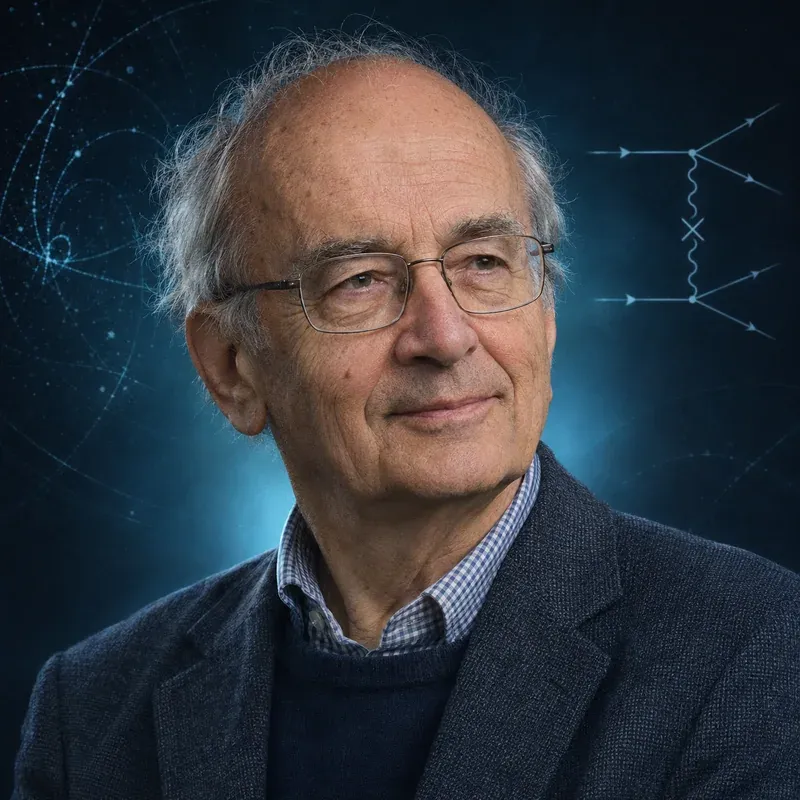
 Illustration
Petr Vogel
Vogel, a long-time member of Felix Boehm's Caltech group, is known for theoretical work on double beta decay and neutrino interactions, recognised by his 1996 APS Fellowship. His 1999 calculation with John Beacom of the cross section and angular distribution of inverse beta decay (ν̄e + p → e⁺ + n) is the standard reference for reactor and supernova antineutrino detection, and he co-authored the textbook 'Physics of Massive Neutrinos' with Boehm.
- Nationality
- Czech-born American
- Field
- Theoretical nuclear and neutrino physics
- Institutions
- Joint Institute for Nuclear Research, Dubna (PhD-equivalent 1966), Niels Bohr Institute, Copenhagen, California Institute of Technology (Kellogg Radiation Laboratory)
Early life and education
Petr Vogel was born in Prague in 1937 and grew up there. He studied at Charles University and then at the Prague Institute of Technology, did graduate work at the Nuclear Research Institute of the Czechoslovak Academy of Sciences near Prague, and completed his graduate studies in 1966 at the Joint Institute for Nuclear Research in Dubna. From 1968 to 1970 he was a postdoctoral researcher at the Niels Bohr Institute in Copenhagen, including a period in Bergen, Norway.
Path to neutrino physics
In 1970 Vogel came to the California Institute of Technology as a postdoctoral fellow in the group of Felix Boehm at the Kellogg Radiation Laboratory, and he stayed at Caltech for the rest of his career, as senior research associate and from 2004 as emeritus. His early work was in nuclear structure theory and on muonic atoms, in which a muon orbits close to the nucleus and probes its size and shape. Boehm's group moved from precision nuclear spectroscopy towards neutrino experiments at nuclear reactors and searches for double beta decay, and Vogel became the theorist who connected these measurements to the underlying physics.
Key contributions
Reactor experiments need to know how many antineutrinos a reactor emits at each energy. In 1981, with G. K. Schenter, F. M. Mann and R. E. Schenck, Vogel calculated reactor antineutrino spectra by summing the beta decays of the thousands of fission fragments, an approach that remains one of the two standard ways of building reactor flux models. He returned to the subject when the reactor antineutrino anomaly and the 5 MeV bump raised doubts about these models.
In double beta decay the measured rate depends on a nuclear matrix element that must be calculated from nuclear theory. In 1986 Vogel and Martin Zirnbauer showed, in Physical Review Letters, that the rate of two-neutrino double beta decay is strongly suppressed by a particular part of the nuclear force, the particle–particle interaction, within the quasiparticle random phase approximation. This explained why measured half-lives were much longer than earlier estimates and became a basic ingredient of matrix-element calculations for neutrinoless double beta decay.
In 1999 Vogel and John Beacom calculated the cross-section and angular distribution of inverse beta decay, ν̄e + p → e⁺ + n, including corrections of order 1/M from the nucleon mass. This is the reaction by which reactor and supernova antineutrinos are detected in water and scintillator, and their paper is the standard reference for it in experiments from KamLAND to JUNO. Vogel also worked on the magnetic moment of the neutrino and contributed to the interpretation of reactor experiments in Japan, including KamLAND.
Legacy
With Felix Boehm he wrote “Physics of Massive Neutrinos” (Cambridge University Press, 1987; second edition 1992), one of the first textbooks to treat neutrino mass, mixing and double beta decay as a coherent subject. He was elected a Fellow of the American Physical Society in 1996. His calculations are among the quiet foundations of experimental neutrino physics: many measurements rest on cross-sections, spectra and matrix elements that he helped to put on a firm basis.
Known for
- Theory of double beta decay and its nuclear matrix elements
- Inverse beta decay cross section and angular distribution (with Beacom, 1999)
- Reactor antineutrino spectra
- 'Physics of Massive Neutrinos' (with Felix Boehm, 1987)
Chronology
- 1966Degree at JINR Dubna
- 1970Joins Boehm's group at Caltech
- 1987'Physics of Massive Neutrinos' (with F. Boehm)
- 1996APS Fellow
- 1999Vogel & Beacom inverse beta decay paper
- 2004Senior Research Associate Emeritus
Original papers
- P. Vogel and J. F. Beacom, Angular distribution of neutron inverse beta decay, ν̄e + p → e⁺ + n, Phys. Rev. D 60, 053003 (1999)DOI 10.1103/PhysRevD.60.053003
Connected people
Frequently asked questions
What is Petr Vogel known for?
For theoretical work on double beta decay and its nuclear matrix elements, reactor antineutrino spectra, and the standard calculation, with John Beacom, of the inverse beta decay cross-section used to detect reactor and supernova antineutrinos.
What is the Vogel–Beacom paper?
Their 1999 Physical Review D paper on the cross-section and angular distribution of inverse beta decay, ν̄e + p → e⁺ + n, including nucleon recoil corrections. It is widely used by reactor and supernova neutrino experiments.
Mentioned in 4 pages
Terms 1
Last updated: · Editorial standard
Cite this page
Text
Neutrino Atlas (2026). “Petr Vogel”. Retrieved 22 November 2026, from https://neutrino-atlas.com/people/petr-vogel/BibTeX
@misc{neutrinoatlas2026peoplepetrvogel,
  title        = {Petr Vogel},
  author       = {{Neutrino Atlas}},
  year         = {2026},
  url          = {https://neutrino-atlas.com/people/petr-vogel/},
  note         = {Accessed 2026-11-22},
  language     = {english}
}