TEXONO
Taiwan-led reactor programme at Kuo-Sheng that set a leading neutrino magnetic-moment limit and measured ν̄e–electron scattering.
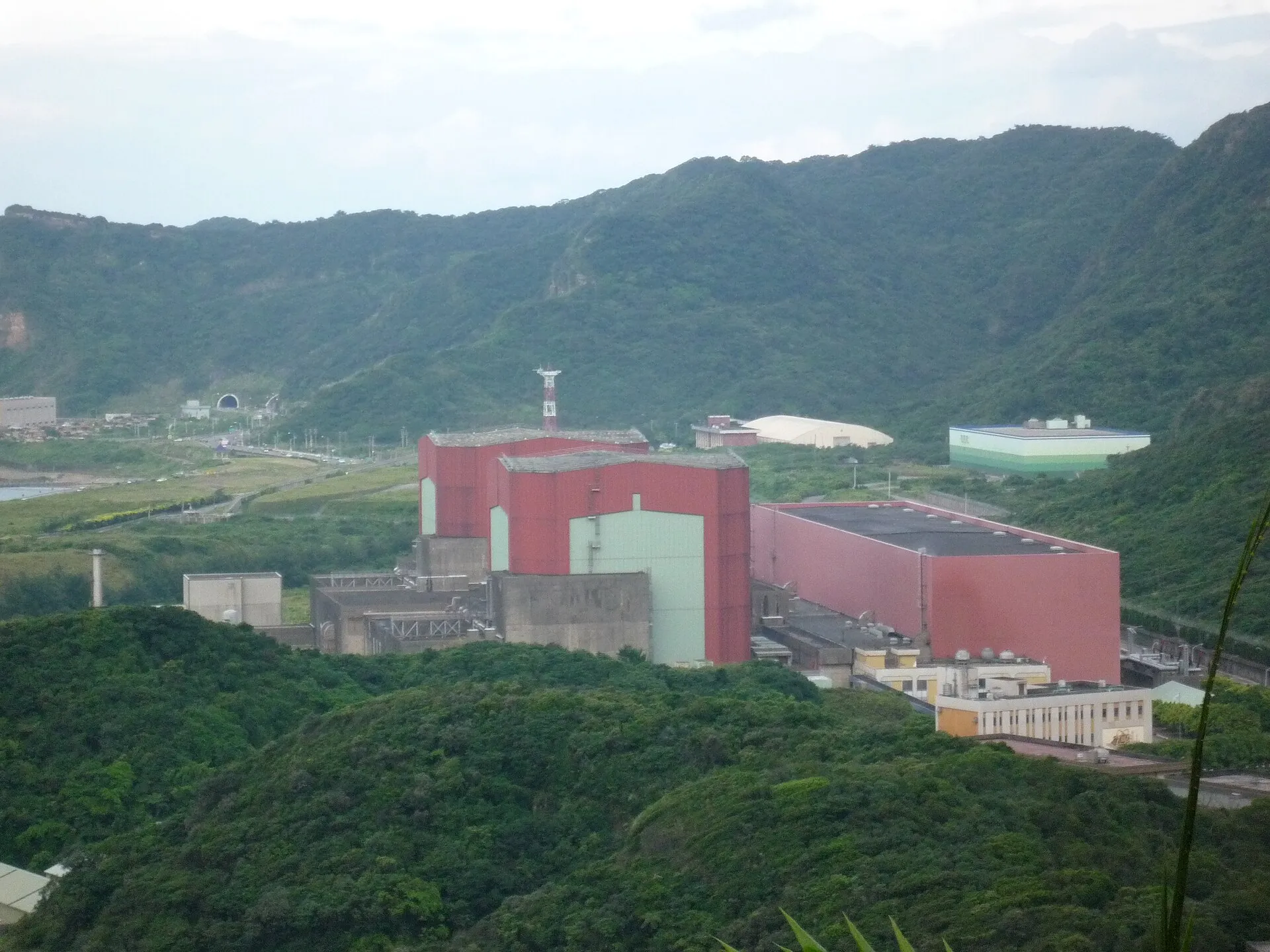
TEXONO operates the Kuo-Sheng Neutrino Laboratory 28 m from a 2.9 GW(th) reactor core in Taiwan. With a 1.06 kg high-purity germanium detector it set μν < 7.4 × 10⁻¹¹ μB (90% CL) in 2007. A 187 kg CsI(Tl) array measured ν̄e–e scattering, giving sin²θW = 0.251 ± 0.031 (stat) ± 0.024 (syst). Its sub-keV germanium work led to the CDEX dark-matter experiment.
Compare all experiments → · World map →
In plain words
A nuclear reactor emits an enormous number of low-energy antineutrinos. Most reactor experiments count them through inverse beta decay, but TEXONO went after rarer and subtler signals: the tiny kick an antineutrino gives to an electron, which could reveal a magnetic moment, and the even smaller recoil of a whole nucleus. For this it needed detectors with very low thresholds and very low background, placed close to a reactor core.
How the detector works
The TEXONO collaboration was formed in 1997 around the Academia Sinica in Taipei, with partners in mainland China, Turkey and India. Its laboratory sits 28 m from a 2.9 GW(th) core at the Kuo-Sheng nuclear power station, under about 30 metres water equivalent of overburden, inside layered shielding of copper, boron-loaded polyethylene, steel and lead with a cosmic-ray veto. Two detector types were used. A 1.06 kg high-purity germanium crystal, surrounded by NaI(Tl) and CsI(Tl) anti-Compton detectors, reached a 5 keV threshold. A 187 kg array of CsI(Tl) scintillating crystals measured electron recoils at MeV energies. Later work developed germanium detectors with sub-keV thresholds.
Key results
- Magnetic moment (2007): with 570.7 reactor-on and 127.8 reactor-off days, the germanium spectrum gave μν̄e < 7.4 × 10⁻¹¹ μB at 90% confidence, one of the strongest laboratory limits of its time.
- Neutrino–electron scattering (2010): the CsI(Tl) array measured the ν̄e–e cross section at about 1.08 times the Standard Model value and gave sin²θW = 0.251 ± 0.031 (stat) ± 0.024 (syst), at a momentum transfer of only about 3 × 10⁻⁶ GeV². It confirmed the destructive interference between charged- and neutral-current contributions.
- New physics: the same data constrained non-standard interactions and neutrino electromagnetic properties.
Status today
TEXONO continues to search for coherent elastic scattering of reactor antineutrinos with sub-keV germanium detectors. Its germanium expertise seeded the CDEX dark-matter experiment at CJPL.
Frequently asked questions
Why use germanium for a magnetic-moment search?
A magnetic moment adds events at low electron recoil energies, and germanium detectors combine low thresholds with excellent energy resolution.
What is the Kuo-Sheng Neutrino Laboratory?
It is TEXONO's shielded laboratory inside the Kuo-Sheng nuclear power station in northern Taiwan, 28 m from a reactor core.
Original papers
- MeasurementH. T. Wong et al. (TEXONO Collaboration), A search of neutrino magnetic moments with a high-purity germanium detector at the Kuo-Sheng nuclear power station, Phys. Rev. D 75, 012001 (2007)DOI 10.1103/PhysRevD.75.012001arXiv:hep-ex/0605006
- MeasurementM. Deniz et al. (TEXONO Collaboration), Measurement of Neutrino-Electron Scattering Cross-Section with a CsI(Tl) Scintillating Crystal Array at the Kuo-Sheng Nuclear Power Reactor, Phys. Rev. D 81, 072001 (2010)DOI 10.1103/PhysRevD.81.072001arXiv:0911.1597
Related terms
- Neutrino magnetic moment
- High-purity germanium detectors
- Neutrino-electron elastic scattering
- Reactor antineutrinos
- Coherent elastic Neutrino-nucleus scattering
Latest research on this topic
- Precision tests of SM and new physics with the COHERENT Ge-mini and TEXONO dataAhmed, Tousib, Chattaraj, Ayan, Majumdar, Anirban et al. · 10 August 2026
- Constraining Axion-Like-Particles with germanium detector at the Kuo-Sheng Reactor Neutrino LaboratoryTEXONO Collaboration · 31 July 2026
- Studies of Neutrino-Nucleus Elastic Scattering with Point-Contact Germanium Detectors at the Kuo-Sheng Reactor Neutrino LaboratoryTEXONO Collaboration · 15 June 2026
- Coherent Neutrino-Nucleus Elastic Scattering at the Kuo-Sheng Reactor: Probing SM and New Physics with the TEXONO ExperimentKarmakar, S., Singh, M.K., Li, H.B. et al. · 3 February 2026
- Investigation of Electromagnetic Properties of Neutrinos with subkeV Sensitive Germanium Detectors in the TEXONO ExperimentGreeshma, C., Rani, Komal, Singh, L. et al. · 3 February 2026
Mentioned in 3 pages
Last updated: · Editorial standard
Cite this page
Text
Neutrino Atlas (2026). “TEXONO”. Retrieved 22 November 2026, from https://neutrino-atlas.com/terms/texono/BibTeX
@misc{neutrinoatlas2026termstexono,
  title        = {TEXONO},
  author       = {{Neutrino Atlas}},
  year         = {2026},
  url          = {https://neutrino-atlas.com/terms/texono/},
  note         = {Accessed 2026-11-22},
  language     = {english}
}