ILL Grenoble reactor experiment
First dedicated reactor oscillation search, run 8.76 m from the ILL research reactor in Grenoble around 1979–1980; it found no oscillation.
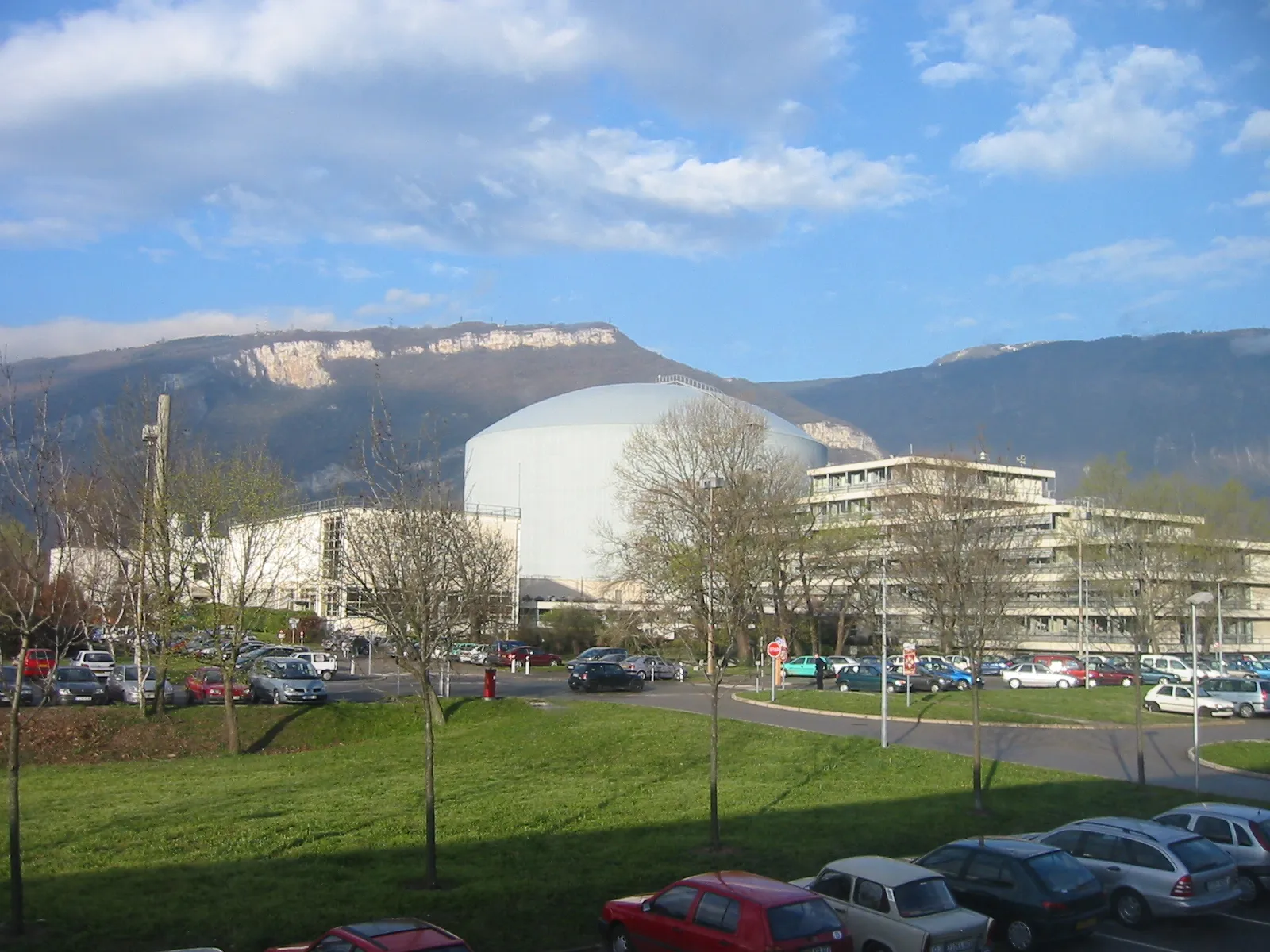
Installed at the Institut Laue–Langevin's 57 MW high-flux reactor, the detector combined 30 liquid-scintillator cells with ³He proportional chambers to record inverse beta decay at 8.76 m. Published in 1981, its spectrum agreed with prediction and excluded Δm² down to about 0.15 eV² for sin²2θ > 0.25. A 1995 correction of the reactor power lowered its measured-to-predicted ratio.
Compare all experiments → · World map →
In plain words
By the late 1970s Bruno Pontecorvo's idea that neutrinos might change flavour had become a question experiments could test. A reactor is a pure source of electron antineutrinos, so a detector placed close to it can check whether some of them disappear on the way. The experiment at the Institut Laue–Langevin (ILL) in Grenoble was the first designed specifically for this purpose.
How the detector works
The ILL high-flux reactor is a compact research reactor of 57 MW fuelled with highly enriched uranium, so almost all antineutrinos come from ²³⁵U fission. The detector stood 8.76 m from the core. Thirty cells of liquid scintillator measured the positron from inverse beta decay, and ³He multiwire proportional chambers placed between them detected the neutron. Requiring both signals in a short time window gave a clean coincidence. The collaboration brought together Caltech, the ILL, the Institut des Sciences Nucléaires (ISN) in Grenoble and TU Munich, with Felix Boehm and Rudolf Mössbauer among its leaders.
Key results
The measured positron spectrum, published by Kwon and colleagues in 1981, agreed with the spectrum calculated from fission data. No oscillation was seen, and the experiment excluded mass splittings down to about 0.15 eV² for sin²2θ above 0.25. The result came at a time when Frederick Reines's group had reported a possible sign of oscillation at the Savannah River reactor, and it helped to set that claim aside.
Later reanalysis
In 1995 part of the collaboration revised the result after finding that the reactor's operating power had been overstated by 9.5% at the time. The 2011 study of the reactor anomaly, using new flux calculations, quoted a measured-to-predicted ratio of about 0.80 for ILL, the lowest of the early experiments. The same reactor later hosted STEREO, whose segmented detector settled the sterile-neutrino question that the reanalysis had raised. The successor experiment at Gösgen used an improved version of the ILL detector.
Frequently asked questions
Why use a research reactor?
Its small core gives a well-defined distance, and its nearly pure ²³⁵U fuel gives a single, well-known antineutrino spectrum.
Is the ILL result still used?
Yes, in reanalyses of short-baseline reactor data, although the power correction makes it one of the less certain points.
Original papers
- Final resultH. Kwon et al., Search for neutrino oscillations at a fission reactor, Phys. Rev. D 24, 1097 (1981)DOI 10.1103/PhysRevD.24.1097
Related terms
- Reactor neutrino experiments
- Gösgen reactor experiment
- Reactor antineutrino anomaly
- STEREO
- Inverse beta decay
Mentioned in 2 pages
People 1
Terms 1
Last updated: · Editorial standard
Cite this page
Text
Neutrino Atlas (2026). “ILL Grenoble reactor experiment”. Retrieved 22 November 2026, from https://neutrino-atlas.com/terms/ill-reactor-experiment/BibTeX
@misc{neutrinoatlas2026ermsillreactorexperiment,
  title        = {ILL Grenoble reactor experiment},
  author       = {{Neutrino Atlas}},
  year         = {2026},
  url          = {https://neutrino-atlas.com/terms/ill-reactor-experiment/},
  note         = {Accessed 2026-11-22},
  language     = {english}
}