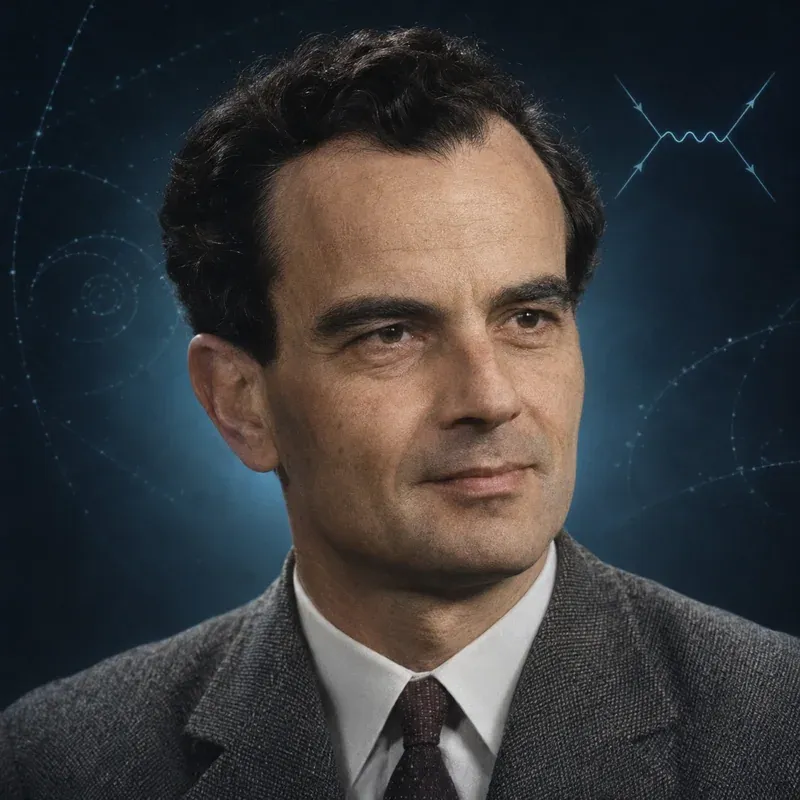
 Illustration
Rudolf Ludwig Mössbauer
After his Nobel-winning work on gamma-ray resonance, Mössbauer devoted the second half of his career to low-energy neutrino physics. With Felix Boehm's Caltech group he set up one of the first dedicated searches for neutrino oscillations, measuring reactor antineutrinos close to the high-flux reactor of the Institut Laue-Langevin and then at three distances from the Gösgen power reactor in Switzerland. Neither experiment saw oscillations, and their limits ruled out several claimed signals of the time. His Munich group was also part of the GALLEX collaboration, which measured low-energy solar neutrinos with gallium at Gran Sasso.
- Born
- 31 January 1929
Munich, Germany - Died
- 14 September 2011
Grünwald, Bavaria, Germany - Nationality
- German
- Field
- Experimental nuclear and neutrino physics
- Nobel Prize
- Physics 1961 (shared with Robert Hofstadter) – for his researches concerning the resonance absorption of gamma radiation and his discovery in this connection of the effect which bears his name
- Institutions
- Technical University of Munich, Max Planck Institute for Medical Research, Heidelberg, California Institute of Technology, Institut Laue-Langevin, Grenoble
Early life and the Mössbauer effect
Rudolf Ludwig Mössbauer was born in Munich in 1929 and studied physics at the Technische Hochschule München from 1949. For his doctorate under Heinz Maier-Leibnitz he worked from 1955 to 1957 at the Max Planck Institute for Medical Research in Heidelberg on the resonance absorption of gamma rays. He found that nuclei bound in a crystal can emit and absorb gamma rays without losing energy to recoil, because the whole lattice takes up the momentum. The resulting lines are so sharp that tiny energy shifts become measurable. The effect, reported in 1958 using iridium-191, became a standard tool in solid-state physics and chemistry and was used in 1960 to measure the gravitational redshift in the laboratory. Mössbauer received the 1961 Nobel Prize in Physics at the age of 32, sharing it with Robert Hofstadter.
Caltech, Munich and Grenoble
From 1960 he worked at Caltech, where he became professor of physics. He returned to the Technical University of Munich as full professor in 1965, on condition that its physics department be reorganised along American lines, a reform that influenced German universities more widely. From 1972 to 1977 he directed the Institut Laue-Langevin (ILL) in Grenoble, the Franco-German neutron research centre, during the years its high-flux reactor came into operation.
Reactor neutrinos and oscillations
A research reactor is also an intense source of electron antineutrinos, and in the late 1970s Mössbauer and Felix Boehm of Caltech set up one of the first dedicated searches for neutrino oscillations. The Caltech–ILL–Munich detector counted inverse beta decay events in liquid scintillator with helium-3 neutron counters about 8.8 metres from the ILL core. The collaboration then moved to the Gösgen power plant in Switzerland and measured at three distances between about 38 and 65 metres, so that the comparison of spectra did not depend on the predicted reactor flux. Neither the ILL experiment nor Gösgen found oscillations. Their limits on mixing at mass differences above about 0.02 eV² contradicted positive claims made at the time, and the multi-distance method was later taken up by reactor experiments such as Bugey and Daya Bay.
Solar neutrinos and later years
Mössbauer's group at the Technical University of Munich, including his colleague Franz von Feilitzsch, joined GALLEX, the gallium experiment at Gran Sasso led by Till Kirsten. Starting in 1991, it measured the low-energy pp neutrinos from the Sun and confirmed the deficit seen by the chlorine experiment. Mössbauer retired in 1997. Among other honours he received the Albert Einstein Medal (1986). He died in Grünwald near Munich in 2011.
Known for
- Discovery of recoilless nuclear resonance absorption, the Mössbauer effect (1958)
- Director of the Institut Laue-Langevin (1972–1977)
- Early reactor searches for neutrino oscillations at Grenoble and Gösgen
- Participation in the GALLEX solar neutrino experiment
Chronology
- 1958Discovers recoilless nuclear resonance absorption; doctorate at TU Munich
- 1961Nobel Prize in Physics; professor at Caltech
- 1965Full professor at the Technical University of Munich
- 1972Becomes director of the Institut Laue-Langevin
- 1981ILL reactor oscillation search published
- 1986Gösgen oscillation results published
Original papers
- R. L. Mössbauer, Kernresonanzfluoreszenz von Gammastrahlung in Ir191, Z. Phys. 151, 124 (1958)DOI 10.1007/BF01344210
- H. Kwon, F. Boehm, A. A. Hahn, H. E. Henrikson, J.-L. Vuilleumier, J.-F. Cavaignac, D. H. Koang, B. Vignon, F. von Feilitzsch, R. L. Mössbauer, Search for neutrino oscillations at a fission reactor, Phys. Rev. D 24, 1097 (1981)DOI 10.1103/PhysRevD.24.1097
- G. Zacek et al., Neutrino-oscillation experiments at the Gösgen nuclear power reactor, Phys. Rev. D 34, 2621 (1986)DOI 10.1103/PhysRevD.34.2621
Experiments
- ILL reactor oscillation experiment
- Gösgen reactor experiment
- GALLEX / GNO
Connected people
Frequently asked questions
Did Mössbauer win the Nobel Prize for neutrino research?
No. His 1961 Nobel Prize was for the recoilless resonance absorption of gamma rays. His neutrino work came later, mainly in the 1970s to 1990s.
What did the Grenoble and Gösgen experiments find?
No oscillations. They set limits on electron-antineutrino disappearance at short baselines and showed how measurements at several distances reduce reactor-flux uncertainties.
Mentioned in 2 pages
Last updated: · Editorial standard
Cite this page
Text
Neutrino Atlas (2026). “Rudolf Ludwig Mössbauer”. Retrieved 22 November 2026, from https://neutrino-atlas.com/people/rudolf-mossbauer/BibTeX
@misc{neutrinoatlas2026peoplerudolfmossbauer,
  title        = {Rudolf Ludwig Mössbauer},
  author       = {{Neutrino Atlas}},
  year         = {2026},
  url          = {https://neutrino-atlas.com/people/rudolf-mossbauer/},
  note         = {Accessed 2026-11-22},
  language     = {english}
}