2024Experiment
KamLAND-Zen's complete data set tightens the Majorana bound
In June 2024 KamLAND-Zen released the analysis of its complete KamLAND-Zen 800 data set, about 745 kg of enriched xenon recorded from 2019 to January 2024. Combined with the earlier phase, it found no neutrinoless double beta decay and set a lower half-life limit for xenon-136 of 3.8 × 10²⁶ years at 90 percent confidence. The effective Majorana mass is below 28–122 meV, reaching into the region expected for inverted ordering. The paper appeared in Physical Review Letters in December 2025.
- Date
- 17 June 2024
- Kind of event
- Experiment
- People involved
- Kunio Inoue
- Experiments
- KamLAND-Zen, KamLAND, Kamioka Observatory
The situation before
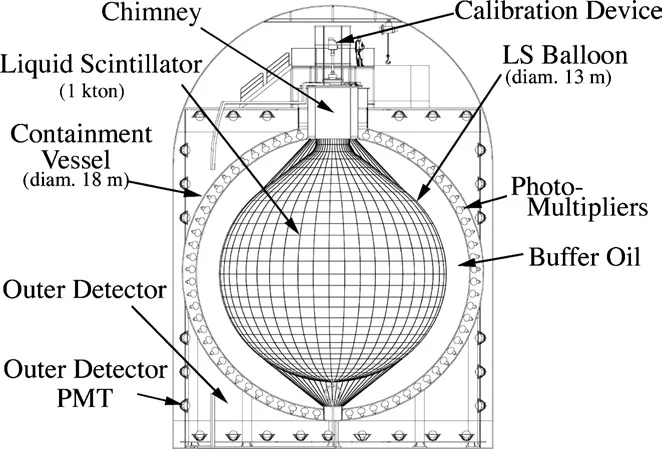
KamLAND-Zen searches for neutrinoless double beta decay of xenon-136, a process that would show that neutrinos are their own antiparticles. Xenon enriched in this isotope is dissolved in liquid scintillator inside a thin nylon balloon at the centre of the KamLAND detector, in the Kamioka mine in Japan. The surrounding scintillator serves as an active shield. The project is run from Tohoku University's Research Center for Neutrino Science, long directed by Kunio Inoue.
The first phase, KamLAND-Zen 400, set a half-life limit of 1.07 × 10²⁶ years in 2016. The second phase, KamLAND-Zen 800, with about 745 kg of enriched xenon in a larger and cleaner balloon, published a limit of 2.3 × 10²⁶ years from its first data, the first search to probe the region expected for the inverted ordering.
What happened
Data taking for KamLAND-Zen 800 ran from 5 February 2019 to 12 January 2024, after which dismantling began. On 17 June 2024 the collaboration posted the analysis of this complete data set, "Search for Majorana Neutrinos with the Complete KamLAND-Zen Dataset" (arXiv:2406.11438). The exposure reached 2.097 tonne-years of xenon-136, more than double that of the previous search. Two improvements helped: the gain of the photosensors had been recovered, and background from xenon spallation by cosmic-ray muons was reduced.
No signal appeared. Combined with the KamLAND-Zen 400 data, the lower limit on the half-life rose by a factor of 1.7. The corresponding upper limit on the effective Majorana mass depends on the nuclear matrix element used and lies between 28 and 122 meV. After review, the paper was published in Physical Review Letters (volume 135, article 262501) in December 2025.
What it shows
For inverted ordering, the effective Majorana mass is expected to lie roughly between 15 and 50 meV. The lower end of the KamLAND-Zen range, obtained with the most favourable nuclear matrix elements, therefore reaches into that band, but does not cover it. The spread of almost a factor of five between nuclear models is itself one of the main limitations of the field. The result remains the strongest half-life limit for xenon-136.
Consequences
To cover the inverted-ordering region completely, KamLAND-Zen plans an upgraded detector, often called KamLAND2-Zen, with improved light collection and energy resolution. Other experiments pursue the same goal with different isotopes, including LEGEND with germanium-76 and CUPID with molybdenum-100. If the ordering turns out to be normal, as hinted by JUNO in 2026, the effective mass could be much smaller, and even tonne-scale experiments might not see a signal.
Frequently asked questions
What did the complete KamLAND-Zen data set show?
No neutrinoless double beta decay of xenon-136. The half-life must exceed 3.8 × 10²⁶ years at 90 percent confidence.
What does this mean for the neutrino mass?
The effective Majorana mass must be below 28 to 122 meV, depending on the nuclear model.
Does KamLAND-Zen exclude inverted ordering?
No. Its limit reaches into the inverted-ordering region but does not cover it; that requires the next generation of experiments.
Concepts
- Neutrinoless double beta decay
- Effective Majorana mass
- Half-life limit & effective Majorana mass
- Inverted ordering
Last updated: · Editorial standard
Cite this page
Text
Neutrino Atlas (2026). “2024: KamLAND-Zen's complete data set tightens the Majorana bound”. Retrieved 22 November 2026, from https://neutrino-atlas.com/timeline/2024-kamland-zen-complete/BibTeX
@misc{neutrinoatlas2026ne2024kamlandzencomplete,
  title        = {2024: KamLAND-Zen's complete data set tightens the Majorana bound},
  author       = {{Neutrino Atlas}},
  year         = {2026},
  url          = {https://neutrino-atlas.com/timeline/2024-kamland-zen-complete/},
  note         = {Accessed 2026-11-22},
  language     = {english}
}