2023Discovery
FASER detects neutrinos from a collider
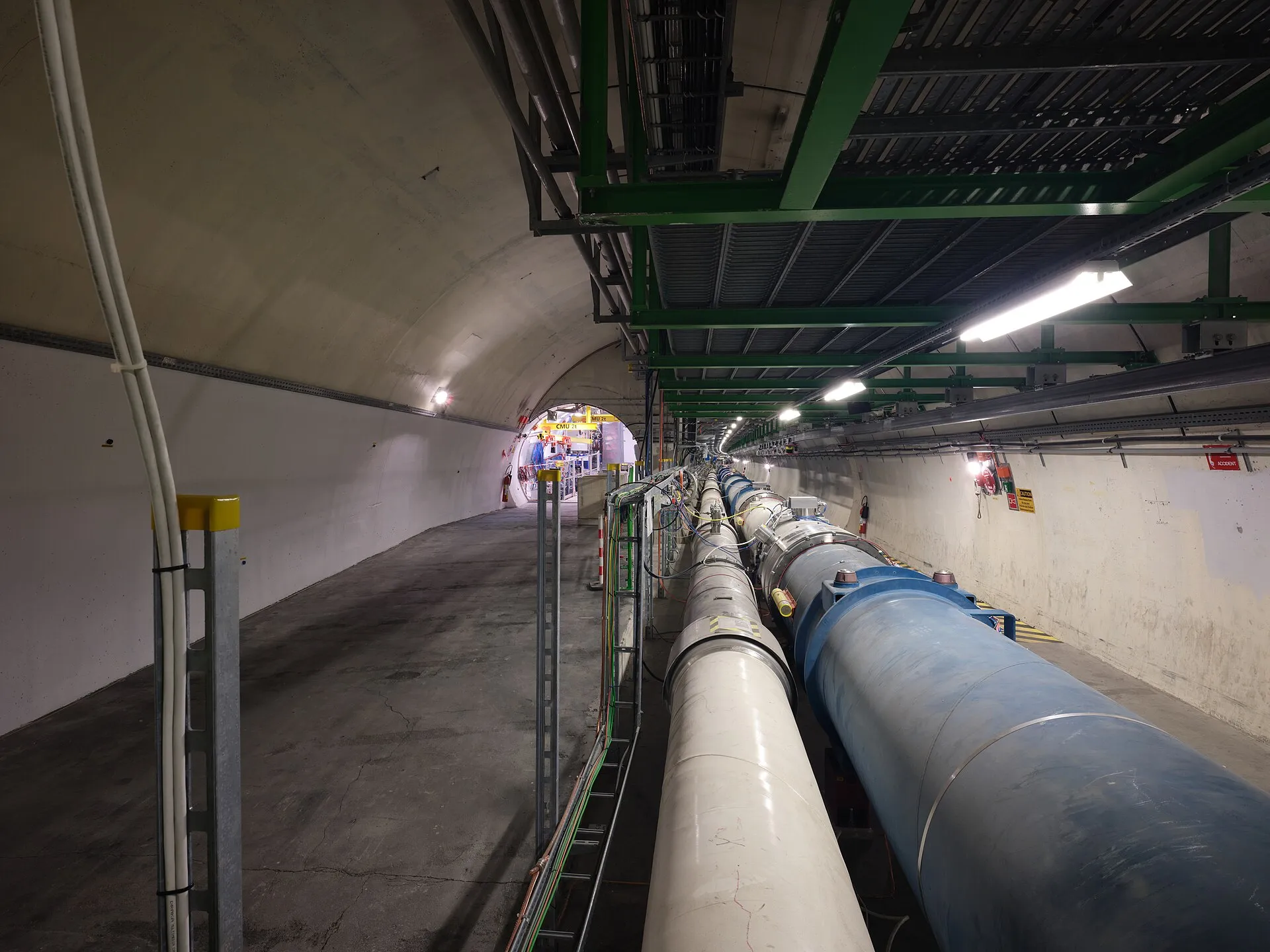
In March 2023 the FASER experiment, 480 m downstream of the ATLAS interaction point at CERN's Large Hadron Collider, announced the first direct observation of neutrinos produced at a particle collider. It identified 153 muon-neutrino candidates at 16σ, with energies of hundreds of GeV to TeV. SND@LHC reported a similar observation. Collider neutrinos open a new energy window for measuring neutrino cross-sections in the laboratory.
- Date
- 2023
- Kind of event
- Discovery
- Experiments
- FASER / FASERν
The situation before
Particle colliders produce enormous numbers of neutrinos, mostly from the decays of pions, kaons and charm hadrons created in proton collisions. Almost all of them fly off along the beam line at very small angles, where the big general-purpose detectors have no instrumentation. For decades, collider neutrinos were therefore inferred only as missing momentum; none had been seen interacting in a detector.
The FASER collaboration, proposed in 2018, planned to exploit this forward flux with a compact detector placed directly on the collision axis. In 2021 a small pilot emulsion detector had already recorded a handful of neutrino interaction candidates at about 2.7σ, a first hint that the idea worked.
What happened
FASER sits in the disused service tunnel TI12, about 480 m downstream of the ATLAS interaction point, where the LHC beam curves away but the neutrinos continue straight through rock. Its electronic detector, a set of scintillator veto stations, a spectrometer and a calorimeter, sits behind a tungsten-and-emulsion target called FASERν. The search used 35.4 fb⁻¹ of proton collisions at 13.6 TeV recorded from July to November 2022, at the start of LHC Run 3.
The signature was simple: a high-energy muon emerging in the spectrometer with no charged particle entering through the front veto. Such events can be produced only by a neutral particle interacting in the target. The team found 153 (+12/−13) candidates, against an expected background of about 0.2 events from neutral hadrons and muons that slipped past the veto.
The result was presented on 19 March 2023 at the Moriond electroweak conference and published in Physical Review Letters in July 2023. The muons showed both charges, so the sample contained muon neutrinos and antineutrinos, with energies from a few hundred GeV to beyond a TeV.
Reaction
At the same conference the neighbouring experiment SND@LHC, located in the tunnel on the opposite side of ATLAS, reported eight muon-neutrino candidates at about 7σ. The two independent observations, published side by side, removed any doubt. The combination of a 16σ signal with a background of a fraction of an event was unusually clean for a first observation, and the results were widely described as opening the field of collider neutrino physics.
Why it matters
Collider neutrinos fill an energy gap. Accelerator beams such as those of NOvA or T2K reach a few GeV, and atmospheric and astrophysical neutrinos seen by IceCube start at around a hundred GeV but come with large flux uncertainties. FASER and SND@LHC can measure cross-sections of all three flavours, including the rarely observed tau neutrino, between a few hundred GeV and a few TeV under controlled conditions.
In 2024 FASER published the first measurements of electron- and muon-neutrino interaction cross-sections at TeV energies using the emulsion data. Because the forward neutrino flux depends on how hadrons are produced at very small angles, the measurements also test models of forward particle production that are used to interpret cosmic-ray air showers. These results support the proposal for a dedicated Forward Physics Facility for the High-Luminosity LHC.
Frequently asked questions
When were neutrinos first seen at a collider?
FASER announced the first direct observation on 19 March 2023, based on LHC data from 2022, and SND@LHC reported an independent observation at the same time.
How did FASER know the events were neutrinos?
It saw high-energy muons appearing inside the detector with no charged particle entering through the front veto, which only a neutral, weakly interacting particle can produce.
Why are collider neutrinos useful?
They give a well-understood beam at energies of hundreds of GeV to TeV, a range where neutrino cross-sections had hardly been measured.
Original papers
- DiscoveryH. Abreu et al. (FASER Collaboration), First Direct Observation of Collider Neutrinos with FASER at the LHC, Phys. Rev. Lett. 131, 031801 (2023)DOI 10.1103/PhysRevLett.131.031801arXiv:2303.14185
- MeasurementR. Albanese et al. (SND@LHC Collaboration), Observation of Collider Muon Neutrinos with the SND@LHC Experiment, Phys. Rev. Lett. 131, 031802 (2023)DOI 10.1103/PhysRevLett.131.031802arXiv:2305.09383
Concepts
Last updated: · Editorial standard
Cite this page
Text
Neutrino Atlas (2026). “2023: FASER detects neutrinos from a collider”. Retrieved 22 November 2026, from https://neutrino-atlas.com/timeline/2023-faser-collider-neutrinos/BibTeX
@misc{neutrinoatlas202623fasercolliderneutrinos,
  title        = {2023: FASER detects neutrinos from a collider},
  author       = {{Neutrino Atlas}},
  year         = {2026},
  url          = {https://neutrino-atlas.com/timeline/2023-faser-collider-neutrinos/},
  note         = {Accessed 2026-11-22},
  language     = {english}
}