2022Experiment
CUORE sets a tonne-scale bolometer limit
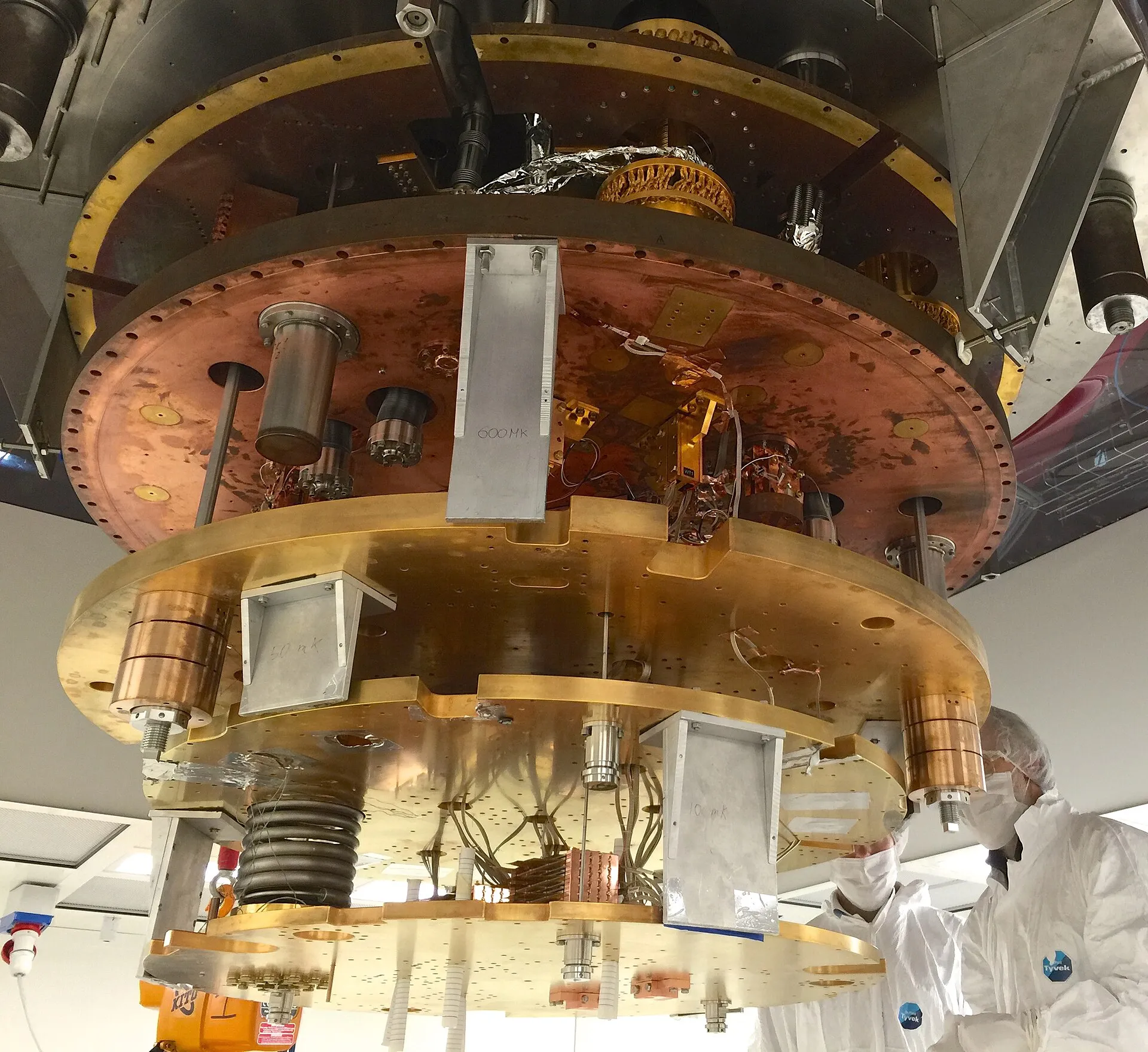
CUORE at Gran Sasso, about 1 tonne of tellurium dioxide crystals cooled to about 10 millikelvin, reported in Nature in April 2022 a lower limit of 2.2 × 10²⁵ years on the neutrinoless double beta decay half-life of tellurium-130. It demonstrated stable operation of a tonne-scale cryogenic bolometer array over years. The successor CUPID plans to use lithium molybdate crystals with particle identification.
- Date
- 2022
- Kind of event
- Experiment
- Experiments
- CUORE, CUPID, Laboratori Nazionali del Gran Sasso (LNGS)
The situation before
Whether neutrinos are their own antiparticles can be tested only through an extremely rare process, neutrinoless double beta decay. By the late 2010s germanium and xenon experiments had pushed half-life limits beyond 10²⁵ years, but tellurium-130 remained attractive: it makes up about a third of natural tellurium, so no costly enrichment is needed, and its decay energy of about 2.53 MeV lies above most natural gamma backgrounds.
The Italian physicist Ettore Fiorini had proposed in the 1980s to read out tellurium dioxide crystals as bolometers, tiny calorimeters that register a decay as a temperature rise. The open question was whether this technique could be scaled from a few kilograms to a tonne and kept stable for years at a temperature close to absolute zero.
What happened
CUORE, in Hall A of the Gran Sasso underground laboratory, began data taking in 2017. Its 988 crystals, with about 742 kg of tellurium dioxide, hang in a purpose-built cryostat that keeps them at roughly 10 millikelvin. Early years brought repeated interruptions to optimise the cryogenics and reduce vibrations, after which the detector ran with high uptime.
On 6 April 2022 the collaboration published in Nature (volume 604) its analysis of the first tonne-year of exposure, 1038.4 kg·yr of tellurium dioxide. No signal appeared at the decay energy. The result was a lower limit on the half-life of tellurium-130 of 2.2 × 10²⁵ years at 90 percent credibility.
The corresponding upper limit on the effective Majorana mass is 90 to 305 meV, depending on the nuclear matrix element used. This is weaker than the best xenon limit of the time, because the exposure in the isotope itself was smaller, but it was the strongest limit for tellurium-130 and an independent check with a different isotope.
Reaction
The publication was received above all as a technical milestone. A tonne-scale array had been operated at millikelvin temperatures for years with stable energy resolution of about 7–8 keV at the decay energy. That showed cryogenic calorimeters to be a credible technology for the next generation of searches, alongside germanium diodes and xenon detectors.
Consequences
The main limitation of CUORE was background from alpha particles that deposit part of their energy on the crystal surfaces. Its successor CUPID is designed to reuse the same cryostat with lithium molybdate crystals enriched in molybdenum-100. Each crystal will also be viewed by a light detector, so that alpha events, which produce less light, can be rejected. CUORE itself continued taking data, and later analyses with about two tonne-years of exposure tightened the half-life limit further.
Frequently asked questions
What did CUORE measure in 2022?
It found no sign of neutrinoless double beta decay in tellurium-130 and set a lower limit of 2.2 × 10²⁵ years on its half-life, using one tonne-year of exposure.
Why is CUORE important if it found nothing?
It proved that a tonne-scale array of cryogenic bolometers can run stably at about 10 millikelvin for years, the basis for the successor CUPID.
Where is CUORE located?
In the Gran Sasso National Laboratory in Italy, under about 1,400 m of rock.
Original papers
- MeasurementD. Q. Adams et al. (CUORE Collaboration), Search for Majorana neutrinos exploiting millikelvin cryogenics with CUORE, Nature 604, 53 (2022)DOI 10.1038/s41586-022-04497-4
Concepts
Last updated: · Editorial standard
Cite this page
Text
Neutrino Atlas (2026). “2022: CUORE sets a tonne-scale bolometer limit”. Retrieved 22 November 2026, from https://neutrino-atlas.com/timeline/2022-cuore-limit/BibTeX
@misc{neutrinoatlas2026timeline2022cuorelimit,
  title        = {2022: CUORE sets a tonne-scale bolometer limit},
  author       = {{Neutrino Atlas}},
  year         = {2026},
  url          = {https://neutrino-atlas.com/timeline/2022-cuore-limit/},
  note         = {Accessed 2026-11-22},
  language     = {english}
}