CUORE
A tonne-scale array of TeO₂ bolometers at about 10 mK searching for 0νββ of ¹³⁰Te.
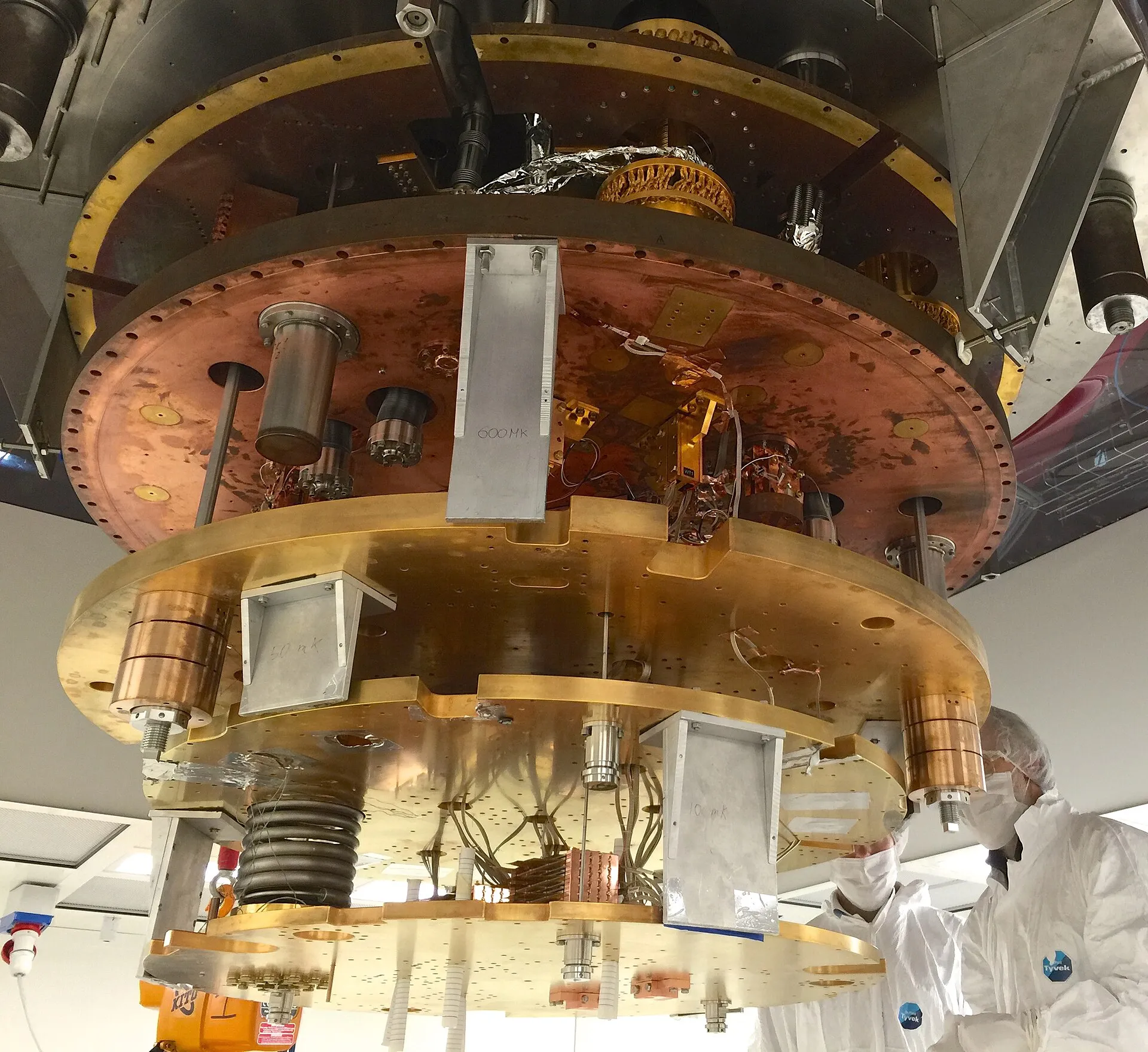
The Cryogenic Underground Observatory for Rare Events operates 988 TeO₂ crystals (742 kg) in the world's largest dilution refrigerator at LNGS. It demonstrated stable tonne-scale millikelvin operation and set T½(¹³⁰Te) > 2.2 × 10²⁵ yr from its first tonne-year (Nature, 2022) and, with more than 2 tonne-years, T½ > 3.5 × 10²⁵ yr (Science, 2025). This corresponds to mββ < 70–250 meV, depending on the nuclear model.
Compare all experiments → · World map →
In plain words
CUORE measures energy as heat. Each of its crystals is cooled to about ten thousandths of a degree above absolute zero, where its heat capacity is so tiny that a single nuclear decay raises its temperature by a measurable fraction of a millikelvin. A sensitive thermometer glued to the crystal records the pulse. This approach, the bolometer, was championed for double beta decay by Ettore Fiorini from the 1980s.
How the detector works
The 988 tellurium dioxide crystals, each a 5 cm cube of about 750 g, are arranged in 19 towers. Tellurium has a practical advantage: ¹³⁰Te makes up about a third of natural tellurium, so no costly enrichment is needed, and the crystals contain about 206 kg of the isotope. Its decay energy is Qββ = 2527 keV. The array is cooled by a custom dilution refrigerator, the largest operating at these temperatures, and shielded by lead that includes ancient Roman ingots recovered from a shipwreck, whose radioactive ²¹⁰Pb has decayed away over two millennia. Phonon sensors (NTD germanium thermistors) read out the heat signal.
Key results
- Energy resolution of about 7.8 keV FWHM at Qββ across the array.
- T½(¹³⁰Te) > 2.2 × 10²⁵ years (90% CL) from about 1 tonne-year of TeO₂ exposure (Nature, 2022), corresponding to an effective Majorana mass below roughly 90–305 meV. With more than two tonne-years of exposure it raised the limit to T½ > 3.5 × 10²⁵ years (Science, 2025).
- A precise measurement of ¹³⁰Te two-neutrino double beta decay and searches for other rare processes.
Limitations
A bolometer measures any deposited energy equally, whatever the particle. CUORE's remaining background in the signal region is dominated by alpha particles from surface contamination of the crystals and copper holders, which lose part of their energy before reaching the crystal. Removing this background requires particle identification, which is the purpose of CUPID.
Status today
CUORE continues to take data at Gran Sasso toward its goal of 3 tonne-years of TeO₂ exposure. Its cryostat will later host CUPID.
Frequently asked questions
Why does CUORE need temperatures near 10 mK?
The heat capacity of a crystal falls steeply with temperature. Only at millikelvin temperatures is a few MeV of deposited energy enough to produce a temperature rise that can be measured precisely.
Why is ancient Roman lead used?
Freshly produced lead contains radioactive ²¹⁰Pb, with a half-life of 22 years. Lead smelted 2000 years ago has lost essentially all of it, making it an unusually clean shielding material.
Original papers
- First resultC. Alduino et al. (CUORE Collaboration), First Results from CUORE: A Search for Lepton Number Violation via 0νββ Decay of ¹³⁰Te, Phys. Rev. Lett. 120, 132501 (2018)DOI 10.1103/PhysRevLett.120.132501arXiv:1710.07988
- MeasurementD. Q. Adams et al. (CUORE Collaboration), Search for Majorana neutrinos exploiting millikelvin cryogenics with CUORE, Nature 604, 53 (2022)DOI 10.1038/s41586-022-04497-4
Go deeper
- CuoricinoA 40.7 kg tower of 62 TeO₂ bolometers at Gran Sasso (2003–2008), the prototype of CUORE for ¹³⁰Te double beta decay.
Related terms
People
Latest research on this topic
- CUORE Data Release for ML Applications: Pulse Shape Analysis DatasetCUORE Collaboration · 25 June 2026
- CUORE low-energy spectrum sensitivity to cosmic axionsCUORE Collaboration · 25 June 2026
- Searching for 123Te electron capture in CUORECUORE Collaboration · 25 June 2026
- A Search for WIMP Dark Matter with the CUORE ExperimentKowalski, Rebecca · May 2026
- CUPID: CUORE Upgrade with Particle IDentificationCUPID Collaboration · 21 November 2025
- Latest results from CUORE and prospects for CUPIDCUORE Collaboration · 10 November 2025
On the timeline
Mentioned in 29 pages
Milestones 4
Terms 15
Last updated: · Editorial standard
Cite this page
Text
Neutrino Atlas (2026). “CUORE”. Retrieved 22 November 2026, from https://neutrino-atlas.com/terms/cuore/BibTeX
@misc{neutrinoatlas2026termscuore,
  title        = {CUORE},
  author       = {{Neutrino Atlas}},
  year         = {2026},
  url          = {https://neutrino-atlas.com/terms/cuore/},
  note         = {Accessed 2026-11-22},
  language     = {english}
}