AMoRE
A Korean search for neutrinoless double-beta decay of ¹⁰⁰Mo using scintillating molybdate crystals operated as cryogenic calorimeters.
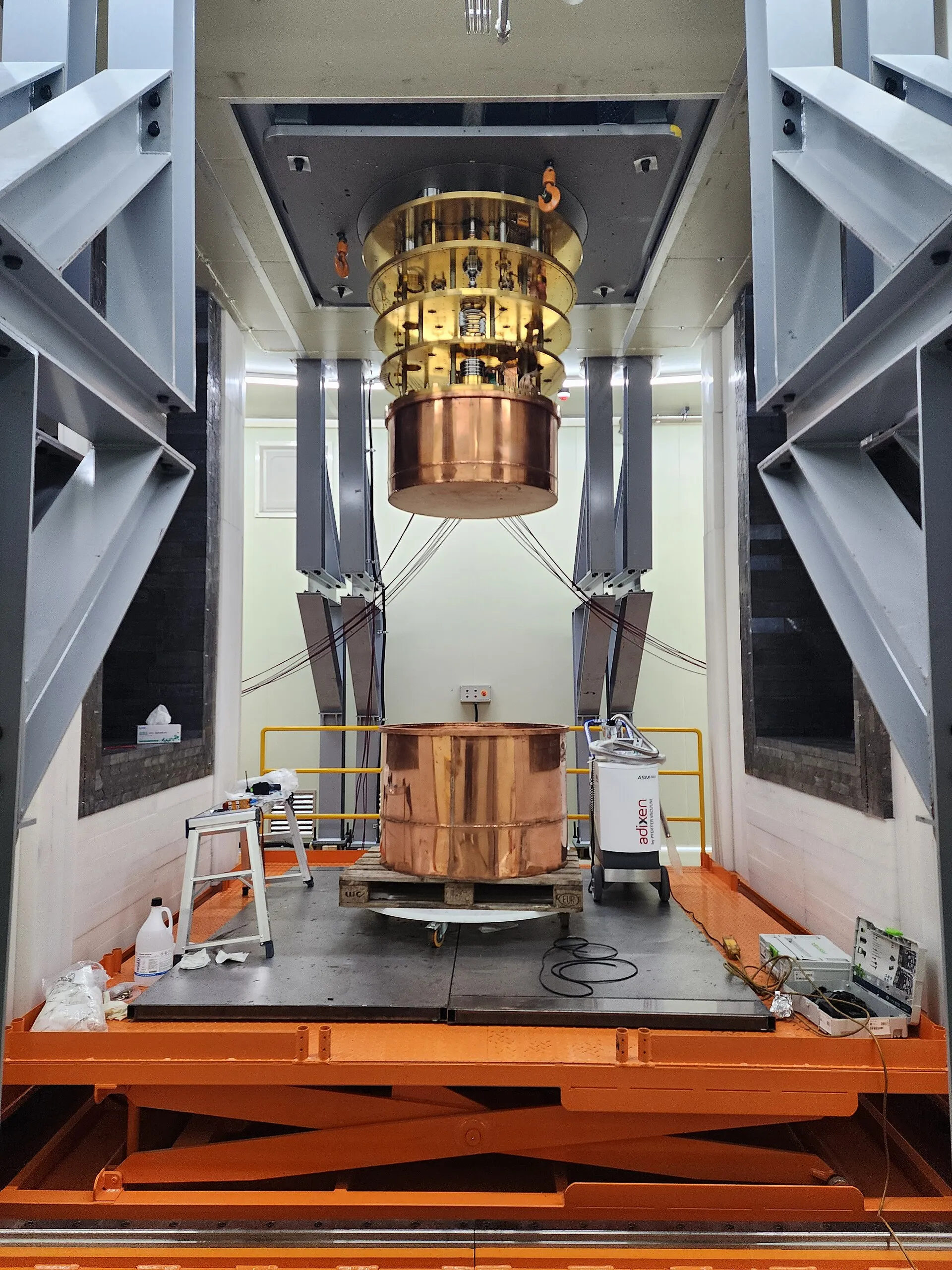
AMoRE measures heat and scintillation light from ¹⁰⁰Mo-enriched crystals at millikelvin temperatures with metallic magnetic calorimeters. AMoRE-I at the Yangyang Underground Laboratory used 18 crystals (6.2 kg, 3.0 kg of ¹⁰⁰Mo) and set T½(0νββ) > 2.9 × 10²⁴ yr (90% CL). AMoRE-II at the deeper Yemilab scales up to about 100 kg of ¹⁰⁰Mo.
Compare all experiments → · World map →
In plain words
If neutrinos are their own antiparticles, some nuclei should undergo a very rare decay in which two neutrons turn into two protons and two electrons with no neutrinos emitted. The two electrons would then carry the full decay energy, a sharp line in the spectrum. AMoRE looks for this line in molybdenum-100, using crystals that are both the source of the decay and the detector.
How the detector works
The crystals contain molybdenum enriched in ¹⁰⁰Mo, whose decay energy of about 3,034 keV lies above most natural gamma backgrounds. Cooled to millikelvin temperatures, each crystal works as a bolometer: a particle deposit raises its temperature very slightly. Metallic magnetic calorimeters, sensors whose magnetisation changes with temperature, read out this heat with excellent energy resolution. The crystals also scintillate, and a separate light detector records the flash. Alpha particles produce less light per unit energy than electrons, so comparing heat and light removes the alpha background that limits pure bolometers.
AMoRE-I used calcium molybdate with calcium depleted in ⁴⁸Ca, since ⁴⁸Ca itself undergoes double-beta decay at higher energy, and lithium molybdate, which became the preferred material.
Key results
After a pilot phase from 2015, AMoRE-I ran at the Yangyang Underground Laboratory, about 700 m deep, from 2019 to 2023 with 18 crystals totalling 6.2 kg, of which 3.0 kg was ¹⁰⁰Mo. With an exposure of 8.02 kg·yr it found no signal and set a half-life limit of T½ > 2.9 × 10²⁴ years at 90% CL, published in 2025. Depending on the nuclear matrix element, this corresponds to an effective Majorana mass below 210–610 meV.
Status today
AMoRE-II is being installed at Yemilab, a new laboratory with about 1,000 m of rock overburden. It will start with around 90 lithium molybdate crystals and grow to about 100 kg of ¹⁰⁰Mo, aiming at half-life sensitivities of a few times 10²⁶ years. It shares its basic technique with the European CUPID project.
Frequently asked questions
Why molybdenum-100?
Its decay energy is high, about 3 MeV, which puts the signal above most natural gamma radiation, and the isotope can be enriched at reasonable cost.
What is special about AMoRE's sensors?
Metallic magnetic calorimeters convert tiny temperature changes into a change of magnetisation, giving fast and precise heat signals.
Original papers
- First resultV. Alenkov et al. (AMoRE Collaboration), First results from the AMoRE-Pilot neutrinoless double beta decay experiment, Eur. Phys. J. C 79, 791 (2019)arXiv:1903.09483
- MeasurementA. Agrawal et al. (AMoRE Collaboration), Improved Limit on Neutrinoless Double Beta Decay of ¹⁰⁰Mo from AMoRE-I, Phys. Rev. Lett. 134, 082501 (2025)arXiv:2407.05618
Related terms
Latest research on this topic
- Search for 7Li solar axion with Li2MoO4 detectors in the AMoRE-I experimentAMoRE Collaboration · 3 November 2026
- Design and Performance of the Cryogenic System for the AMoRE-II ExperimentKwon, Do-Hyung, Lee, Seung-Hun, Jeon, Jin-A. et al. · September 2026
- A study of neutrinoless double electron capture in 40Ca from the AMoRE experimentAMoRE Collaboration · 9 July 2026
Mentioned in 1 page
Terms 1
Last updated: · Editorial standard
Cite this page
Text
Neutrino Atlas (2026). “AMoRE”. Retrieved 22 November 2026, from https://neutrino-atlas.com/terms/amore/BibTeX
@misc{neutrinoatlas2026termsamore,
  title        = {AMoRE},
  author       = {{Neutrino Atlas}},
  year         = {2026},
  url          = {https://neutrino-atlas.com/terms/amore/},
  note         = {Accessed 2026-11-22},
  language     = {english}
}