Yemilab
South Korea's deep underground laboratory, about 1,000 m below Mount Yemi in an operating iron mine, completed in 2022.
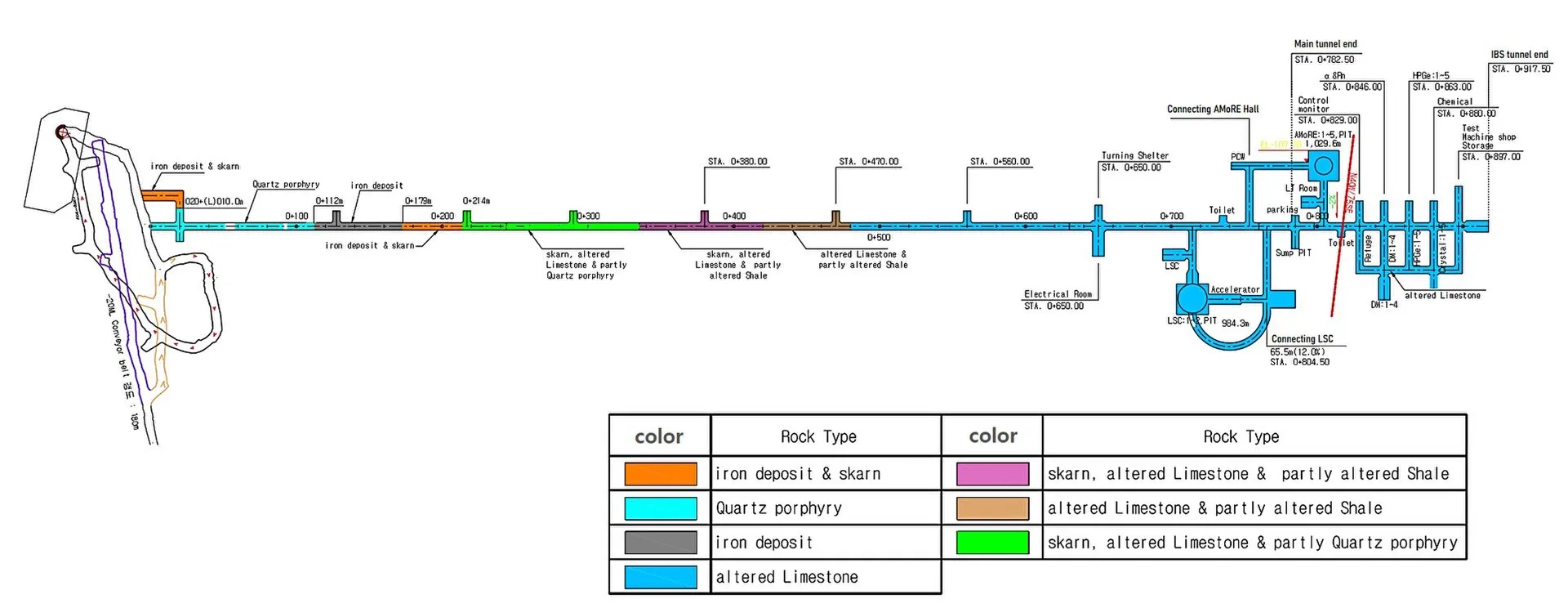
Yemilab was built by the IBS Center for Underground Physics in the Handuk iron mine in Jeongseon, Gangwon Province, as the successor to the Yangyang laboratory (Y2L). It offers about 3,000 m² of space under roughly 2,700 m water equivalent. It hosts the AMoRE-II double-beta experiment and COSINE-200 and is the proposed site of a kiloton-scale liquid scintillator counter (LSC).
Compare all experiments → · World map →
In plain words
Rare-event experiments need to hide from cosmic rays, and the most practical way is to go deep underground. For two decades South Korean physicists worked in the Yangyang Underground Laboratory (Y2L), a space about 700 m underground next to a pumped-storage power plant. Yemilab is its larger and deeper successor, built inside a working iron mine in the mountains of Gangwon Province.
The laboratory
Yemilab lies about 1,000 m below the summit of Mount Yemi, in the Handuk iron mine in Jeongseon county. The rock overburden corresponds to roughly 2,700 m water equivalent, which reduces the flux of cosmic muons by several orders of magnitude compared with the surface (see underground depth). The second construction stage was completed in 2022, giving about 3,000 m² of experimental area, roughly ten times the space at Y2L and about 400 m deeper. Moving equipment from Y2L began in 2023. The laboratory is run by the Center for Underground Physics (CUP) of the Institute for Basic Science (IBS).
Experiments
- AMoRE-II searches for neutrinoless double beta decay of ¹⁰⁰Mo using molybdate crystals operated as cryogenic calorimeters, a major step up from the AMoRE pilot and AMoRE-I phases at Y2L.
- COSINE-200 uses sodium iodide crystals to test the annual modulation claimed by the DAMA/LIBRA dark matter experiment.
- The Liquid Scintillator Counter (LSC) is a proposed detector of kiloton scale in a dedicated cavern, aimed at solar neutrinos, geoneutrinos and searches for sterile neutrinos, possibly together with an intense artificial neutrino source.
Why it matters
Together with Kamioka in Japan and CJPL in China, Yemilab gives East Asia a third deep laboratory with room for large detectors. Its first flagship, AMoRE-II, places it in the international search for neutrinoless double beta decay.
Frequently asked questions
Why is Yemilab in an iron mine?
An active mine provides access tunnels, ventilation and infrastructure at depth, which lowers the cost of excavating a laboratory far below the surface.
What happened to Y2L?
Y2L's experiments and equipment are being moved to Yemilab, which is deeper and offers about ten times more space.
Original papers
- ProposalK. S. Park et al., Construction of Yemilab, Front. Phys. 12, 1323991 (2024)DOI 10.3389/fphy.2024.1323991arXiv:2402.13708
Related terms
- AMoRE
- Underground depth & metres water equivalent
- Neutrinoless double beta decay
- Kamioka Observatory
- China Jinping Underground Laboratory (CJPL)
Latest research on this topic
- IsoDAR@Yemilab: Preliminary design report—volume II (beam transport, neutrino source, and shielding)IsoDAR Collaboration · 10 November 2025
Mentioned in 2 pages
Last updated: · Editorial standard
Cite this page
Text
Neutrino Atlas (2026). “Yemilab”. Retrieved 22 November 2026, from https://neutrino-atlas.com/terms/yemilab/BibTeX
@misc{neutrinoatlas2026termsyemilab,
  title        = {Yemilab},
  author       = {{Neutrino Atlas}},
  year         = {2026},
  url          = {https://neutrino-atlas.com/terms/yemilab/},
  note         = {Accessed 2026-11-22},
  language     = {english}
}