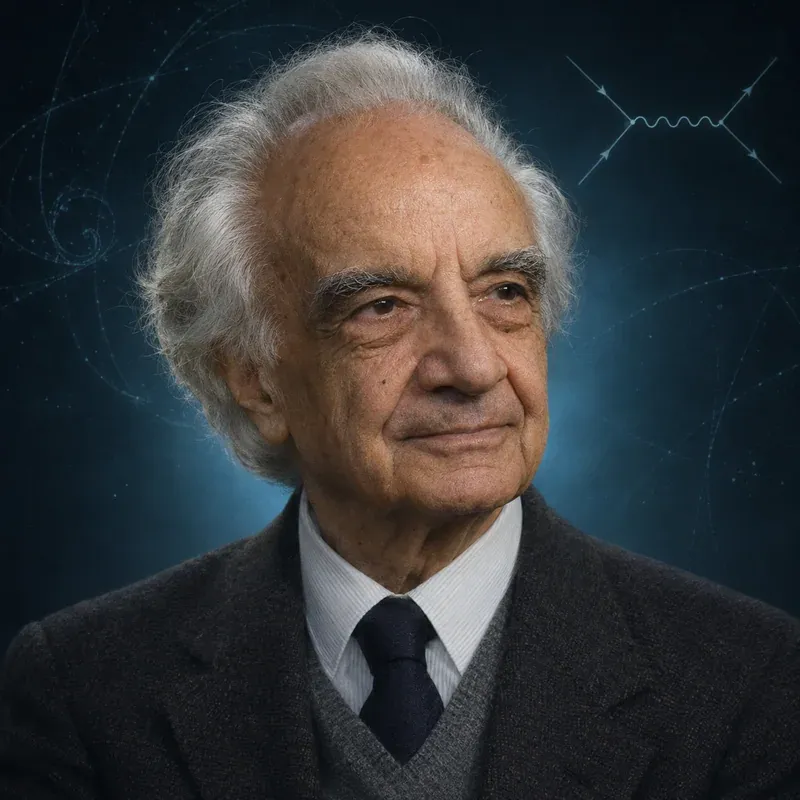
 Illustration
Antonino Zichichi
As president of INFN, Zichichi conceived in 1979 an underground laboratory alongside the motorway tunnel then being built under the Gran Sasso massif and won the political support to build it. Completed in the mid-1980s and shielded by about 1400 m of rock, the Laboratori Nazionali del Gran Sasso became one of the largest underground laboratories in the world and the home of GALLEX/GNO, Borexino, OPERA, ICARUS, GERDA, CUORE and many other neutrino and rare-event experiments. The 2007 Pontecorvo Prize recognised his fundamental contributions to its development and to large facilities for solar and accelerator neutrino studies.
- Born
- 15 October 1929
Trapani, Sicily, Italy - Died
- 9 February 2026
Rome, Italy - Nationality
- Italian
- Field
- Experimental particle physics
- Institutions
- University of Palermo, CERN, University of Bologna, INFN
Early career
Antonino Zichichi was born in Trapani, Sicily, on 15 October 1929, to a family from nearby Erice, and trained as a physicist in Palermo. He joined CERN in 1955, worked in the early years between CERN and laboratories in the United States, and became professor of physics at the University of Bologna in 1960. At CERN he took part in the first measurement of the anomalous magnetic moment of the muon, and in 1965 he led the group at the Proton Synchrotron that observed the antideuteron, a nucleus of an antiproton and an antineutron and the first antinucleus to be seen; a team at Brookhaven reported it at about the same time. Later projects associated with his name include a search for heavy leptons, the time-of-flight system of the ALICE detector at the LHC and the LAA detector research programme at CERN.
Erice
In 1963 Zichichi founded the Ettore Majorana Foundation and Centre for Scientific Culture in Erice, named after the Sicilian physicist Ettore Majorana. Its International School of Subnuclear Physics, which he directed for decades, became a regular meeting point for theorists and experimentalists from East and West. In 1982 he promoted the Erice Statement on the responsibilities of science for peace, and from 1986 he presided over the World Lab and the World Federation of Scientists.
A laboratory under the Gran Sasso
From 1977 to 1982 Zichichi was president of the Italian National Institute for Nuclear Physics (INFN), and from 1978 to 1980 of the European Physical Society. In 1979, while the motorway tunnel under the Gran Sasso massif in Abruzzo was being built, he proposed to dig experimental halls off the tunnel and persuaded the Senate president Amintore Fanfani to set up the necessary public-works commission. Construction ran from 1982 to 1985. The resulting Laboratori Nazionali del Gran Sasso have about 1400 m of rock overhead, which reduces the flux of cosmic muons by roughly a factor of a million, and three large halls about 100 m long that can be reached by road.
The laboratory began operating in 1987 with MACRO, a large detector for cosmic-ray muons and magnetic monopoles that also measured atmospheric neutrinos, followed by the LVD supernova watch. GALLEX and GNO measured the low-energy pp neutrinos from the Sun; Borexino observed solar neutrinos from the pp chain and the CNO cycle; OPERA and ICARUS received the CNGS beam from CERN, 730 km away, and OPERA saw tau-neutrino appearance; GERDA, CUORE and LEGEND search for neutrinoless double-beta decay. Few individual decisions have shaped European neutrino physics as strongly.
Recognition
Zichichi received the 2007 Pontecorvo Prize of the Joint Institute for Nuclear Research "for fundamental contributions to the development of the largest underground Gran Sasso National Laboratory" and for large facilities for solar and accelerator neutrino studies, as well as the Enrico Fermi Prize of the Italian Physical Society and many national honours; asteroid 3951 Zichichi is named after him. He was also a prominent science communicator on Italian television. He died in Rome on 9 February 2026, aged 96.
Known for
- Conceiving the Gran Sasso National Laboratory (1979)
- Discovery of the antideuteron at CERN (1965)
- Founding the Ettore Majorana Centre in Erice (1963)
- President of INFN (1977–1982) and of the European Physical Society (1978–1980)
- Pontecorvo Prize (2007)
Chronology
- 1955Joins CERN
- 1963Founds the Ettore Majorana Centre in Erice
- 1965His CERN group observes the antideuteron
- 1977President of INFN (to 1982)
- 1979Conceives the Gran Sasso underground laboratory
- 1987Gran Sasso laboratory becomes operational, with MACRO as first experiment
- 2007Pontecorvo Prize
Original papers
- T. Massam, Th. Muller, B. Righini, M. Schneegans, A. Zichichi, Experimental observation of antideuteron production, Nuovo Cimento 39, 10 (1965)DOI 10.1007/BF02814251
Experiments
Connected people
Frequently asked questions
Who founded the Gran Sasso laboratory?
Antonino Zichichi conceived it in 1979 as president of INFN and secured the support to build it next to the Gran Sasso motorway tunnel; it opened for experiments in 1987.
What did Zichichi discover?
In 1965 his CERN group observed the antideuteron, the first antinucleus to be detected; a Brookhaven team reported it at about the same time.
Mentioned in 1 page
Last updated: · Editorial standard
Cite this page
Text
Neutrino Atlas (2026). “Antonino Zichichi”. Retrieved 22 November 2026, from https://neutrino-atlas.com/people/antonino-zichichi/BibTeX
@misc{neutrinoatlas2026peopleantoninozichichi,
  title        = {Antonino Zichichi},
  author       = {{Neutrino Atlas}},
  year         = {2026},
  url          = {https://neutrino-atlas.com/people/antonino-zichichi/},
  note         = {Accessed 2026-11-22},
  language     = {english}
}