2022Experiment
BEST strengthens the gallium anomaly
The Baksan Experiment on Sterile Transitions exposed gallium in two concentric zones to an intense chromium-51 neutrino source of about 3.4 MCi. Published in June 2022, it measured capture rates about 20–25 percent below expectation in both zones, confirming the deficit seen in earlier SAGE and GALLEX source calibrations at a combined significance of roughly 4–5σ, depending on the analysis. The deficit could indicate a sterile neutrino, but this interpretation conflicts with other data. Cross-section uncertainties are also under scrutiny.
- Date
- 2022
- Kind of event
- Experiment
- People involved
- Vladimir N. Gavrin (Vladimir Nikolaevich Gavrin), Steven R. Elliott
The situation before
In the 1990s the solar neutrino experiments GALLEX and SAGE tested their gallium detectors with intense artificial neutrino sources made of chromium-51 and argon-37. The counted germanium atoms came out consistently below expectation, by about 10–20 percent. With only four calibration runs, the deficit was intriguing but not decisive. It became known as the gallium anomaly, and one proposed explanation was oscillation into a sterile neutrino over just a few metres.
What happened
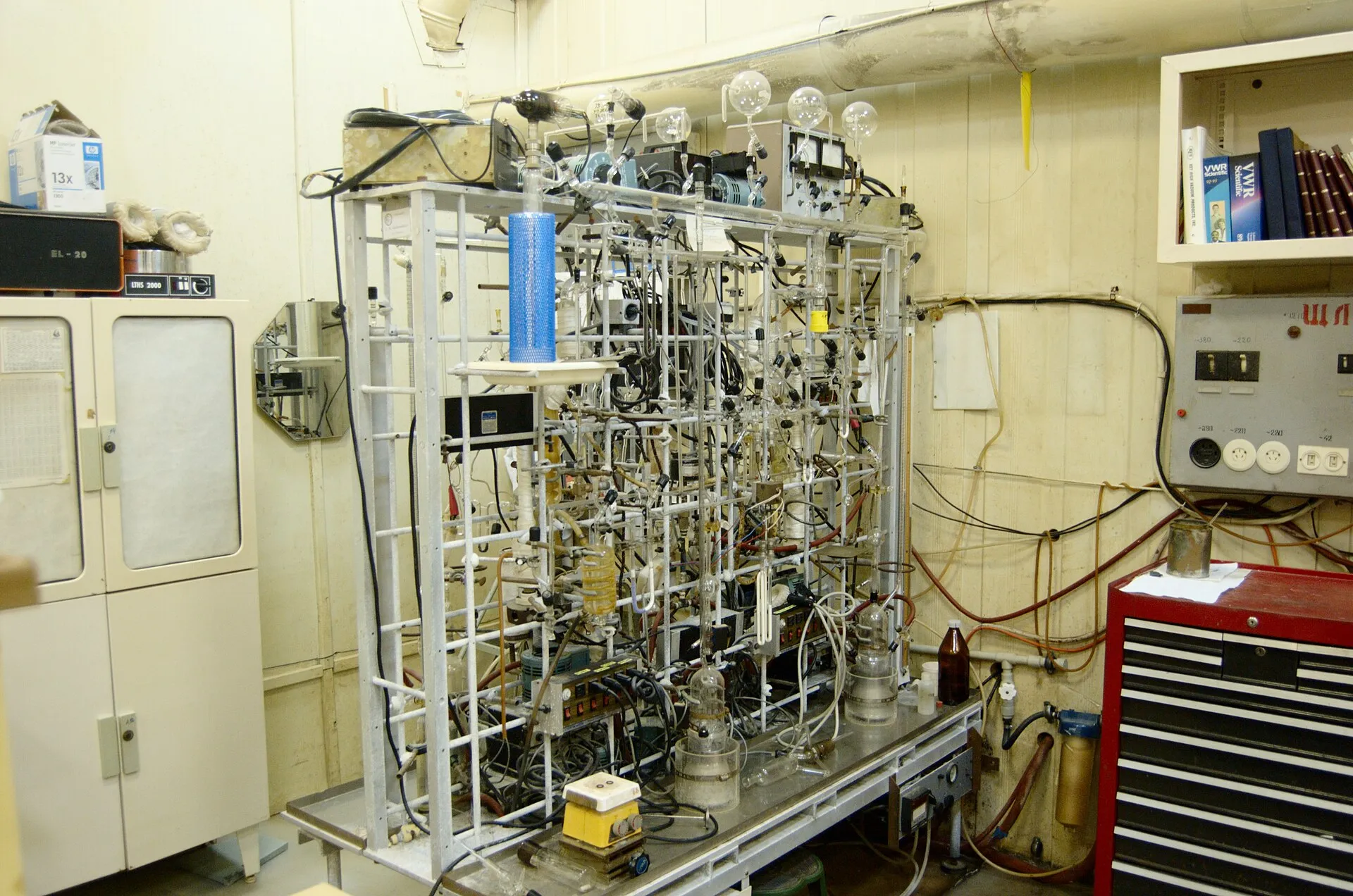
The Baksan Experiment on Sterile Transitions, led by Vladimir Gavrin at the Institute for Nuclear Research in Moscow with US partners including Steven Elliott of Los Alamos, was designed to test this idea directly. At the Baksan Neutrino Observatory in the Caucasus, the team placed about 47 tonnes of liquid gallium in two nested zones, a sphere surrounded by a cylinder, so that neutrinos from a central source crossed two different average distances.
The source consisted of 26 chromium-51 disks irradiated in a reactor in Russia, with an activity of 3.414 MCi on 5 July 2019. Between July and October 2019 the team repeatedly extracted the germanium-71 produced by neutrino capture and counted its decays, a classic radiochemical technique.
Both zones showed 20 to 24 percent fewer captures than predicted from the known cross-section and efficiencies. The ratio of outer to inner rate, 0.97 ± 0.07, was consistent with one. The results appeared in Physical Review Letters and Physical Review C in June 2022. Combined with the earlier source runs, the average of all gallium measurements fell to about 0.80 ± 0.05, a deficit of roughly 4σ or more depending on how uncertainties are treated.
Reaction
Elliott said the result "definitely reaffirms the anomaly we've seen in previous experiments". The interpretation was more contested than the measurement. A sterile neutrino fitting BEST would need a mass-squared splitting above about 0.5 eV² and large mixing. That conflicts with reactor experiments such as PROSPECT and STEREO, which see no comparable oscillation, and with solar neutrino data. Because the rates at both distances were nearly equal, BEST also did not show the distance dependence that oscillations over short baselines would produce.
Consequences
Attention therefore turned to the inputs of the prediction: the capture cross-section on gallium-71, which has never been measured directly at these energies, the excited nuclear states involved, and the counting efficiency. Theorists re-examined these ingredients without finding an obvious error. The anomaly remains one of the open short-baseline anomalies, and proposals include a stronger zinc-65 or cerium source to probe shorter oscillation lengths.
Frequently asked questions
What is the gallium anomaly?
A persistent shortfall of about 20 percent in neutrino captures on gallium when detectors are exposed to calibrated radioactive sources, seen by GALLEX, SAGE and BEST.
Did BEST discover a sterile neutrino?
No. The deficit is compatible with a sterile neutrino, but that interpretation conflicts with reactor and solar data, and a misunderstanding of the gallium cross-section has not been ruled out.
Who led BEST?
The experiment was led by Vladimir Gavrin of the Institute for Nuclear Research, with Los Alamos physicists including Steven Elliott among the US partners.
Original papers
- First resultV. V. Barinov et al. (BEST Collaboration), Results from the Baksan Experiment on Sterile Transitions (BEST), Phys. Rev. Lett. 128, 232501 (2022)DOI 10.1103/PhysRevLett.128.232501arXiv:2109.11482
Concepts
Mentioned in 2 pages
Last updated: · Editorial standard
Cite this page
Text
Neutrino Atlas (2026). “2022: BEST strengthens the gallium anomaly”. Retrieved 22 November 2026, from https://neutrino-atlas.com/timeline/2022-best-gallium-anomaly/BibTeX
@misc{neutrinoatlas2026ne2022bestgalliumanomaly,
  title        = {2022: BEST strengthens the gallium anomaly},
  author       = {{Neutrino Atlas}},
  year         = {2026},
  url          = {https://neutrino-atlas.com/timeline/2022-best-gallium-anomaly/},
  note         = {Accessed 2026-11-22},
  language     = {english}
}