2001Discovery
SNO shows solar neutrinos change flavour
The Sudbury Neutrino Observatory, 1,000 tonnes of heavy water 2 km underground in Ontario, announced on 18 June 2001 its measurement of the boron-8 electron-neutrino flux via charged-current interactions. Compared with Super-Kamiokande's elastic-scattering rate, which includes a small contribution from other flavours, it showed at 3.3σ that part of the solar flux arrives as muon or tau neutrinos. The solar neutrino problem was therefore caused by neutrino flavour change, not by the solar model.
- Date
- 18 June 2001
- Kind of event
- Discovery
- People involved
- Arthur B. McDonald, George Ewan, Mark C. Chen, John Norris Bahcall
- Experiments
- SNO (Sudbury Neutrino Observatory), Super-Kamiokande
The situation before
For more than thirty years every solar neutrino experiment had seen too few electron neutrinos: about a third at Homestake, about half at Kamiokande and Super-Kamiokande, a little over half in the gallium detectors. The pattern suggested that neutrinos change flavour on the way, but each result was a comparison with the standard solar model of John Bahcall and colleagues. A measurement independent of the model was needed, of the kind Herbert H. Chen had proposed in 1985: count the electron neutrinos and, separately, all flavours.
What happened
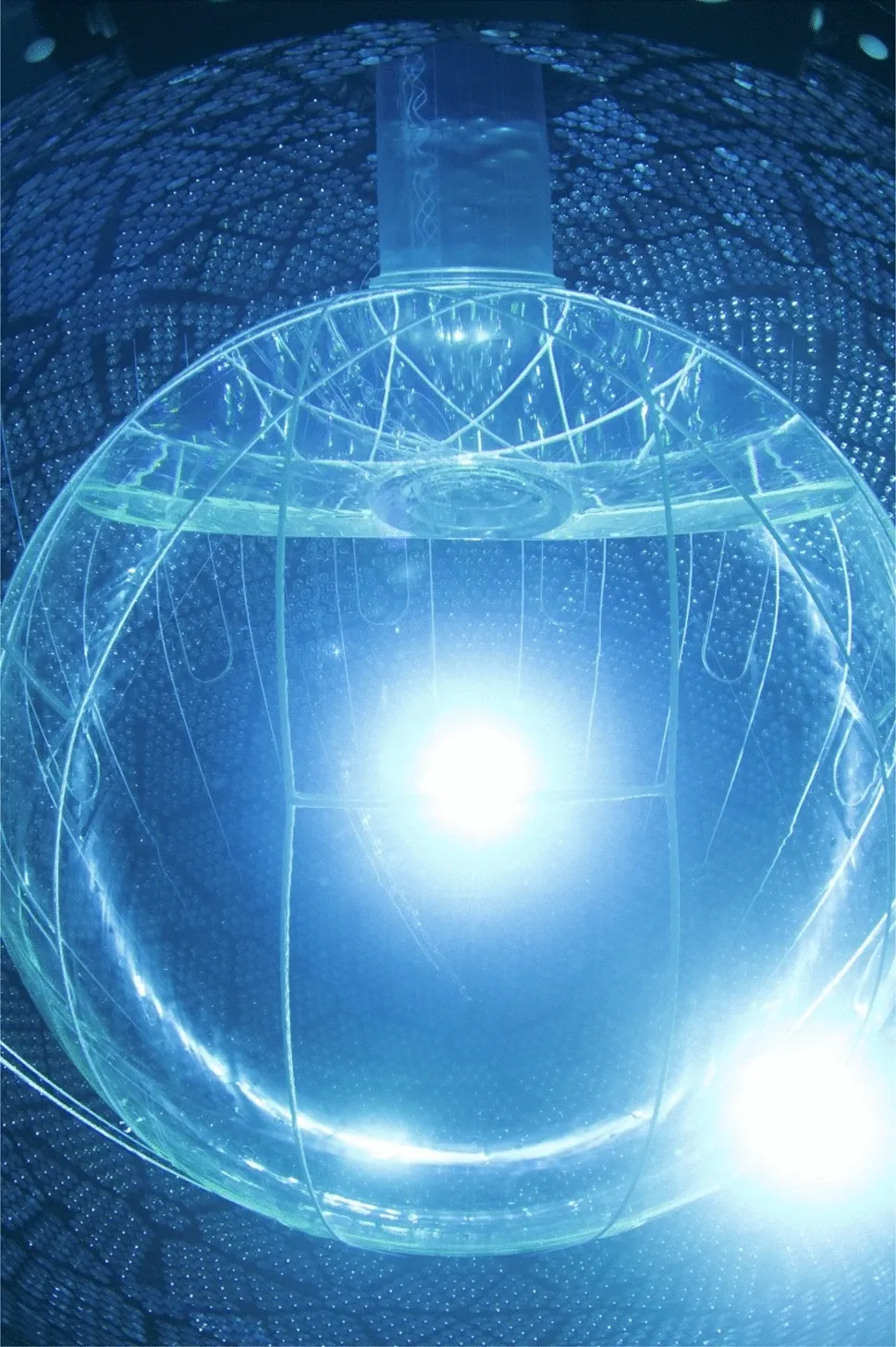
The Sudbury Neutrino Observatory held 1,000 tonnes of heavy water, on loan from Atomic Energy of Canada Limited, in a 12 m acrylic sphere viewed by about 9,500 photomultipliers. It sat about 2 km underground in the Creighton nickel mine near Sudbury, Ontario, surrounded by ultrapure light water. The collaboration of Canadian, American and British institutes was directed by Arthur B. McDonald, with founding figures including George Ewan and, among its physicists, Mark Chen. Data taking began in November 1999.
The first analysis used about 241 live days up to January 2001. It measured the charged-current reaction νₑ + d → p + p + e⁻, sensitive only to electron neutrinos, above an electron kinetic energy of 6.75 MeV. On 18 June 2001 the collaboration announced the result:
Super-Kamiokande's precise measurement of elastic scattering on electrons, which responds mainly to electron neutrinos but also, with about one sixth of the strength, to muon and tau neutrinos, gave a higher flux, 2.32 × 10⁶ cm⁻² s⁻¹. The difference, 0.57 ± 0.17 × 10⁶ cm⁻² s⁻¹, is 3.3 standard deviations from zero. It could only mean that some of the boron-8 neutrinos arrive as muon or tau neutrinos. Inferring the total flux of all flavours gave 5.44 ± 0.99 × 10⁶ cm⁻² s⁻¹, in good agreement with the solar model prediction of about 5.05 × 10⁶.
Reaction
The result was reported worldwide as the solution of the solar neutrino problem: the Sun works as calculated, and the neutrinos change on the way. For Bahcall and for Raymond Davis Jr., whose chlorine result had started the debate in 1968, it was a vindication after decades of doubt about solar models and radiochemistry. Physicists noted that 3.3σ, and the reliance on a second experiment, left room for confirmation.
Consequences
- In April 2002 SNO published its own neutral-current measurement, sensitive to all flavours equally, and found a total flux of about 5.1 × 10⁶ cm⁻² s⁻¹, with flavour change established at 5.3σ.
- Later SNO phases added salt and then helium-3 proportional counters to improve neutron detection.
- In December 2002 KamLAND's reactor measurement confirmed the large-mixing-angle MSW solution.
- McDonald shared the 2015 Nobel Prize in Physics with Takaaki Kajita for the discovery of neutrino oscillations.
- The SNO cavern and its infrastructure grew into SNOLAB, and the detector itself became SNO+.
Frequently asked questions
What did SNO announce on 18 June 2001?
That the flux of solar electron neutrinos measured by the charged-current reaction was lower than the flux seen by Super-Kamiokande's elastic scattering, proving at 3.3σ that solar neutrinos change flavour.
Did the solar model turn out to be right?
Yes. The total flux of all flavours inferred by SNO agreed with the standard solar model.
What came after the 2001 result?
SNO's neutral-current measurement in 2002 confirmed flavour change at 5.3σ, and KamLAND confirmed the oscillation parameters with reactor antineutrinos.
Original papers
- DiscoveryQ. R. Ahmad et al. (SNO), Measurement of the rate of νe + d → p + p + e− interactions produced by 8B solar neutrinos at the Sudbury Neutrino Observatory, Phys. Rev. Lett. 87, 071301 (2001)DOI 10.1103/PhysRevLett.87.071301arXiv:nucl-ex/0106015
Concepts
Mentioned in 1 page
Lessons 1
Last updated: · Editorial standard
Cite this page
Text
Neutrino Atlas (2026). “2001: SNO shows solar neutrinos change flavour”. Retrieved 22 November 2026, from https://neutrino-atlas.com/timeline/2001-sno-charged-current/BibTeX
@misc{neutrinoatlas2026ine2001snochargedcurrent,
  title        = {2001: SNO shows solar neutrinos change flavour},
  author       = {{Neutrino Atlas}},
  year         = {2026},
  url          = {https://neutrino-atlas.com/timeline/2001-sno-charged-current/},
  note         = {Accessed 2026-11-22},
  language     = {english}
}