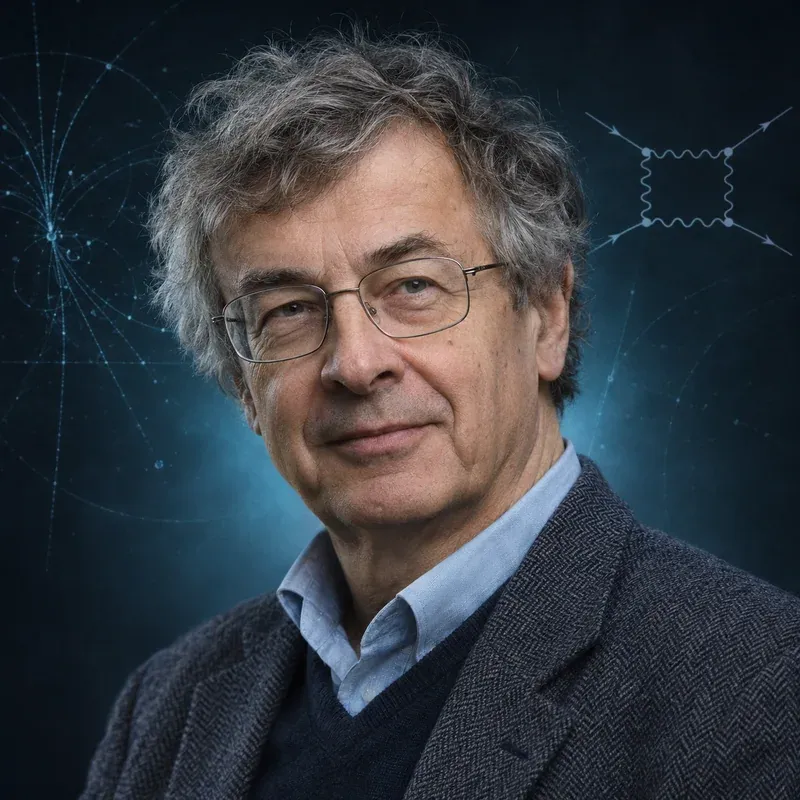
 Illustration
Mikhail Shaposhnikov
In 1985, with Kuzmin and Rubakov, Shaposhnikov showed that electroweak (sphaleron) processes violate baryon and lepton number in the hot early universe, the step that makes leptogenesis work. In 2005, with Takehiko Asaka, he proposed the νMSM, adding three right-handed (sterile) neutrinos with masses below the electroweak scale to explain neutrino masses, a keV-scale sterile-neutrino dark matter candidate and the baryon asymmetry.
- Born
- 1956
Sochi, USSR - Nationality
- Swiss (Soviet-born)
- Field
- Theoretical particle physics; cosmology
- Institutions
- Institute for Nuclear Research (INR), Moscow, CERN Theory Division, University of Lausanne, EPFL
Education and career
Mikhail Evgenievich Shaposhnikov was born in 1956 in Sochi. He graduated in physics from Moscow State University in 1979 and received his PhD in 1982 from the Institute for Nuclear Research (INR) of the Academy of Sciences in Moscow, with a thesis on the baryon asymmetry in grand unified theories. He worked in the INR theory division until 1991, then joined the Theory Division at CERN. In 1998 he became professor of theoretical physics at the University of Lausanne and in 2003 professor at EPFL, the Swiss Federal Institute of Technology in Lausanne, where he leads the Laboratory of Particle Physics and Cosmology.
Key contributions
Shaposhnikov's work is driven by one question: how much of what we observe in the universe can be explained with as little new physics as possible? Neutrinos play a central role in his answers.
In 1985, with Vadim Kuzmin and Valery Rubakov, he showed that the electroweak theory itself violates baryon number and lepton number in the hot early universe. At low temperatures such processes are suppressed by a tunnelling factor so small that they are never seen, but above roughly a hundred GeV, thermal fluctuations can pass over the energy barrier through configurations called sphalerons. These processes conserve the difference between baryon and lepton number, B − L, but convert a lepton excess into a baryon excess. One year later Masataka Fukugita and Tsutomu Yanagida used exactly this effect to propose leptogenesis: heavy right-handed neutrinos decaying in the early universe create a lepton asymmetry, and sphalerons turn part of it into the matter–antimatter asymmetry we see today.
In 2005, with Takehiko Asaka, he proposed the νMSM, the “neutrino Minimal Standard Model”. It adds to the Standard Model only three right-handed neutrinos, all lighter than the electroweak scale rather than at the very high masses of the classic seesaw. The lightest, with a mass of a few keV, would be a sterile neutrino dark matter candidate. The other two, at around the GeV scale, give the active neutrinos their small masses and generate the baryon asymmetry through CP-violating oscillations, a mechanism first proposed by Evgeny Akhmedov, Rubakov and Alexei Smirnov in 1998. The model therefore links three open problems, neutrino mass, dark matter and the baryon asymmetry, to a single set of new particles.
The νMSM makes testable predictions. GeV-scale heavy neutral leptons could be produced in meson decays at high-intensity proton beams, which is one of the motivations for the SHiP experiment approved at CERN in 2024. A keV sterile neutrino could decay into an active neutrino and an X-ray photon, so X-ray telescopes search for a narrow line from galaxies and clusters; a possible line near 3.5 keV reported in 2014 remains disputed.
Higgs inflation and recognition
In 2008, with Fedor Bezrukov, he showed that the Higgs boson itself could drive cosmic inflation if it couples to gravity in a particular non-minimal way, without requiring a new inflaton field. Shaposhnikov received the Markov Prize in 2005, shared with Rubakov, a Humboldt Research Award in 2008, the Andrei Sakharov Gold Medal of the Russian Academy of Sciences in 2011 and an ERC Advanced Grant in 2015. In 2022 he signed open letters of Russian scientists against the invasion of Ukraine.
Known for
- Electroweak baryon-number violation in the early universe (Kuzmin–Rubakov–Shaposhnikov 1985)
- νMSM: three right-handed neutrinos below the electroweak scale (2005)
- Higgs inflation (with Bezrukov, 2008)
Chronology
- 1985Kuzmin–Rubakov–Shaposhnikov paper on electroweak baryon-number violation
- 2005νMSM with Asaka; Markov Prize
- 2008Higgs inflation; Humboldt Research Prize
- 2011Sakharov Gold Medal
Original papers
- V. A. Kuzmin, V. A. Rubakov, M. E. Shaposhnikov, On anomalous electroweak baryon-number non-conservation in the early universe, Phys. Lett. B 155, 36 (1985)DOI 10.1016/0370-2693(85)91028-7
- T. Asaka, M. Shaposhnikov, The νMSM, dark matter and baryon asymmetry of the universe, Phys. Lett. B 620, 17 (2005)
Experiments
- SHiP
- XMM-Newton
Connected people
- Evgeny Kh. Akhmedov
- Masataka Fukugita
- Tsutomu Yanagida
- Gerardus 't Hooft
- Vadim Alekseevich Kuzmin
- Valery Anatolievich Rubakov
Frequently asked questions
What is the νMSM?
The neutrino Minimal Standard Model, proposed by Asaka and Shaposhnikov in 2005. It adds three right-handed neutrinos below the electroweak scale to explain neutrino masses, a dark matter candidate and the matter–antimatter asymmetry.
Why are sphalerons important for neutrino physics?
They convert a lepton asymmetry into a baryon asymmetry in the early universe. Without them, an excess of leptons produced by neutrino decays or oscillations could not explain why the universe contains matter rather than antimatter.
Mentioned in 16 pages
People 6
Last updated: · Editorial standard
Cite this page
Text
Neutrino Atlas (2026). “Mikhail Shaposhnikov”. Retrieved 22 November 2026, from https://neutrino-atlas.com/people/mikhail-shaposhnikov/BibTeX
@misc{neutrinoatlas2026eoplemikhailshaposhnikov,
  title        = {Mikhail Shaposhnikov},
  author       = {{Neutrino Atlas}},
  year         = {2026},
  url          = {https://neutrino-atlas.com/people/mikhail-shaposhnikov/},
  note         = {Accessed 2026-11-22},
  language     = {english}
}