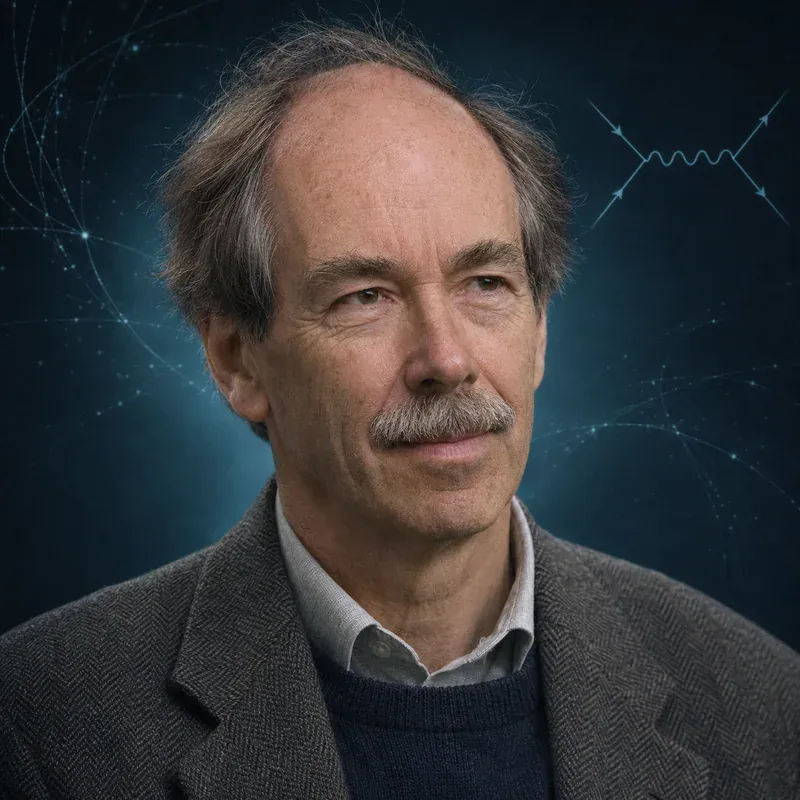
 Illustration
Gerardus 't Hooft
't Hooft's 1971 proof that spontaneously broken Yang–Mills theories are renormalizable turned the Glashow–Weinberg–Salam model into a predictive theory, including the neutral-current neutrino interactions found at Gargamelle in 1973. Precise loop calculations built on this work underlie the electroweak fits that combine neutrino scattering with Z-boson data. In 1976 he showed that quantum anomalies let the electroweak theory violate baryon and lepton number together while conserving their difference, B − L. At high temperatures these processes become fast (sphalerons) and are the step that converts a lepton asymmetry into a baryon asymmetry in leptogenesis.
- Born
- 5 July 1946
Den Helder, Netherlands - Nationality
- Dutch
- Field
- Theoretical physics; gauge theories
- Nobel Prize
- Physics 1999 – for elucidating the quantum structure of electroweak interactions in physics (shared with Martinus J. G. Veltman)
- Institutions
- Utrecht University (PhD 1972; professor, later emeritus), CERN (fellow)
Education
Gerardus 't Hooft was born on 5 July 1946 in Den Helder in the Netherlands and entered Utrecht University in 1964. His master's thesis of 1968, supervised by Martinus Veltman, dealt with the Adler–Bell–Jackiw anomaly, a quantum effect that would return in his later work. He stayed with Veltman for his doctorate, completed in 1972, then held a fellowship at CERN before returning to Utrecht, where he became professor.
Making the electroweak theory calculable
By the late 1960s Sheldon Glashow, Steven Weinberg and Abdus Salam had written down an electroweak theory with massive W and Z bosons generated by the Higgs mechanism. Nobody knew whether it gave finite answers beyond the simplest approximation. In two papers in 1971 't Hooft showed that massless and then spontaneously broken Yang–Mills theories are renormalizable: all infinities can be absorbed into a few measurable constants. With Veltman he introduced dimensional regularization in 1972, which became the standard tool for such calculations.
The effect on neutrino physics was immediate. The theory now made firm predictions for neutral-current interactions, and their discovery at Gargamelle in 1973 was taken as strong support for it. Later, loop-level predictions allowed neutrino scattering, the weak mixing angle and LEP measurements of the number of light neutrinos to be compared within one consistent framework.
Anomalies and the matter–antimatter puzzle
In 1976 't Hooft found that instantons, tunnelling configurations of the gauge field, combine with the electroweak anomaly to violate baryon number and lepton number together while conserving B − L. At zero temperature the rate is negligibly small. In the hot early universe, however, the related sphaleron processes are fast, which is why leptogenesis can turn a lepton excess from heavy neutrino decays into the observed matter–antimatter asymmetry.
't Hooft also discovered the magnetic monopole of broken gauge theories (independently of Alexander Polyakov), the simplifications of large-N gauge theories and, with Leonard Susskind, the holographic principle. He shared the 1999 Nobel Prize with Veltman.
Known for
- Proof that the electroweak gauge theory is renormalizable (1971)
- Dimensional regularization (with M. Veltman, 1972)
- Anomalous baryon- and lepton-number violation via instantons (1976)
- 't Hooft–Polyakov magnetic monopole
- Large-N limit of gauge theories
- Holographic principle
Chronology
- 1964Begins physics studies at Utrecht
- 1968Master's thesis under Martinus Veltman
- 1971Renormalizability of massless and massive Yang–Mills theories
- 1972PhD; dimensional regularization with Veltman
- 1976Instanton-induced B + L violation
- 1999Nobel Prize in Physics
Original papers
- G. 't Hooft, Renormalization of massless Yang-Mills fields, Nucl. Phys. B 33, 173 (1971)DOI 10.1016/0550-3213(71)90395-6
- G. 't Hooft, Renormalizable Lagrangians for massive Yang-Mills fields, Nucl. Phys. B 35, 167 (1971)DOI 10.1016/0550-3213(71)90139-8
- G. 't Hooft, M. Veltman, Regularization and renormalization of gauge fields, Nucl. Phys. B 44, 189 (1972)DOI 10.1016/0550-3213(72)90279-9
- G. 't Hooft, Symmetry Breaking through Bell-Jackiw Anomalies, Phys. Rev. Lett. 37, 8 (1976)DOI 10.1103/PhysRevLett.37.8
Experiments
- Gargamelle
- LEP
Connected people
Frequently asked questions
What did 't Hooft win the Nobel Prize for?
He shared the 1999 Nobel Prize in Physics with Martinus Veltman for elucidating the quantum structure of electroweak interactions, chiefly the proof that the theory is renormalizable.
How is his work relevant to neutrinos?
It made the electroweak predictions for neutrino interactions calculable, and his 1976 result on anomalous B + L violation underlies the sphaleron step of leptogenesis.
Mentioned in 1 page
People 1
Last updated: · Editorial standard
Cite this page
Text
Neutrino Atlas (2026). “Gerardus 't Hooft”. Retrieved 22 November 2026, from https://neutrino-atlas.com/people/gerard-t-hooft/BibTeX
@misc{neutrinoatlas2026peoplegerardthooft,
  title        = {Gerardus 't Hooft},
  author       = {{Neutrino Atlas}},
  year         = {2026},
  url          = {https://neutrino-atlas.com/people/gerard-t-hooft/},
  note         = {Accessed 2026-11-22},
  language     = {english}
}