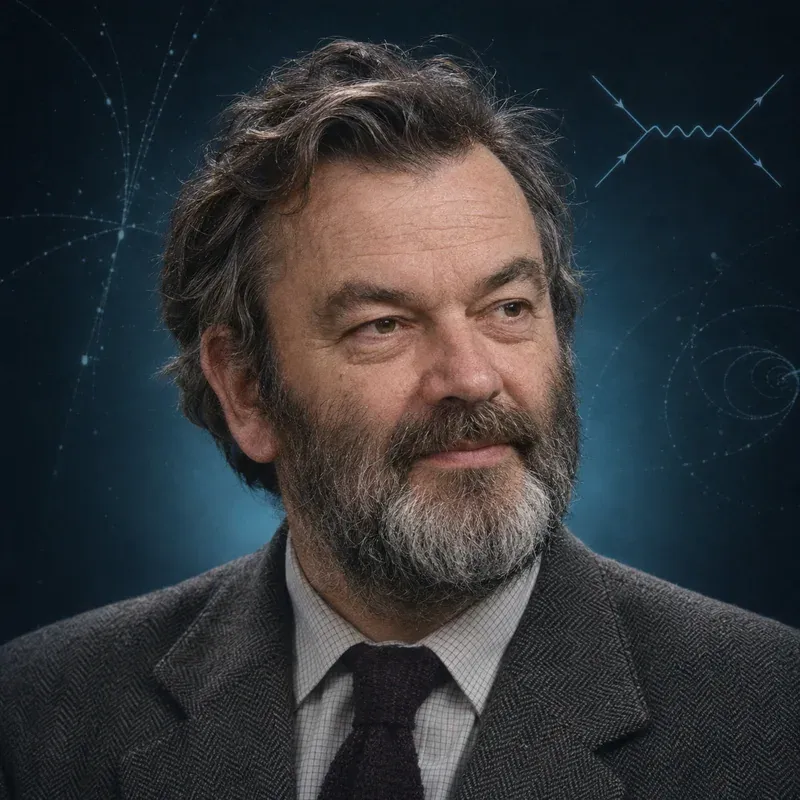
 Illustration
Martinus J. G. Veltman
At CERN in the early 1960s Veltman was drawn into weak interactions and neutrino physics. With John Bell he calculated in 1963 how neutrinos could produce the hypothetical intermediate vector boson, and he was closely involved with CERN's 1963 neutrino experiment, speaking for the group at that year's Brookhaven conference. His conviction that weak interactions are carried by vector bosons led him to the renormalization programme that he completed with his student Gerard 't Hooft. That work made the electroweak predictions for neutrino scattering, including neutral currents, calculable to high precision.
- Born
- 27 June 1931
Waalwijk, Netherlands - Died
- 4 January 2021
Bilthoven, Netherlands - Nationality
- Dutch
- Field
- Theoretical particle physics
- Nobel Prize
- Physics 1999 – for elucidating the quantum structure of electroweak interactions in physics (shared with Gerardus 't Hooft)
- Institutions
- Utrecht University (PhD 1963; professor from 1966), CERN Theory Division (1961–1966), SLAC (visiting), University of Michigan, Ann Arbor (1981–1996)
From Utrecht to CERN
Martinus Justinus Godefriedus (Tini) Veltman was born on 27 June 1931 in Waalwijk in the Netherlands. He studied physics at Utrecht University, first leaning towards experiment before turning to theory. After military service, Léon Van Hove offered him a doctoral position; when Van Hove became head of the CERN Theory Division, Veltman followed him there in 1961 and completed his PhD in 1963.
Neutrinos and vector bosons
At CERN, Sam Berman interested him in weak interactions and neutrino physics. The laboratory was then preparing its first accelerator neutrino experiments, using the magnetic horn invented by Simon van der Meer to focus the parent pions. With John Bell, Veltman worked out in 1963 how high-energy neutrinos could produce the intermediate vector boson, the then hypothetical carrier of the weak force later found as the W boson. He was closely involved with the 1963 CERN neutrino experiment and spoke for the group at that year's Brookhaven conference.
To handle the long algebra these calculations required, he wrote Schoonschip, one of the first computer-algebra programs, during a stay at SLAC in 1963–64. In 1966 he argued that the weak currents must be conserved in the way expected if vector bosons mediate them, which pointed to a non-abelian gauge theory and to the question of whether such theories are renormalizable.
Renormalization and the Nobel Prize
Veltman became professor at Utrecht in 1966 and took on Gerard 't Hooft as a student. Their work of 1971–72 showed that the electroweak theory is renormalizable, which made predictions for neutral currents and Z-boson properties precise. Veltman then used the rho parameter, the ratio of neutral- to charged-current strengths, to show that the Higgs field must start as a doublet and to estimate the top-quark mass before its discovery. He moved to the University of Michigan in 1981, retired in 1996 and shared the 1999 Nobel Prize with 't Hooft. He died in Bilthoven on 4 January 2021.
Known for
- Renormalization of electroweak gauge theory (with G. 't Hooft)
- Phenomenology of the first CERN neutrino experiments (1963)
- Schoonschip computer-algebra program
- Rho parameter as a probe of the Higgs sector and the top-quark mass
- Dimensional regularization (with 't Hooft, 1972)
Chronology
- 1961Joins Léon Van Hove at the CERN Theory Division
- 1963PhD, Utrecht; Bell–Veltman paper on intermediate-boson production by neutrinos
- 1966Professor at Utrecht
- 1971Renormalization of Yang–Mills theories completed with 't Hooft
- 1981Moves to the University of Michigan
- 1996Retires from the University of Michigan
- 1999Nobel Prize in Physics
Original papers
- J. S. Bell, M. Veltman, Intermediate boson production by neutrinos, Phys. Lett. 5, 94 (1963)
- G. 't Hooft, M. Veltman, Regularization and renormalization of gauge fields, Nucl. Phys. B 44, 189 (1972)DOI 10.1016/0550-3213(72)90279-9
Experiments
- CERN neutrino experiment
- Gargamelle
- LEP
Connected people
Frequently asked questions
What was Veltman's link to neutrino physics?
He analysed the first CERN neutrino experiments in the early 1960s, including a 1963 calculation with John Bell of intermediate-boson production by neutrinos, and spoke for the CERN group in 1963.
What is Schoonschip?
A computer-algebra program Veltman wrote in 1963–64 to handle the lengthy calculations of particle physics, a forerunner of modern symbolic codes such as FORM.
Mentioned in 1 page
People 1
Last updated: · Editorial standard
Cite this page
Text
Neutrino Atlas (2026). “Martinus J. G. Veltman”. Retrieved 22 November 2026, from https://neutrino-atlas.com/people/martinus-veltman/BibTeX
@misc{neutrinoatlas2026peoplemartinusveltman,
  title        = {Martinus J. G. Veltman},
  author       = {{Neutrino Atlas}},
  year         = {2026},
  url          = {https://neutrino-atlas.com/people/martinus-veltman/},
  note         = {Accessed 2026-11-22},
  language     = {english}
}