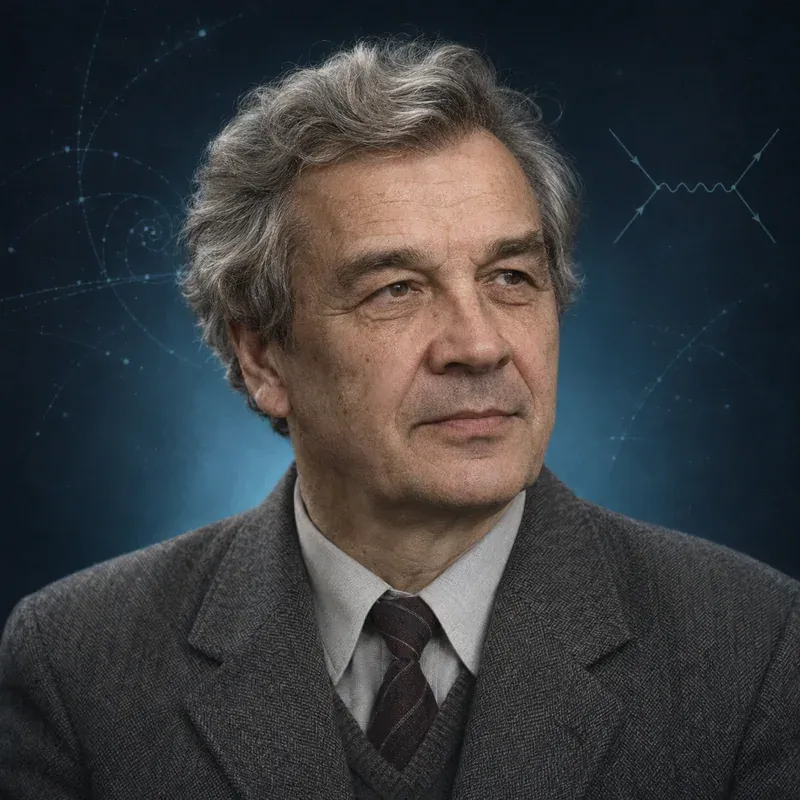
 Illustration
Vadim Alekseevich Kuzmin
In 1964–65 Kuzmin proposed detecting solar neutrinos with the reaction ⁷¹Ga + νe → ⁷¹Ge + e⁻, whose low threshold of 233 keV makes it sensitive to the dominant pp neutrinos; the method was realised by SAGE and GALLEX/GNO in the 1990s. With Georgiy Zatsepin he predicted in 1966 the cutoff of cosmic-ray protons on the microwave background, the process that also produces cosmogenic neutrinos. In 1985, with Valery Rubakov and Mikhail Shaposhnikov, he showed that electroweak sphaleron processes violate baryon plus lepton number rapidly in the hot early Universe, which made leptogenesis through heavy neutrino decays possible.
- Born
- 16 April 1937
Moscow, Soviet Union - Died
- 17 September 2015
Moscow, Russia - Nationality
- Soviet / Russian
- Field
- Theoretical particle physics and astroparticle physics
- Institutions
- Moscow State University, Lebedev Physical Institute, Moscow, Institute for Nuclear Research (INR), Moscow
Early life and education
Vadim Alekseevich Kuzmin was born in Moscow in 1937 and graduated from Moscow State University in 1961. He worked at the Lebedev Physical Institute, in the group around Georgiy Zatsepin that was laying the foundations of neutrino astrophysics in the Soviet Union, and received his PhD there in 1971. When the Institute for Nuclear Research (INR) of the Academy of Sciences was founded in 1970, he became one of its first members; he later headed its department of particle astrophysics and cosmology and was a professor at Moscow State University.
A gallium detector for the Sun
In the early 1960s the only planned solar neutrino experiment used the chlorine reaction proposed by Pontecorvo, whose threshold of 814 keV makes it blind to the pp neutrinos that carry most of the Sun's neutrino flux. In 1964–65 Kuzmin proposed gallium-71 instead. A neutrino turns ⁷¹Ga into ⁷¹Ge with a threshold of only 233 keV, and the germanium atoms, radioactive with an 11-day half-life, can be extracted chemically and counted. Such a detector measures the basic fusion reaction of the Sun directly and so tests the standard solar model independently of its uncertain high-energy branches. The gallium-germanium method needs tens of tonnes of gallium and took a quarter of a century to realise: SAGE in the Baksan laboratory, led by Vladimir Gavrin, and GALLEX at Gran Sasso both reported in the early 1990s a rate clearly below prediction, an important step towards solving the solar neutrino problem.
Cosmic rays and the early Universe
In 1966 Kuzmin and Zatsepin, independently of Kenneth Greisen, showed that cosmic-ray protons above about 5 × 10¹⁹ eV lose energy by producing pions on photons of the newly discovered cosmic microwave background. This Greisen–Zatsepin–Kuzmin cutoff limits the range of the most energetic cosmic rays, and the decays of the pions produce cosmogenic neutrinos, as Veniamin Berezinsky and Zatsepin pointed out in 1969.
In 1970 Kuzmin proposed neutron-antineutron oscillations as a test of baryon number violation and, independently of Sakharov, listed the conditions under which a matter-antimatter asymmetry can arise. In 1985, with Valery Rubakov and Mikhail Shaposhnikov, he showed that the sphaleron transitions of the electroweak theory, negligible today, run rapidly at temperatures above about 100 GeV. They violate baryon plus lepton number while conserving their difference. This result reshaped baryogenesis: it means that a lepton asymmetry produced by decays of heavy right-handed neutrinos is partly converted into a baryon asymmetry, the mechanism of leptogenesis proposed by Fukugita and Yanagida a year later.
Honours
Kuzmin received the Friedmann Prize of the Russian Academy of Sciences (1999, with Rubakov), the INR Markov Prize (2003) and the Pomeranchuk Prize of ITEP (2006). He was elected a corresponding member of the Russian Academy of Sciences in 2000 and died in Moscow in 2015.
Known for
- Proposal of the gallium-germanium solar neutrino detector (1964–65)
- Greisen–Zatsepin–Kuzmin (GZK) cutoff of cosmic rays (1966)
- Neutron-antineutron oscillations and conditions for baryogenesis (1970)
- Kuzmin–Rubakov–Shaposhnikov electroweak baryon-number violation (1985)
Chronology
- 1961Graduates from Moscow State University
- 1965Gallium-71 solar neutrino detector proposal published
- 1966Predicts the GZK cutoff with Zatsepin
- 1970Proposes neutron-antineutron oscillations; joins the new INR
- 1985Electroweak baryon-number violation with Rubakov and Shaposhnikov
- 2000Corresponding member of the Russian Academy of Sciences
Original papers
- V. A. Kuzmin, Detection of solar neutrinos by means of the ⁷¹Ga(ν,e⁻)⁷¹Ge reaction, Sov. Phys. JETP 22, 1051 (1966) [Zh. Eksp. Teor. Fiz. 49, 1532 (1965)]
- G. T. Zatsepin, V. A. Kuzmin, Upper limit of the spectrum of cosmic rays, JETP Lett. 4, 78 (1966)
- V. A. Kuzmin, V. A. Rubakov, M. E. Shaposhnikov, On anomalous electroweak baryon-number non-conservation in the early universe, Phys. Lett. B 155, 36 (1985)DOI 10.1016/0370-2693(85)91028-7
Experiments
Connected people
- Georgy Timofeyevich Zatsepin
- Mikhail Shaposhnikov
- Vladimir N. Gavrin (Vladimir Nikolaevich Gavrin)
- Veniamin Sergeevich Berezinsky
- Till A. Kirsten
Frequently asked questions
Why was gallium important for solar neutrinos?
Its low threshold of 233 keV makes it sensitive to the pp neutrinos from the Sun's main fusion reaction, which the chlorine detector could not see. SAGE and GALLEX used Kuzmin's method.
How is Kuzmin's work connected to leptogenesis?
The 1985 Kuzmin–Rubakov–Shaposhnikov paper showed that electroweak processes in the early Universe convert lepton number into baryon number, which allows a lepton asymmetry from heavy neutrino decays to explain the excess of matter.
Mentioned in 3 pages
Last updated: · Editorial standard
Cite this page
Text
Neutrino Atlas (2026). “Vadim Alekseevich Kuzmin”. Retrieved 22 November 2026, from https://neutrino-atlas.com/people/vadim-kuzmin/BibTeX
@misc{neutrinoatlas2026peoplevadimkuzmin,
  title        = {Vadim Alekseevich Kuzmin},
  author       = {{Neutrino Atlas}},
  year         = {2026},
  url          = {https://neutrino-atlas.com/people/vadim-kuzmin/},
  note         = {Accessed 2026-11-22},
  language     = {english}
}