 Illustration
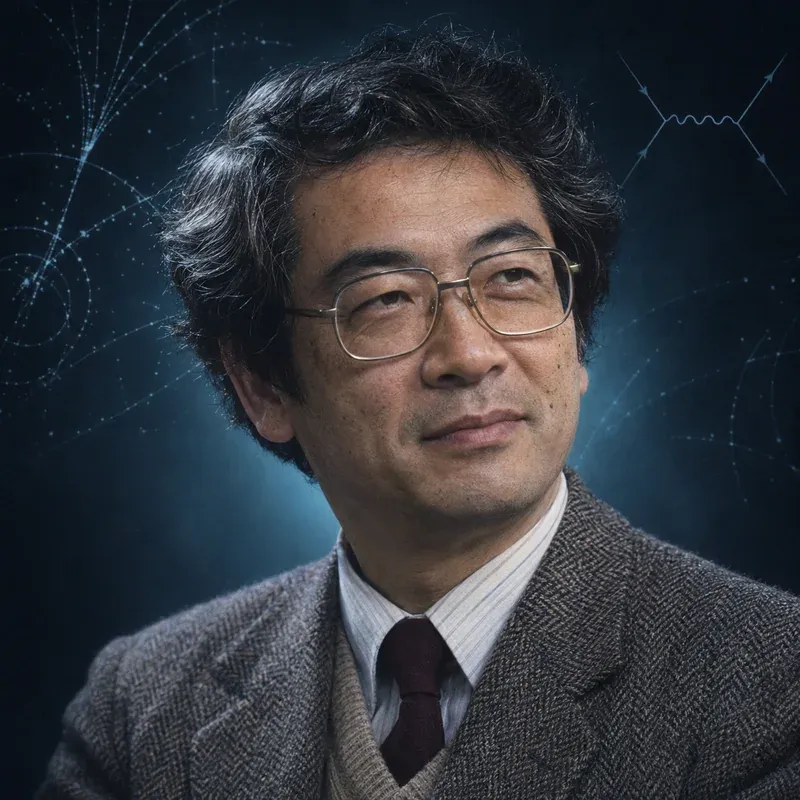
Yoji Totsuka
Totsuka took over leadership of the Super-Kamiokande project in 1988 after Koshiba's retirement and saw it into operation on 1 April 1996. Under his leadership the collaboration reported definitive evidence for atmospheric neutrino oscillations in 1998, and with SNO, evidence for solar neutrino oscillation in 2001.
- Born
- 6 March 1942
Fuji, Shizuoka, Japan - Died
- 10 July 2008
- Nationality
- Japanese
- Field
- Experimental particle physics
- Institutions
- University of Tokyo, Institute for Cosmic Ray Research (ICRR), Kamioka Observatory, KEK
Early life and education
Yoji Totsuka was born in 1942 in Fuji, Shizuoka Prefecture, Japan. He studied at the University of Tokyo, where he received his bachelor's degree in 1965, his master's in 1967 and his doctorate in 1972, all under Masatoshi Koshiba. He then spent almost a decade in Hamburg working on the DASP and JADE experiments at DESY, which studied electron–positron collisions. This period gave him experience of large detectors and international collaborations that later shaped his leadership in Japan.
Path to neutrino physics
In 1981 Totsuka returned to Japan to work at the Kamioka Observatory and, with Koshiba, helped establish Kamiokande, the Kamioka Nucleon Decay Experiment. The detector was a tank of 3,000 tonnes of ultrapure water viewed by large photomultiplier tubes, placed about one kilometre underground in a zinc mine. Built to search for proton decay, it was upgraded to detect low-energy solar neutrinos. In February 1987 it recorded a burst of neutrinos from the supernova SN 1987A in the Large Magellanic Cloud, one of the founding events of neutrino astronomy. Totsuka became a full professor at the University of Tokyo in 1987.
Key contributions
When Koshiba retired in 1988, Totsuka succeeded him as organiser and spokesperson of the planned successor, Super-Kamiokande. The project was approved in 1991. Its design was a cylindrical stainless-steel tank about 40 metres high and 40 metres across, holding 50,000 tonnes of water and lined with about 11,000 photomultipliers of 50 centimetres diameter. Totsuka oversaw its construction in the Kamioka mine and its start of operation on 1 April 1996. From 1995 to 2002 he was also director of the Kamioka Observatory.
Super-Kamiokande soon delivered results that changed particle physics. In 1998 the collaboration reported that atmospheric muon neutrinos coming up through the Earth were depleted relative to those coming from above, the first compelling evidence for neutrino oscillation and for non-zero neutrino mass. The analysis was led by Takaaki Kajita, but as spokesperson Totsuka carried responsibility for the experiment and for presenting its conclusions to the community. In 2001 Super-Kamiokande's precise measurement of the boron-8 solar neutrino flux, combined with the first results of SNO, showed that solar neutrinos also change flavour.
On 12 November 2001 the detector suffered a serious accident: while the tank was being refilled after maintenance, one photomultiplier imploded, and the resulting shock wave destroyed more than half of the tubes in a chain reaction. Totsuka led the reconstruction. The remaining tubes were redistributed and fitted with protective acrylic and fibreglass covers, and the detector resumed operation with about half its photocathode coverage in late 2002. Full coverage was restored in 2006. The episode is described in more detail under the PMT accident.
Later work
In 2002 Totsuka moved to the High Energy Accelerator Research Organization (KEK) in Tsukuba and served as its Director-General from 2003 to 2006. KEK then ran the K2K experiment, the first long-baseline accelerator experiment, which sent a muon-neutrino beam 250 kilometres to Super-Kamiokande and confirmed the atmospheric oscillation result with a controlled source. KEK also operated the Belle B-factory, which helped confirm the Kobayashi–Maskawa mechanism of CP violation. From 2006 he directed the Research Center for Science Systems of the Japan Society for the Promotion of Science.
Totsuka was diagnosed with colorectal cancer in 2000 and continued working through treatment. He retired from KEK in 2006 and died in July 2008, aged 66.
Recognition and legacy
His honours include the Asahi Prize, the Nishina Memorial Prize, the Bruno Rossi Prize (1989), the Panofsky Prize (2002), the Order of Culture (2004) and the Benjamin Franklin Medal in Physics (2007). He died seven years before Kajita and Arthur B. McDonald received the 2015 prize for the discovery of neutrino oscillations. The Yoji Totsuka Award, established in his memory, is awarded by the Japanese physics community for outstanding research. Super-Kamiokande, the detector he built, has been running for three decades and is the basis for its successor Hyper-Kamiokande.
Known for
- Leader of Super-Kamiokande
- 1998 discovery of atmospheric neutrino oscillations
- Director-General of KEK 2003–2006
Chronology
- 1988Takes over Super-Kamiokande project
- 1995Director of Kamioka Observatory (to 2002)
- 1996Super-K starts operation
- 1998Evidence for atmospheric neutrino oscillation
- 2003Director-General of KEK
Original papers
- Y. Fukuda et al. (Super-Kamiokande), Evidence for oscillation of atmospheric neutrinos, Phys. Rev. Lett. 81, 1562 (1998)DOI 10.1103/PhysRevLett.81.1562
Experiments
Connected people
Frequently asked questions
What was Yoji Totsuka's role in Super-Kamiokande?
He led the project from 1988, after Koshiba's retirement, through construction and the start of operation in 1996, and was spokesperson when the collaboration reported atmospheric neutrino oscillation in 1998.
What happened to Super-Kamiokande in 2001?
A chain reaction of photomultiplier implosions destroyed more than half of the tubes. Totsuka led the rebuilding, and the detector resumed operation in 2002. See Super-Kamiokande PMT accident.
Did Yoji Totsuka receive a Nobel Prize?
No. He died in 2008; the Nobel Prize for neutrino oscillations was awarded in 2015 to Takaaki Kajita and Arthur B. McDonald.
On the timeline
- 1989Kamiokande sees solar neutrinos in real time
- 1996Super-Kamiokande begins operation
- 1998Super-Kamiokande discovers neutrino oscillation
Mentioned in 22 pages
Lessons 1
Milestones 6
People 11
Last updated: · Editorial standard
Cite this page
Text
Neutrino Atlas (2026). “Yoji Totsuka”. Retrieved 22 November 2026, from https://neutrino-atlas.com/people/yoji-totsuka/BibTeX
@misc{neutrinoatlas2026peopleyojitotsuka,
  title        = {Yoji Totsuka},
  author       = {{Neutrino Atlas}},
  year         = {2026},
  url          = {https://neutrino-atlas.com/people/yoji-totsuka/},
  note         = {Accessed 2026-11-22},
  language     = {english}
}