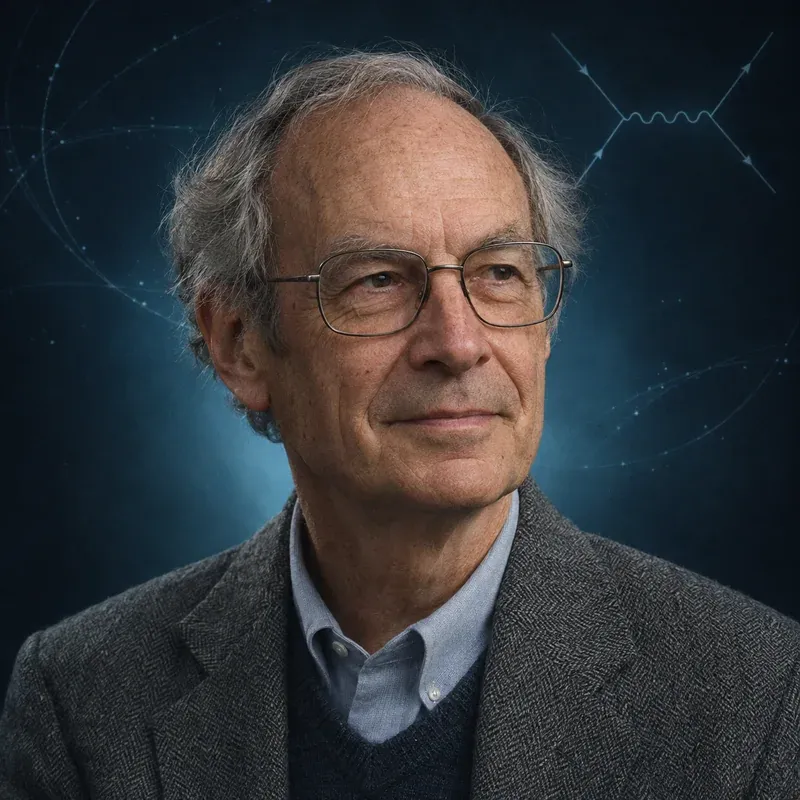
 Illustration
Eugene W. Beier
Beier spent more than four decades measuring neutrino interactions and properties. At Brookhaven, experiment E734 measured elastic neutrino scattering on electrons and protons, a test of the electroweak theory. From 1984 he led University of Pennsylvania physicists in Kamiokande-II, which recorded neutrinos from SN1987A, made the first real-time directional measurement of solar neutrinos and found an anomalous ratio of atmospheric muon to electron neutrinos. In SNO, where he was US co-spokesperson with Hamish Robertson, he contributed to the 2001–02 demonstration that solar electron neutrinos change flavour.
- Born
- 30 January 1940
Harvey, Illinois, USA - Nationality
- American
- Field
- Experimental particle and neutrino physics
- Institutions
- Stanford University, University of Illinois at Urbana-Champaign, University of Pennsylvania
Education and early work
Eugene W. Beier studied at Stanford University (BS 1961) and the University of Illinois at Urbana-Champaign, where he received his PhD in 1966. He joined the University of Pennsylvania in 1967 and became full professor in 1979. Alongside physics, his work has included the development of electronics and detectors for large experiments.
Neutrino scattering at Brookhaven
From the late 1970s Beier worked on experiment E734 at Brookhaven's Alternating Gradient Synchrotron. It measured elastic scattering of muon neutrinos on electrons and on protons, processes governed by the neutral current, and so tested the electroweak theory and the value of the weak mixing angle.
Kamiokande-II
In 1984 Beier and colleagues at Penn, among them Alfred Mann, joined the Japanese Kamiokande experiment led by Masatoshi Koshiba, which was being upgraded from a proton-decay search into a low-energy neutrino detector. The upgraded Kamiokande-II recorded 11 neutrino events from SN1987A in February 1987, measured solar boron-8 neutrinos in real time and showed that they come from the direction of the Sun, and found that atmospheric neutrinos contained fewer muon neutrinos relative to electron neutrinos than expected. The team received the Bruno Rossi Prize in 1989.
SNO and beyond
From 1987 Beier was part of the Sudbury Neutrino Observatory, serving with Hamish Robertson as co-spokesperson for the US groups. SNO's heavy water allowed charged-current and neutral-current reactions of solar neutrinos to be compared, and in 2001–02 showed that the missing electron neutrinos had changed into other flavours. Beier then turned to neutrinoless double beta decay with SNO+, which reuses the SNO detector filled with liquid scintillator loaded with a double-beta isotope. He received the American Physical Society's W. K. H. Panofsky Prize in Experimental Particle Physics in 2010 for his contributions to the study of neutrino interactions.
Known for
- Brookhaven experiment E734 on neutrino elastic scattering
- US group in Kamiokande-II (SN1987A, solar and atmospheric neutrinos)
- US co-spokesperson of the Sudbury Neutrino Observatory
- Work towards SNO+ double beta decay
Chronology
- 1966PhD at the University of Illinois
- 1967Joins the University of Pennsylvania
- 1984Joins Kamiokande-II
- 1987Kamiokande-II detects SN1987A neutrinos; joins SNO
- 1989Bruno Rossi Prize to the Kamiokande-II team
- 2010W. K. H. Panofsky Prize
Original papers
- K. Hirata et al. (Kamiokande-II), Observation of a neutrino burst from the supernova SN1987A, Phys. Rev. Lett. 58, 1490 (1987)DOI 10.1103/PhysRevLett.58.1490
- Q. R. Ahmad et al. (SNO), Direct evidence for neutrino flavor transformation from neutral-current interactions in the Sudbury Neutrino Observatory, Phys. Rev. Lett. 89, 011301 (2002)DOI 10.1103/PhysRevLett.89.011301
Experiments
Connected people
Frequently asked questions
Which experiments did Eugene Beier work on?
Mainly Brookhaven E734, Kamiokande-II, the Sudbury Neutrino Observatory and SNO+.
What prize did Beier receive in 2010?
The W. K. H. Panofsky Prize in Experimental Particle Physics of the American Physical Society.
Last updated: · Editorial standard
Cite this page
Text
Neutrino Atlas (2026). “Eugene W. Beier”. Retrieved 22 November 2026, from https://neutrino-atlas.com/people/eugene-beier/BibTeX
@misc{neutrinoatlas2026peopleeugenebeier,
  title        = {Eugene W. Beier},
  author       = {{Neutrino Atlas}},
  year         = {2026},
  url          = {https://neutrino-atlas.com/people/eugene-beier/},
  note         = {Accessed 2026-11-22},
  language     = {english}
}