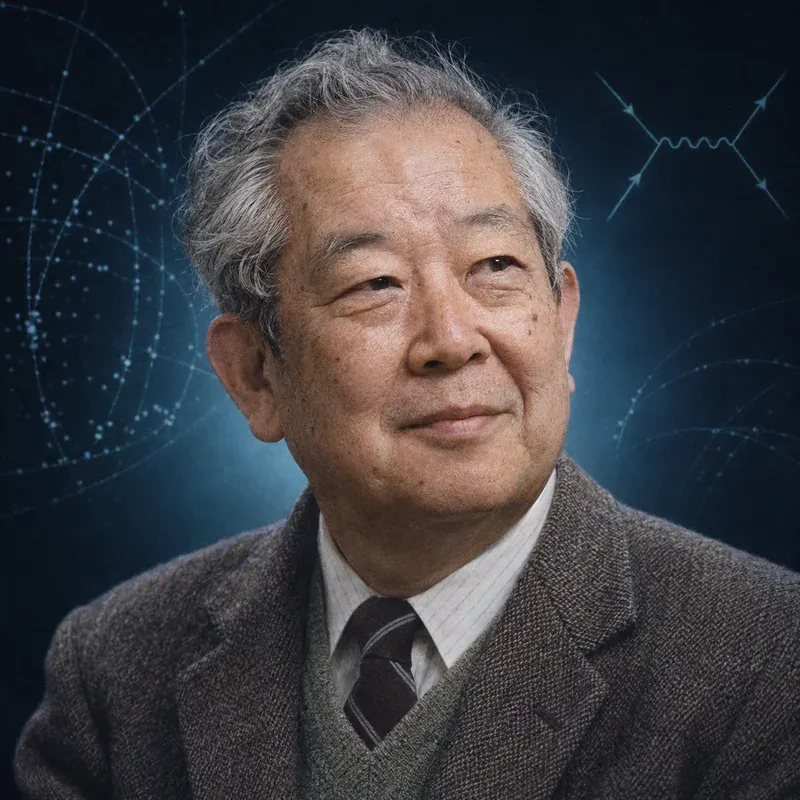
 Illustration
Masatoshi Koshiba
Koshiba led the Kamiokande water Cherenkov detector, built to search for proton decay and converted to detect neutrinos. In February 1987 Kamiokande detected the neutrino burst from SN 1987A, and it confirmed in real time that the Sun emits neutrinos, but fewer than predicted. He initiated Super-Kamiokande, whose oscillation results resolved these puzzles.
- Born
- 19 September 1926
Toyohashi, Aichi, Japan - Died
- 12 November 2020
Tokyo, Japan - Nationality
- Japanese
- Field
- Experimental particle and astroparticle physics
- Nobel Prize
- Physics 2002 – for pioneering contributions to astrophysics, in particular for the detection of cosmic neutrinos (shared with Davis; Giacconi for X-ray astronomy)
- Institutions
- University of Tokyo, University of Chicago, Tokai University, ICEPP
Early life and education
Masatoshi Koshiba was born in 1926 in Toyohashi, Aichi prefecture, and grew up in Yokosuka. His path into physics was unusual: he first wanted to study German literature and turned to physics partly out of defiance after a teacher’s dismissive remark. His grades at the First Higher School in Tokyo were poor, and he managed to enter the University of Tokyo with the help of a roommate who tutored him in physics. He graduated in 1951 and went to the United States on a Fulbright scholarship, receiving his PhD from the University of Rochester in 1955 with a thesis on high-energy cascades in cosmic radiation.
Path to neutrino physics
After working as a research associate at the University of Chicago from 1955 to 1958, Koshiba returned to Tokyo, first at the Institute for Nuclear Study and from 1963 at the University of Tokyo itself, where he became a full professor in 1970. Through the 1960s and 1970s he worked on cosmic rays and then on electron–positron collisions, including the JADE experiment at DESY in Hamburg. This experience with large international detectors shaped his next project.
In the late 1970s grand unified theories predicted that the proton might decay, with a lifetime long but perhaps measurable. Koshiba and his colleagues designed Kamiokande, the Kamioka Nucleon Decay Experiment: a tank holding about 3,000 tonnes of ultra-pure water deep in a zinc mine in the Kamioka area of Gifu prefecture. A charged particle moving faster than light does in water emits a faint cone of Cherenkov light, which was recorded by about a thousand photomultipliers. For this Koshiba pushed the company Hamamatsu Photonics to develop a photomultiplier with a 50-centimetre (20-inch) photocathode, far larger than anything available before. The detector started in 1983.
Key contributions
No proton decay was seen. Koshiba’s group, with Yoji Totsuka and others, therefore upgraded the detector to Kamiokande-II, with better shielding and electronics, and a collaboration with the University of Pennsylvania around Alfred Mann joined. The goal was to lower the energy threshold enough to see solar neutrinos through the light of electrons they scatter. Koshiba was due to retire from the University of Tokyo in the spring of 1987; the detector’s greatest moment came only weeks before.
On 23 February 1987 Kamiokande-II recorded a burst of about a dozen neutrino events within roughly 13 seconds. They had come from SN 1987A, a supernova in the Large Magellanic Cloud about 160,000 light-years away, whose light reached Earth a few hours later. The IMB detector in the United States saw eight events at the same moment. It was the first time neutrinos had been detected from a source outside the Solar System, and the observed energies and numbers confirmed that a collapsing star releases almost all its energy as neutrinos. See SN 1987A detection for the details.
In 1989 Kamiokande-II measured boron-8 solar neutrinos in real time. Unlike the radiochemical Homestake experiment of Raymond Davis Jr., it could record the arrival time and direction of each event, and the events pointed back to the Sun. The flux was only about half of what the standard solar model predicted, confirming the solar neutrino problem with a completely different technique. Kamiokande also found that the ratio of muon to electron atmospheric neutrinos was lower than expected, an early sign of oscillations.
Later work and legacy
Koshiba was a driving force behind Super-Kamiokande, a 50,000-tonne successor, which began operating in 1996. In 1998 it presented convincing evidence for oscillations of atmospheric neutrinos, a discovery for which Takaaki Kajita, one of Koshiba’s former students, shared the 2015 Nobel Prize. After his retirement Koshiba taught at Tokai University until 1997.
In 2002 Koshiba and Davis shared one half of the Nobel Prize in Physics for pioneering contributions to astrophysics, in particular for the detection of cosmic neutrinos; the other half went to Riccardo Giacconi for X-ray astronomy. Koshiba also received the Order of Culture (1997) and the Wolf Prize in Physics (2000). He died in Tokyo on 12 November 2020, aged 94. Through Kamiokande and its successors he is regarded as one of the founders of neutrino astronomy.
Known for
- Kamiokande
- Detection of neutrinos from supernova SN 1987A
- Real-time solar neutrino detection
- Founder of neutrino astronomy
Chronology
- 1955PhD, University of Rochester
- 1987Kamiokande observes SN 1987A neutrinos; becomes emeritus at Tokyo
- 1989Kamiokande real-time solar ⁸B neutrino measurement
- 2002Nobel Prize in Physics
Original papers
- K. Hirata et al. (Kamiokande-II), Observation of a neutrino burst from the supernova SN1987A, Phys. Rev. Lett. 58, 1490 (1987)DOI 10.1103/PhysRevLett.58.1490
- K. S. Hirata et al. (Kamiokande-II), Observation of ⁸B solar neutrinos in the Kamiokande-II detector, Phys. Rev. Lett. 63, 16 (1989)DOI 10.1103/PhysRevLett.63.16
Experiments
Connected people
- Alfred K. Mann
- Masayuki Nakahata
- Raymond Davis Jr.
- Takaaki Kajita
- Yoji Totsuka
- Atsuto Suzuki
- Eugene W. Beier
Frequently asked questions
Why did Masatoshi Koshiba win the Nobel Prize?
He received half of the 2002 Nobel Prize in Physics, together with Raymond Davis Jr., for detecting cosmic neutrinos, in particular the neutrinos from supernova SN 1987A and from the Sun with the Kamiokande detector.
What was Kamiokande originally built for?
It was built to search for proton decay, as predicted by grand unified theories. When no decay was found, it was upgraded to detect neutrinos from the Sun, the atmosphere and supernovae.
How many neutrinos from SN 1987A did Kamiokande see?
About a dozen events within roughly 13 seconds on 23 February 1987. Together with IMB and the Baksan detector, these are the only neutrinos ever recorded from a supernova.
On the timeline
- 1983Large water Cherenkov detectors begin operation
- 1987Neutrinos from supernova SN 1987A
- 1988Kamiokande finds an atmospheric neutrino anomaly
- 1989Kamiokande sees solar neutrinos in real time
- 1996Super-Kamiokande begins operation
- 2002Nobel Prize for neutrino astrophysics
Mentioned in 43 pages
Lessons 6
FAQ 5
Comparisons 1
Milestones 12
- 1964 · Bahcall and Davis propose a solar neutrino test
- 1968 · Homestake finds too few solar neutrinos
- 1983 · Large water Cherenkov detectors begin operation
- 1987 · Neutrinos from supernova SN 1987A
- 1988 · Kamiokande finds an atmospheric neutrino anomaly
- 1989 · Kamiokande sees solar neutrinos in real time
- 1995 · Nobel Prize for neutrino detection
- 1996 · Super-Kamiokande begins operation
Last updated: · Editorial standard
Cite this page
Text
Neutrino Atlas (2026). “Masatoshi Koshiba”. Retrieved 22 November 2026, from https://neutrino-atlas.com/people/masatoshi-koshiba/BibTeX
@misc{neutrinoatlas2026peoplemasatoshikoshiba,
  title        = {Masatoshi Koshiba},
  author       = {{Neutrino Atlas}},
  year         = {2026},
  url          = {https://neutrino-atlas.com/people/masatoshi-koshiba/},
  note         = {Accessed 2026-11-22},
  language     = {english}
}