1964Experiment
Bahcall and Davis propose a solar neutrino test
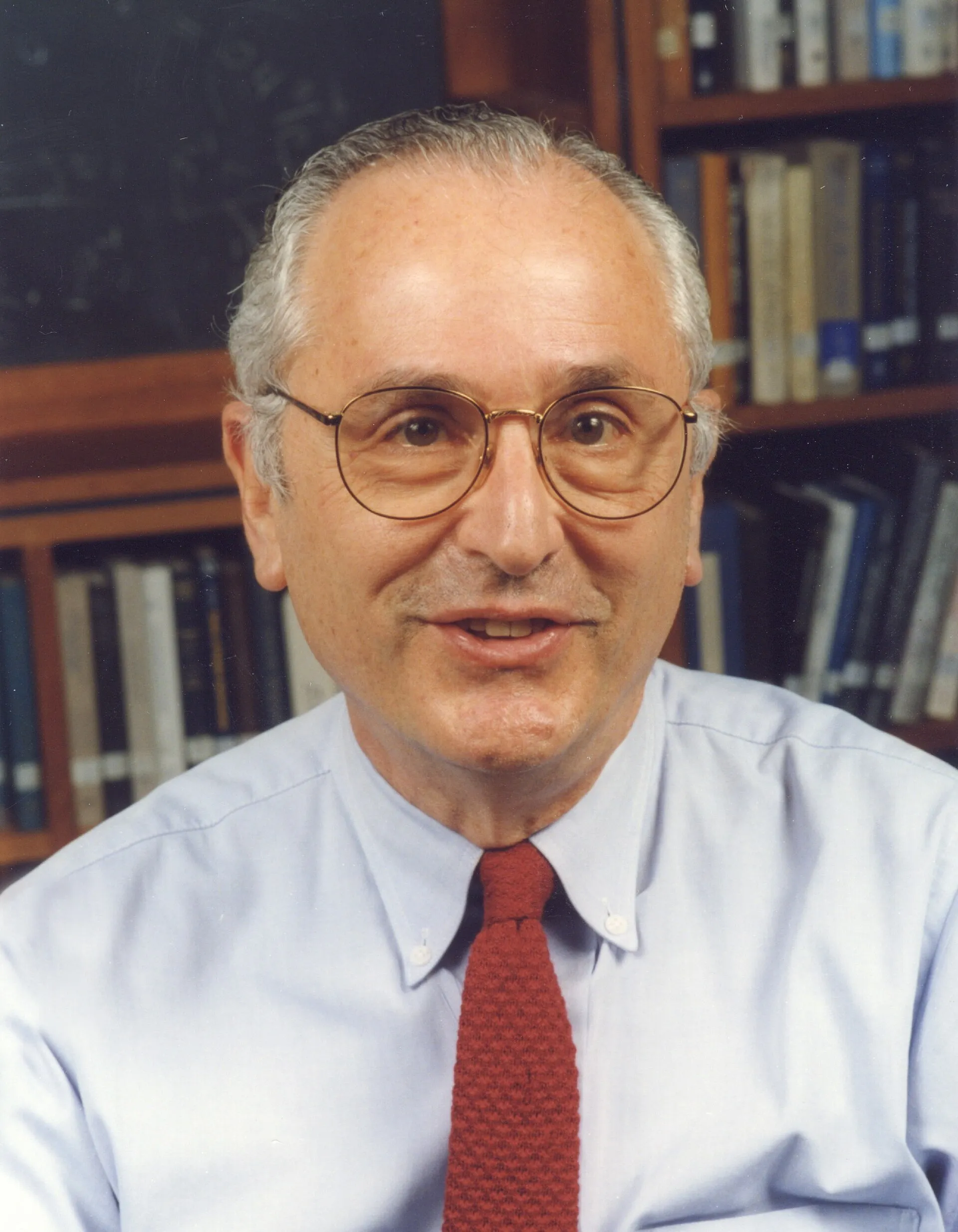
In back-to-back Physical Review Letters papers in March 1964, John Bahcall calculated the expected solar neutrino capture rate on chlorine, and Raymond Davis described a detector of about 100,000 gallons of perchloroethylene to measure it. The aim was to test directly the theory of nuclear fusion in the Sun's core. The proposal led to the construction of the Homestake detector deep in a South Dakota gold mine.
- Date
- 1964
- Kind of event
- Experiment
- People involved
- John Norris Bahcall, Raymond Davis Jr.
- Experiments
- Homestake Chlorine Experiment
The situation before
By the early 1960s astrophysicists were confident that the Sun shines by nuclear fusion, converting hydrogen into helium through the pp chain, as worked out by Hans Bethe and others. But all evidence was indirect: the light leaving the surface was emitted long after the energy was produced. Only neutrinos escape the core directly. Raymond Davis Jr. at Brookhaven had for years developed the chlorine–argon method suggested by Bruno Pontecorvo, in which a neutrino converts chlorine-37 into radioactive argon-37. A small test tank in a limestone mine had shown that the technique worked and that the solar flux had to be detected in a much larger detector.
What happened
The decisive step came from John Bahcall, a young theorist at Caltech working with William Fowler's group. In 1963–64 he calculated the capture rate of solar neutrinos on chlorine-37 and found that a transition to an excited state of argon-37 increased the capture of high-energy boron-8 neutrinos by a large factor. This made the experiment far more promising than earlier estimates suggested.
On 9 March 1964 Physical Review Letters published two consecutive papers: "Solar neutrinos. I. Theoretical" by Bahcall and "Solar neutrinos. II. Experimental" by Davis. Bahcall gave the expected rate based on the solar models of the time. Davis described a detector of about 100,000 gallons (some 380,000 litres) of the cleaning fluid perchloroethylene, deep underground to shield it from cosmic rays. Every few months the few atoms of argon-37 produced would be flushed out with helium and counted by their radioactive decay.
The proposal is an example of radiochemical capture: the detector does not record individual events in real time, but counts the accumulated product atoms.
Reaction
The papers gave the case that persuaded Brookhaven and the US Atomic Energy Commission to fund the experiment. Construction began in 1965 in a cavern 1,478 m below ground in the Homestake gold mine in Lead, South Dakota, and the tank was filled in 1966. Bahcall and Davis worked closely together for the next three decades, Bahcall refining the predictions and Davis the measurement.
Why it matters
The 1964 proposal turned the Sun into a laboratory for neutrino physics. Davis's first results in 1968 showed a deficit compared with Bahcall's prediction, which became the solar neutrino problem. Its resolution through flavour conversion took until the SNO results of 2001–2002. Davis shared the 2002 Nobel Prize in Physics with Masatoshi Koshiba for pioneering contributions to astrophysics, in particular the detection of cosmic neutrinos.
Frequently asked questions
What did Bahcall and Davis propose in 1964?
To test the theory of solar fusion by detecting neutrinos from the Sun's core with a large tank of perchloroethylene, which converts chlorine-37 into argon-37.
Where were the proposals published?
In two back-to-back papers in Physical Review Letters on 9 March 1964.
What came of it?
The Homestake chlorine experiment, built in 1965–66, which found fewer solar neutrinos than predicted and so started the solar neutrino problem.
Original papers
- ProposalJ. N. Bahcall, Solar Neutrinos. I. Theoretical, Phys. Rev. Lett. 12, 300 (1964)DOI 10.1103/PhysRevLett.12.300
- ProposalR. Davis, Solar Neutrinos. II. Experimental, Phys. Rev. Lett. 12, 303 (1964)DOI 10.1103/PhysRevLett.12.303
Concepts
Mentioned in 1 page
Lessons 1
Last updated: · Editorial standard
Cite this page
Text
Neutrino Atlas (2026). “1964: Bahcall and Davis propose a solar neutrino test”. Retrieved 22 November 2026, from https://neutrino-atlas.com/timeline/1964-bahcall-davis-proposal/BibTeX
@misc{neutrinoatlas20261964bahcalldavisproposal,
  title        = {1964: Bahcall and Davis propose a solar neutrino test},
  author       = {{Neutrino Atlas}},
  year         = {2026},
  url          = {https://neutrino-atlas.com/timeline/1964-bahcall-davis-proposal/},
  note         = {Accessed 2026-11-22},
  language     = {english}
}