1968Discovery
Homestake finds too few solar neutrinos
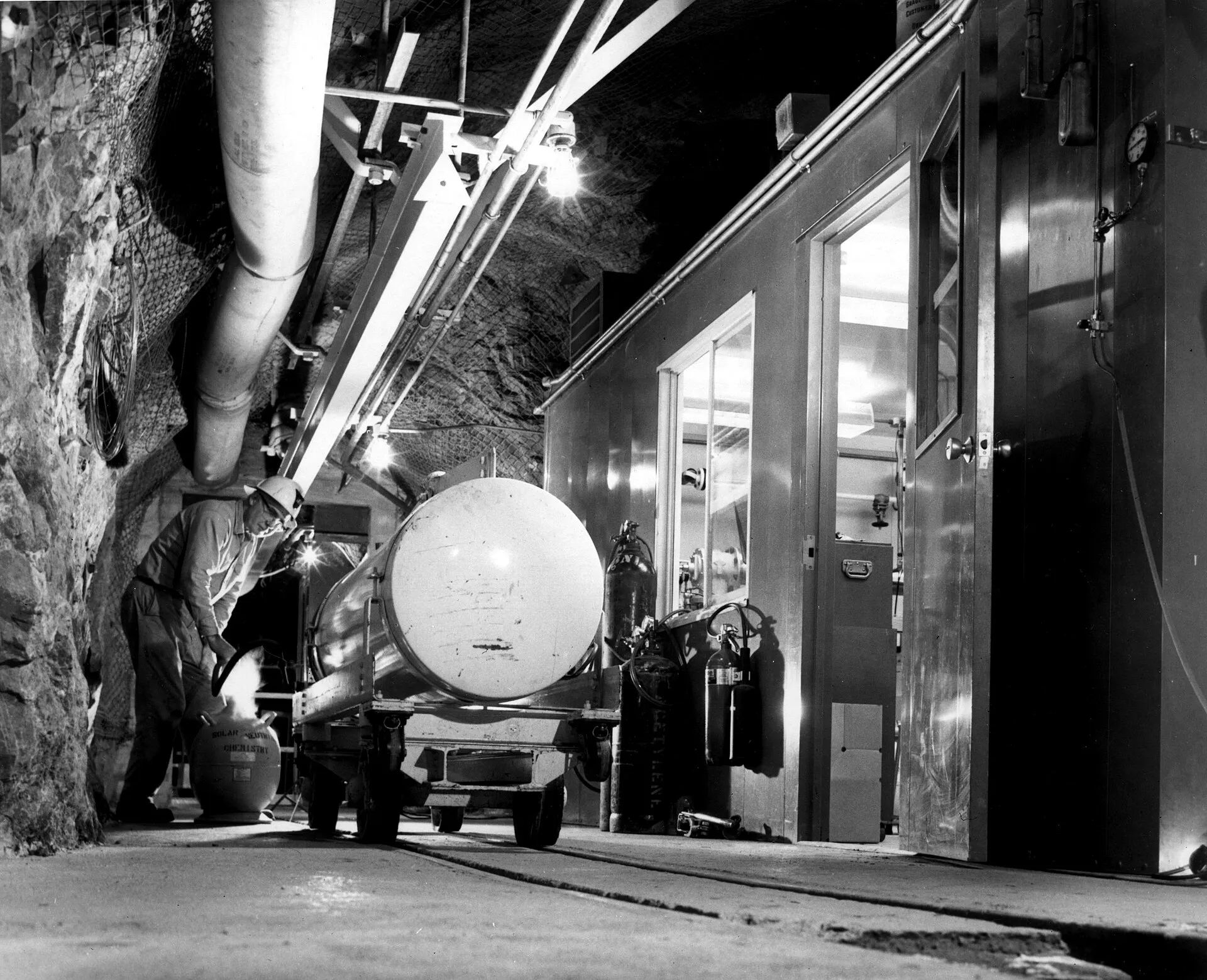
Raymond Davis, Don Harmer and Kenneth Hoffman reported the first results of the chlorine detector 1,478 m underground in the Homestake mine. The argon production rate was well below John Bahcall's solar-model prediction, published alongside. Over three decades the experiment consistently saw only about a third of the expected flux. This discrepancy became known as the solar neutrino problem.
- Date
- 20 May 1968
- Kind of event
- Discovery
- People involved
- Raymond Davis Jr., John Norris Bahcall
The situation before
Following the proposals of John Bahcall and Raymond Davis Jr. in 1964, Brookhaven built a tank holding about 615 tons of perchloroethylene, a dry-cleaning fluid rich in chlorine, in a cavern excavated 1,478 m underground in the Homestake gold mine in Lead, South Dakota. The site is now the Sanford Underground Research Facility. Solar neutrinos above 0.814 MeV can convert chlorine-37 into argon-37, which decays with a half-life of 35 days. Every few weeks to months, Davis and his team bubbled helium through the tank to sweep out the few argon atoms produced and counted their decays in small proportional counters. The expected yield was about one argon atom per day in a tank containing some 10³⁰ chlorine atoms, an extraction task of extraordinary precision.
The theoretical prediction had meanwhile dropped. Improved nuclear cross-sections and solar models lowered Bahcall's expected rate during 1964–1968, which made the experiment harder but also made a clear test possible.
What happened
On 20 May 1968 Physical Review Letters published the first result: "Search for neutrinos from the Sun" by Davis, Don S. Harmer and Kenneth C. Hoffman. The argon produced was barely above background. The authors gave an upper limit of 3 SNU (solar neutrino units; 1 SNU is one capture per second per 10³⁶ target atoms). In the same issue John Bahcall, Neta Bahcall and Giora Shaviv presented the solar-model prediction for the chlorine detector: 7.5 ± 3 SNU. The measured rate was well below the expected one.
The experiment then ran almost continuously until 1994, using an improved counting system from 1970. The final analysis, published by Bruce Cleveland, Davis, Kenneth Lande and colleagues in The Astrophysical Journal in 1998, gave an average rate of 2.56 ± 0.16 (statistical) ± 0.16 (systematic) SNU, about one third of the standard solar-model prediction of the time.
Reaction
Many physicists first suspected the experiment. Could argon be trapped in the tank, or could the extraction efficiency be lower than thought? Davis tested this repeatedly, including by introducing known amounts of argon and by irradiating the tank with a neutron source to produce argon-37 inside it. Others suspected the standard solar model: a slightly cooler solar core would sharply reduce the flux of boron-8 neutrinos, which dominate the chlorine signal. Some proposed changes in particle physics instead. Bahcall consistently defended both the measurement and the model, and helioseismology in the 1990s strongly supported the model's description of the solar interior.
For two decades Homestake was the only solar neutrino experiment. In 1989 Kamiokande-II measured the boron-8 flux in real time and also found a deficit, about half of the prediction. In the 1990s the gallium experiments SAGE and GALLEX observed the low-energy pp neutrinos and found a deficit there too. The pattern of deficits that differed between experiments could not be explained by any reasonable change in the solar model.
Why it matters
The 1968 result opened the solar neutrino problem, one of the longest-running puzzles in physics. Already in 1969 Vladimir Gribov and Bruno Pontecorvo proposed that neutrino oscillations could explain it; in 1978 and 1985 Lincoln Wolfenstein, Stanislav Mikheyev and Alexei Smirnov showed that matter in the Sun enhances the conversion. In 2001–2002 SNO, using heavy water, measured the total flux of all neutrino flavours and found it equal to the solar-model prediction, while the electron-neutrino component was only about one third. The Sun was right, and so was Davis: electron neutrinos change flavour on their way to Earth.
Davis shared the 2002 Nobel Prize in Physics with Masatoshi Koshiba "for pioneering contributions to astrophysics, in particular for the detection of cosmic neutrinos". The chlorine experiment also established the techniques of radiochemical detection deep underground on which later solar neutrino experiments built.
Frequently asked questions
When did Homestake report its first result?
On 20 May 1968, in Physical Review Letters, together with Bahcall's solar-model prediction in the same issue.
How many solar neutrinos did Homestake find?
About one third of the predicted rate: 2.56 SNU on average over 1970–1994, compared with a prediction of about 7–8 SNU.
What explained the deficit?
Neutrino flavour conversion. SNO showed in 2001–2002 that the total solar neutrino flux agrees with the solar model, but about two thirds arrive as muon or tau neutrinos, which the chlorine detector cannot see.
Original papers
- First resultR. Davis, D. S. Harmer and K. C. Hoffman, Search for Neutrinos from the Sun, Phys. Rev. Lett. 20, 1205 (1968)DOI 10.1103/PhysRevLett.20.1205
- Final resultB. T. Cleveland et al., Measurement of the Solar Electron Neutrino Flux with the Homestake Chlorine Detector, Astrophys. J. 496, 505 (1998)DOI 10.1086/305343
Concepts
Mentioned in 3 pages
Last updated: · Editorial standard
Cite this page
Text
Neutrino Atlas (2026). “1968: Homestake finds too few solar neutrinos”. Retrieved 22 November 2026, from https://neutrino-atlas.com/timeline/1968-homestake-first-result/BibTeX
@misc{neutrinoatlas20261968homestakefirstresult,
  title        = {1968: Homestake finds too few solar neutrinos},
  author       = {{Neutrino Atlas}},
  year         = {2026},
  url          = {https://neutrino-atlas.com/timeline/1968-homestake-first-result/},
  note         = {Accessed 2026-11-22},
  language     = {english}
}