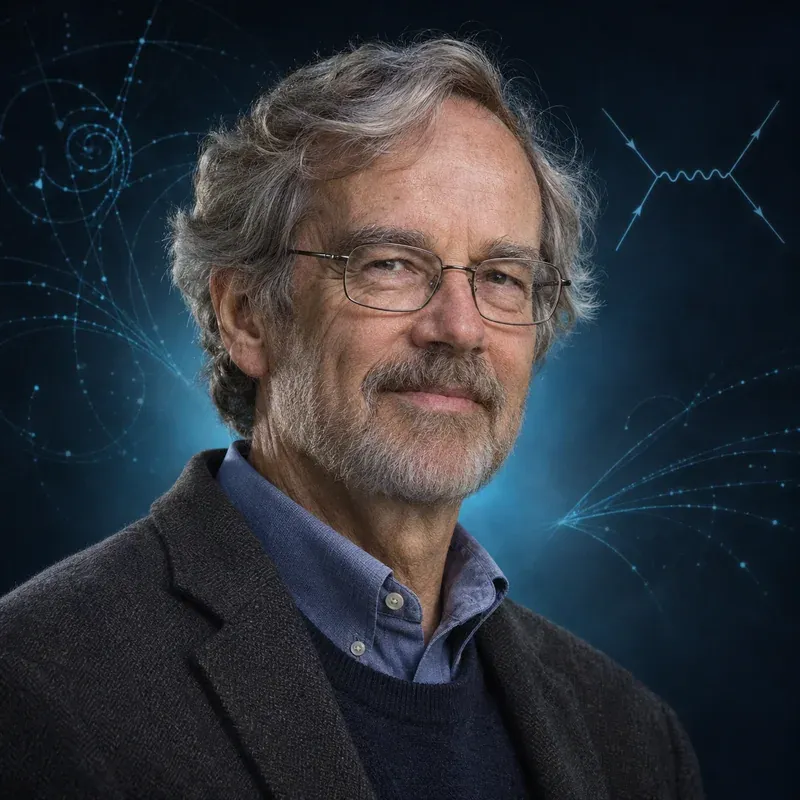
 Illustration
Bruce T. Cleveland
Cleveland worked with Ray Davis on the Homestake chlorine experiment and was first author of its definitive 1998 result. He was part of Davis's Brookhaven gallium development effort from the 1970s, later worked on the Russian–American SAGE experiment, and then on the Sudbury Neutrino Observatory, where he contributed to the heavy-water purification and low-radioactivity programme.
- Field
- Experimental neutrino physics, low-background techniques
- Institutions
- Brookhaven National Laboratory, University of Washington, SNOLAB / Laurentian University
Path to neutrino physics
Bruce T. Cleveland spent his career on the least glamorous and most decisive part of solar neutrino experiments: counting a handful of radioactive atoms against a background of everything else. He began at Brookhaven National Laboratory in the group of Raymond Davis Jr., whose Homestake chlorine detector had been running since the late 1960s. In such a radiochemical experiment solar neutrinos convert chlorine-37 into argon-37; every few weeks the few argon atoms produced are extracted from 615 tonnes of cleaning fluid and their decays are counted in tiny proportional counters.
Key contributions
Cleveland developed the statistical treatment of these very low counting rates, a maximum-likelihood method that separates argon-37 decays from counter background, and he was first author of the definitive analysis of the full Homestake data set, published in 1998. It combined more than a hundred extraction runs and gave a capture rate of about one third of the standard solar model prediction, the measurement that had defined the solar neutrino problem for three decades.
In the 1970s Cleveland was part of Davis's Brookhaven effort on a gallium detector, which can see the low-energy pp neutrinos; a 1978 proposal on which he was a co-author was not funded in the United States. The idea was realised by SAGE in Russia, which he later joined from the University of Washington, spending long periods at the Baksan laboratory and helping to develop its ultra-low-background techniques.
Sudbury and SNOLAB
Cleveland then brought this expertise to SNO. He was part of the water group that designed the heavy-water and light-water systems and the methods for removing uranium, thorium, radium, radon and lead, served as the collaboration's database expert and built SNO's first germanium counting system. At SNOLAB he was central to the low-background counting facility, which assays materials for many experiments. In 2004 he co-organised the first Low Radioactivity Techniques workshop at Laurentian University. Colleagues regard him as one of the founders of astroparticle physics in Canada.
Known for
- Homestake data analysis (lead author of the 1998 final paper)
- SAGE collaborator
- SNO water and low-background systems
- Founder of astroparticle physics in Canada
Chronology
- 1978Senior Research Associate at BNL; co-author of gallium proposal
- 1998Final Homestake result (Cleveland et al.)
- 2004Co-organises first Low Radioactivity Techniques workshop
Original papers
- B. T. Cleveland et al., Measurement of the Solar Electron Neutrino Flux with the Homestake Chlorine Detector, Astrophys. J. 496, 505 (1998)DOI 10.1086/305343
Experiments
- Homestake Chlorine Experiment
- SAGE (Soviet–American Gallium Experiment)
- SNO (Sudbury Neutrino Observatory)
Connected people
Frequently asked questions
What was Bruce Cleveland's role in the Homestake experiment?
He worked with Ray Davis on the analysis of the argon counting data and was lead author of the final 1998 Homestake result.
Why does background control matter so much in solar neutrino detectors?
The signals are extremely rare, from a few atoms per month in radiochemical detectors to a few events per day in real-time detectors, so even trace radioactivity in materials can swamp them.
On the timeline
Mentioned in 6 pages
Last updated: · Editorial standard
Cite this page
Text
Neutrino Atlas (2026). “Bruce T. Cleveland”. Retrieved 22 November 2026, from https://neutrino-atlas.com/people/bruce-cleveland/BibTeX
@misc{neutrinoatlas2026peoplebrucecleveland,
  title        = {Bruce T. Cleveland},
  author       = {{Neutrino Atlas}},
  year         = {2026},
  url          = {https://neutrino-atlas.com/people/bruce-cleveland/},
  note         = {Accessed 2026-11-22},
  language     = {english}
}