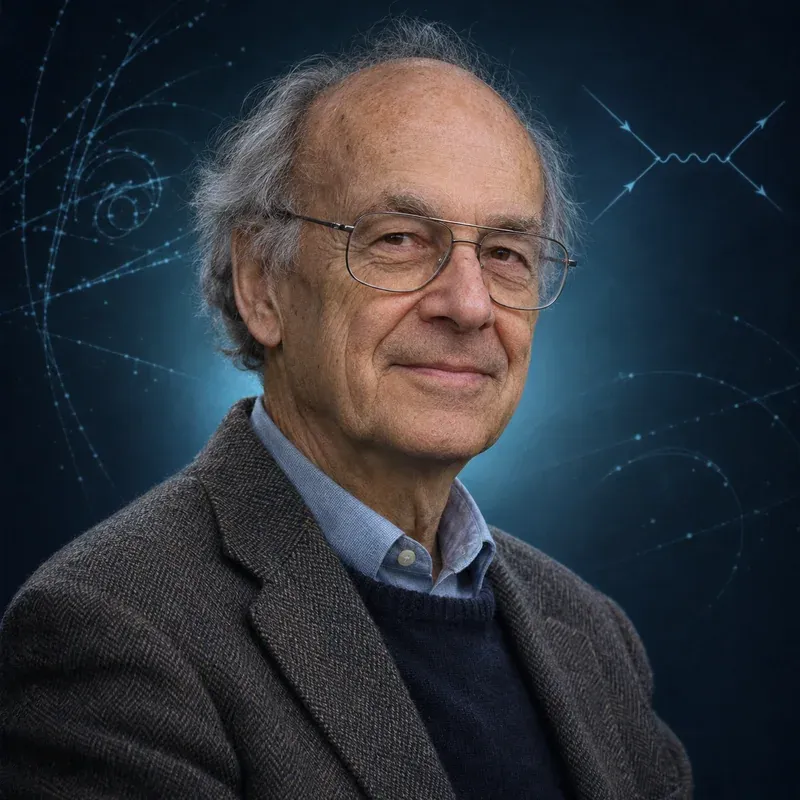
 Illustration
Kenneth Lande
A Penn physics professor from 1959, Lande worked with Raymond Davis on the solar neutrino programme using the 610-ton chlorine detector at the Homestake gold mine. He also took part in the gallium proposals of the late 1970s and in the SAGE gallium experiment at Baksan.
- Nationality
- American
- Field
- Neutrino astrophysics
- Institutions
- University of Pennsylvania, Columbia University (PhD 1958)
Education and early work
Kenneth Lande is an American experimental physicist and professor of physics at the University of Pennsylvania, where he has taught since 1959. He received his PhD from Columbia University in 1958. As a graduate student he was first author of the 1956 paper by Lande, Booth, Impeduglia, Lederman and Chinowsky reporting the observation of long-lived neutral V particles – the discovery of the long-lived neutral kaon, K⁰_L,. Leon Lederman listed it among the key results of his career in his Nobel lecture.
Joining the Homestake experiment
At Penn, Lande's research turned to astrophysics, with two experimental programmes: very high-energy cosmic rays and solar neutrinos. Soon after Raymond Davis announced his first results from the Homestake mine in 1968, Lande became involved in the project. The detector held about 615 tonnes of perchloroethylene, a cleaning fluid rich in chlorine. Solar neutrinos converted roughly one chlorine-37 atom into argon-37 every two days, so the team had to extract and count about fifteen argon atoms a month (see chlorine–argon detectors and radiochemical capture).
When Davis had to retire from Brookhaven in 1984, Lande suggested he continue the work at Penn, and Davis joined the Penn faculty in 1985. Lande served as director of the Homestake experiment for more than a decade. The final analysis, published in 1998 by Bruce Cleveland, Davis, Lande and colleagues, gave a measured rate of about one third of the standard solar model prediction – the core of the solar neutrino problem, later explained by neutrino oscillations.
Gallium detectors and an underground laboratory
Chlorine is blind to the low-energy pp neutrinos that make up most of the solar flux. Davis and Lande developed gallium-based detection techniques that could see them, and Lande was a co-author of the 1978 Brookhaven–Heidelberg gallium proposal, which was not funded. They were later invited to join Soviet physicists using one of the techniques, and Lande took part in the 60-tonne gallium detector at the Baksan observatory that became SAGE (see gallium–germanium detectors).
When mining at Homestake was to end in 2001, Lande was among the physicists who worked to convert the mine into a national underground science laboratory. That effort eventually led to the Sanford Underground Research Facility, which now hosts the far detector of DUNE at the same 4850-foot level where Davis's tank once stood.
Known for
- Penn group in the Homestake solar neutrino programme
- SAGE collaborator
- Gallium detector at Baksan
Chronology
- 1958PhD, Columbia University
- 1959Joins University of Pennsylvania faculty
- 1978Co-author of BNL–MPIK gallium proposal
Original papers
- B. T. Cleveland et al., Measurement of the Solar Electron Neutrino Flux with the Homestake Chlorine Detector, Astrophys. J. 496, 505 (1998)DOI 10.1086/305343
Experiments
Connected people
Frequently asked questions
What is Kenneth Lande known for in neutrino physics?
For his long work with Raymond Davis on the Homestake chlorine experiment, which he directed for more than a decade, and for helping start gallium solar-neutrino detection.
What did Lande discover before neutrinos?
As a Columbia graduate student he was first author of the 1956 observation of the long-lived neutral kaon.
Mentioned in 6 pages
Last updated: · Editorial standard
Cite this page
Text
Neutrino Atlas (2026). “Kenneth Lande”. Retrieved 22 November 2026, from https://neutrino-atlas.com/people/kenneth-lande/BibTeX
@misc{neutrinoatlas2026peoplekennethlande,
  title        = {Kenneth Lande},
  author       = {{Neutrino Atlas}},
  year         = {2026},
  url          = {https://neutrino-atlas.com/people/kenneth-lande/},
  note         = {Accessed 2026-11-22},
  language     = {english}
}