IMB (Irvine–Michigan–Brookhaven)
A large US water Cherenkov proton-decay detector that recorded 8 neutrinos from SN1987A.
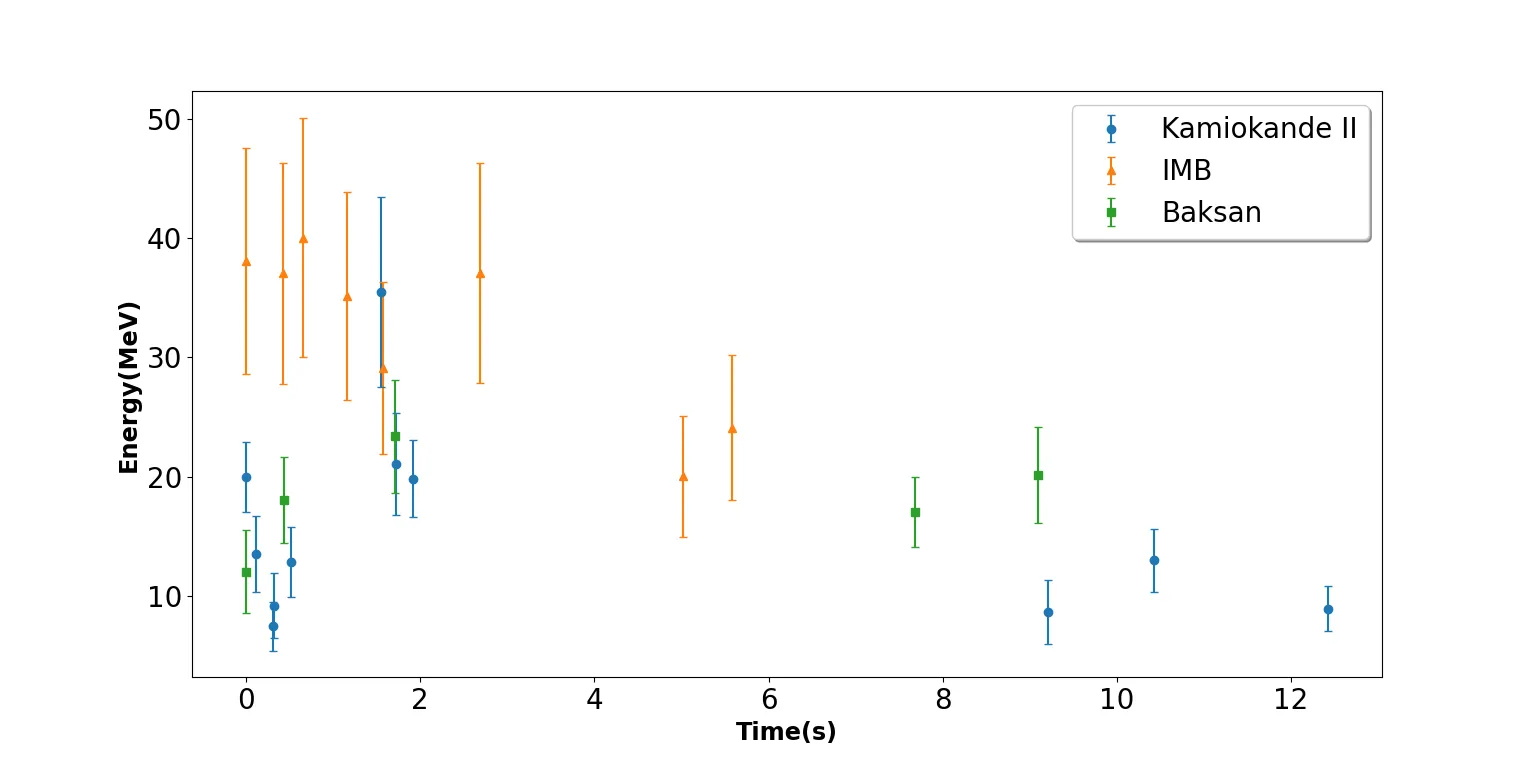
About 8000 tonnes of water in the Morton–Thiokol salt mine near Cleveland were viewed by 2048 PMTs. IMB set proton-decay limits, observed a low atmospheric ν_µ fraction, and detected 8 SN1987A events.
Compare all experiments → · World map →
In plain words
IMB was the American answer to the question of whether protons decay. Physicists from the University of California at Irvine, the University of Michigan and Brookhaven National Laboratory filled a large pit in a salt mine under the shore of Lake Erie with purified water and watched it for flashes of light. No proton ever decayed, but on 23 February 1987 the detector caught eight neutrinos from a supernova in the Large Magellanic Cloud.
How the detector works
The detector was a rectangular tank of roughly 7000 to 8000 tonnes of water about 600 metres underground in the Morton salt mine at Fairport Harbor, Ohio, near Cleveland. Its walls carried 2048 photomultipliers that recorded the Cherenkov light of charged particles. In later upgrades the 5-inch tubes were replaced by 8-inch tubes and fitted with wavelength-shifting plates, which collected several times more light and lowered the energy threshold. IMB ran from 1982 to 1991.
The project was proposed in the late 1970s by Frederick Reines, Lawrence Sulak and John Learned, among others; Henry Sobel was a leading member and later served as US co-spokesperson of Super-Kamiokande.
Key results
- Proton decay: no signal; limits above 10³² years for the main decay channels, which excluded the minimal SU(5) grand unified theory together with Kamiokande.
- SN1987A: 8 events within about 6 seconds, recorded at the same moment as Kamiokande's 11 events. Because IMB's threshold was higher, its events had higher energies.
- Atmospheric neutrinos: a smaller fraction of events with a muon decay signature than expected, an early indication of the atmospheric neutrino anomaly.
Why it matters for neutrino physics
Together with Kamiokande and the Baksan telescope, IMB's supernova events confirmed that a core-collapse supernova releases most of its energy as neutrinos, in line with models of the supernova mechanism. The events are still used to constrain neutrino mass, lifetime and exotic particles. The deficit of muon-like atmospheric events, seen by two very different water detectors, prepared the ground for Super-Kamiokande's discovery of oscillations.
Frequently asked questions
Why was IMB built in a salt mine?
The mine provided a large, dry cavity about 600 metres underground, enough rock to reduce cosmic-ray muons to a manageable rate, and a site close to the participating universities.
Did IMB and Kamiokande detect the same supernova neutrinos?
They detected different individual neutrinos from the same burst of SN1987A, arriving within seconds of each other on 23 February 1987.
Original papers
- DiscoveryR. M. Bionta et al. (IMB Collaboration), Observation of a neutrino burst in coincidence with supernova 1987A in the Large Magellanic Cloud, Phys. Rev. Lett. 58, 1494 (1987)DOI 10.1103/PhysRevLett.58.1494
Related terms
People
- Frederick Reines
- Hans Bethe
- Masatoshi Koshiba
- Takaaki Kajita
- Georg G. Raffelt
- James Ricker Wilson
- John G. Learned
- Lawrence R. Sulak
- Masayuki Nakahata
- Richard H. White
- Stirling Auchincloss Colgate
- Jogesh C. Pati
- Alfred K. Mann
- Henry W. Sobel
- Adam Burrows
On the timeline
- 1983Large water Cherenkov detectors begin operation
- 1987Neutrinos from supernova SN 1987A
- 1988Kamiokande finds an atmospheric neutrino anomaly
Mentioned in 56 pages
Lessons 4
FAQ 3
Comparisons 1
Milestones 9
- 1965 · First detection of atmospheric neutrinos
- 1966 · Neutrinos proposed to drive supernova explosions
- 1983 · Large water Cherenkov detectors begin operation
- 1987 · Neutrinos from supernova SN 1987A
- 1988 · Kamiokande finds an atmospheric neutrino anomaly
- 1995 · Nobel Prize for neutrino detection
- 1996 · Super-Kamiokande begins operation
- 1998 · Super-Kamiokande discovers neutrino oscillation
People 15
Terms 24
- Atmospheric & Large water Cherenkov experiments
- Atmospheric neutrinos
- Baksan Neutrino Observatory
- Baksan Underground Scintillation Telescope
- Baryon number
- Case–Witwatersrand–Irvine (East Rand) experiment
- Cherenkov radiation (detection)
- Detection principles & detector technology
16 more
- Discovery of neutrino oscillations
- Experiments & detectors
- Fréjus detector
- Grand unification
- Gravity
- Kamiokande
- Laboratoire Souterrain de Modane (LSM)
- LVD (Large Volume Detector)
- Neutrino astronomy
- NUSEX
- Proton decay
- SN 1987A
- SN1987A neutrino burst
- Soudan 2
- Supernova neutrino signal phases
- Water Cherenkov detector
Last updated: · Editorial standard
Cite this page
Text
Neutrino Atlas (2026). “IMB (Irvine–Michigan–Brookhaven)”. Retrieved 22 November 2026, from https://neutrino-atlas.com/terms/imb/BibTeX
@misc{neutrinoatlas2026termsimb,
  title        = {IMB (Irvine–Michigan–Brookhaven)},
  author       = {{Neutrino Atlas}},
  year         = {2026},
  url          = {https://neutrino-atlas.com/terms/imb/},
  note         = {Accessed 2026-11-22},
  language     = {english}
}