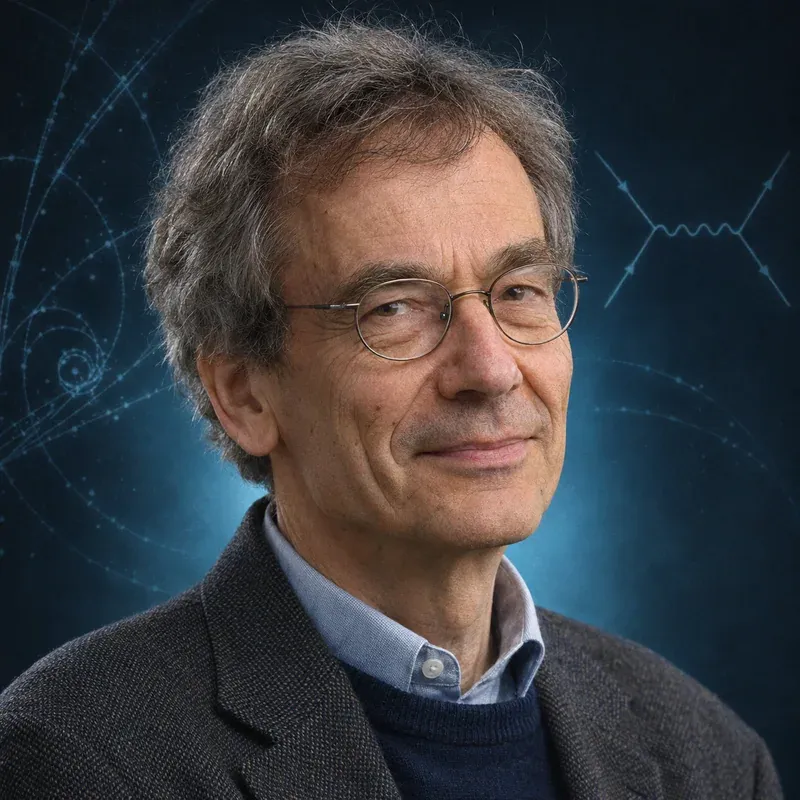
 Illustration
Georg G. Raffelt
Raffelt uses stars and supernovae as laboratories for weakly interacting particles, deriving astrophysical limits on neutrino magnetic moments, masses and new interactions from stellar cooling and from SN 1987A. His 1996 monograph is a standard reference on neutrino and axion astrophysics, and his group has worked on supernova neutrino transport and collective flavour conversion in dense neutrino gases.
- Nationality
- German
- Field
- Particle astrophysics
- Institutions
- Max Planck Institute for Physics (Werner-Heisenberg-Institut), Munich
Career
Georg G. Raffelt is a German theoretical physicist at the Max Planck Institute for Physics (Werner-Heisenberg-Institut) in Munich, where he has led research in particle astrophysics for several decades, and he is also affiliated with the Faculty of Physics of Ludwig-Maximilians-Universität München. His work sits at the meeting point of particle physics, nuclear physics and astrophysics, and his group has trained many of the researchers now working on supernova neutrinos and on axions.
Stars as particle laboratories
Raffelt's central idea is simple to state. Stars are in a long-lived balance between the energy produced by nuclear fusion and the energy they lose by radiation. If a new, weakly interacting particle could be produced in the hot stellar interior and escape freely, it would carry away energy and speed up the star's evolution. Because astronomers can measure stellar lifetimes and luminosities well, this extra energy loss can be constrained, which in turn limits the properties of the particle.
Applied to neutrinos, this argument gives some of the strongest limits on non-standard properties. A neutrino magnetic moment would enhance the emission of neutrino pairs from plasma oscillations in the dense core of a red giant, delaying helium ignition and making the stars at the tip of the red-giant branch in globular clusters brighter than observed. Raffelt used such observations to bound the magnetic moment to a few times 10⁻¹² Bohr magnetons, far below what laboratory experiments with reactor antineutrinos reached at the time. Similar reasoning constrains axions, which arise in a proposed solution to the strong CP problem of quantum chromodynamics.
The neutrino burst from SN 1987A, observed by Kamiokande-II, IMB and Baksan, offered another test. Its duration of about ten seconds matched the expected cooling of a newborn neutron star by neutrino diffusion. Any additional cooling channel would have shortened the burst, and Raffelt and collaborators turned this into bounds on axions, right-handed neutrino interactions and other exotic particles.
He collected these methods in the monograph 'Stars as Laboratories for Fundamental Physics' (University of Chicago Press, 1996), which remains a standard reference for stellar neutrino astrophysics.
Supernova neutrinos and collective oscillations
In a core-collapse supernova the density of neutrinos near the neutrinosphere is so high that neutrinos interact with each other through the weak force. With Günter Sigl, Raffelt developed in 1993 a kinetic description of mixed neutrinos in such environments based on density matrices, a framework that later became the starting point for the study of collective oscillations. In these, the flavour content of the whole neutrino gas evolves coherently and can produce sharp features such as spectral splits. Working with simulation groups, including that of Hans-Thomas Janka, his group has also studied which features of the explosion would be visible in the signal of a future galactic supernova in detectors such as Super-Kamiokande, IceCube, JUNO and DUNE.
Legacy
Raffelt helped turn astrophysical arguments into quantitative tools that sit alongside laboratory searches. Limits on neutrino magnetic moments and new light particles quoted in reviews of particle properties routinely include stellar bounds of the kind he developed, and the physics of dense neutrino gases that he helped formulate is now a central topic in supernova neutrino research.
Known for
- 'Stars as Laboratories for Fundamental Physics' (1996)
- Stellar and supernova bounds on neutrino properties and axions
- Collective flavour oscillations of supernova neutrinos
Chronology
- 1996'Stars as Laboratories for Fundamental Physics' published
Original papers
- G. G. Raffelt, Stars as Laboratories for Fundamental Physics: The Astrophysics of Neutrinos, Axions, and Other Weakly Interacting Particles, University of Chicago Press (1996)
Experiments
Connected people
Frequently asked questions
How can stars limit neutrino properties?
If neutrinos had, for example, a magnetic moment, stars would lose energy faster by emitting extra neutrinos. Observed stellar lifetimes and brightnesses show no such extra loss, which caps the size of the effect.
What is Georg Raffelt's best-known book?
'Stars as Laboratories for Fundamental Physics' (1996), a monograph on the astrophysics of neutrinos, axions and other weakly interacting particles.
Mentioned in 11 pages
Last updated: · Editorial standard
Cite this page
Text
Neutrino Atlas (2026). “Georg G. Raffelt”. Retrieved 22 November 2026, from https://neutrino-atlas.com/people/georg-raffelt/BibTeX
@misc{neutrinoatlas2026peoplegeorgraffelt,
  title        = {Georg G. Raffelt},
  author       = {{Neutrino Atlas}},
  year         = {2026},
  url          = {https://neutrino-atlas.com/people/georg-raffelt/},
  note         = {Accessed 2026-11-22},
  language     = {english}
}