 Illustration
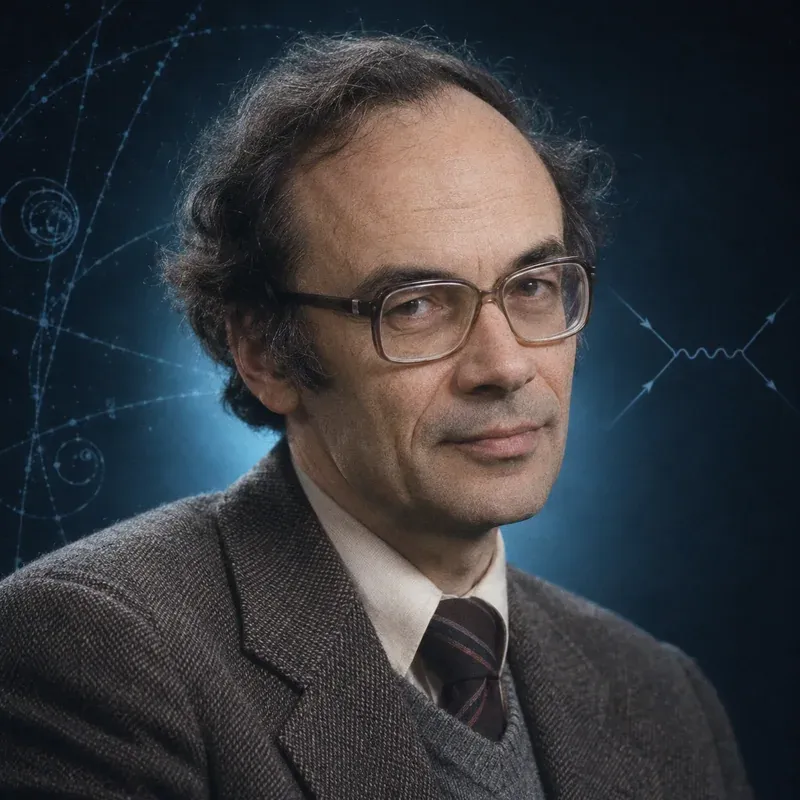
Alexander Dmitrievich Dolgov
Dolgov studied neutrino kinetics in the early universe, including neutrino decoupling, the effect of oscillations on Big Bang nucleosynthesis and relic neutrino spectra, and cosmological bounds on neutrino masses and lifetimes. His 2002 Physics Reports review 'Neutrinos in cosmology' is a standard reference. He received the 2009 Bruno Pontecorvo Prize for work on neutrino oscillations and neutrino kinetics in cosmology.
- Born
- 1 July 1941
Russia - Nationality
- Russian
- Field
- Cosmology; astroparticle physics
- Institutions
- ITEP Moscow, University of Ferrara / INFN Ferrara, Novosibirsk State University, University of Copenhagen (TAC)
Education and career
Alexander Dmitrievich Dolgov was born in Russia in 1941. He studied at the Moscow Institute of Physics and Technology and obtained his doctorate at the Institute for Theoretical and Experimental Physics (ITEP) in Moscow under Lev Okun. He spent much of his career at ITEP and later worked at the Theoretical Astrophysics Center in Copenhagen, at INFN and the University of Ferrara in Italy, and at Novosibirsk State University.
Key contributions
Dolgov's main subject is how neutrinos behave in the hot early universe. About one second after the Big Bang, at temperatures near 1 MeV, neutrinos stop interacting with the surrounding plasma (neutrino decoupling). Shortly afterwards electrons and positrons annihilate and heat the photons. Because decoupling is not instantaneous, the neutrinos receive a small share of that heat and their spectrum ends up slightly non-thermal. In 1997, with Steen Hansen and Dmitry Semikoz, Dolgov solved the kinetic equations for this process; such calculations underlie the standard value of the effective number of neutrino species, Neff ≈ 3.044, slightly above three.
He also studied how neutrino oscillations act in this environment, where frequent collisions and the dense medium compete with flavour change, and developed density-matrix descriptions of the problem. With Riccardo Barbieri he derived in 1990 limits on sterile neutrinos from Big Bang nucleosynthesis, since extra species produced by oscillations would speed up expansion and change the helium yield. In 2002, with Hansen, Pastor, Petcov, Raffelt and Semikoz, he showed that oscillations equalise any lepton asymmetries among the flavours before nucleosynthesis, which tightened limits on a cosmic neutrino asymmetry. With Hansen he also discussed keV-scale sterile neutrinos as warm dark matter.
Earlier, in 1977, he had updated cosmological bounds on neutrino masses with Yakov Zeldovich and Vysotskii, and with Zeldovich he wrote the 1981 Reviews of Modern Physics article 'Cosmology and elementary particles'. His 2002 Physics Reports review 'Neutrinos in cosmology' is a standard reference.
Recognition
Dolgov received the Lenin Komsomol Prize (1973), the Landau–Weizmann Prize (1996), the Bruno Pontecorvo Prize of JINR (2009) 'for fundamental contributions to the understanding of neutrino oscillations and neutrino kinetics in cosmology', the Friedmann Prize (2011) and the Markov Prize (2014). With Cosimo Bambi he wrote the textbook 'Introduction to Particle Cosmology'.
Known for
- Neutrino kinetics and oscillations in the early universe
- Review 'Neutrinos in cosmology' (2002)
- Cosmological neutrino bounds (with Zeldovich and Vysotskii, 1977)
Chronology
- 1977Cosmological neutrino constraints with Zeldovich and Vysotskii
- 2002'Neutrinos in cosmology' review
- 2009Bruno Pontecorvo Prize
- 2011Friedmann Prize
Original papers
- A. D. Dolgov, Neutrinos in cosmology, Phys. Rep. 370, 333 (2002)
Experiments
- Planck
Connected people
Frequently asked questions
Why is N_eff slightly larger than three?
Because neutrinos were still weakly coupled when electrons and positrons annihilated, they took a little of the released energy. Detailed kinetic calculations of the kind Dolgov pioneered give Neff ≈ 3.044 for three standard neutrinos.
What did the 2009 Pontecorvo Prize recognise?
Dolgov's 'fundamental contributions to the understanding of neutrino oscillations and neutrino kinetics in cosmology'. He shared the year's prize with Henry Sobel, who was honoured for experimental work.
Mentioned in 4 pages
Last updated: · Editorial standard
Cite this page
Text
Neutrino Atlas (2026). “Alexander Dmitrievich Dolgov”. Retrieved 22 November 2026, from https://neutrino-atlas.com/people/alexander-dolgov/BibTeX
@misc{neutrinoatlas2026peoplealexanderdolgov,
  title        = {Alexander Dmitrievich Dolgov},
  author       = {{Neutrino Atlas}},
  year         = {2026},
  url          = {https://neutrino-atlas.com/people/alexander-dolgov/},
  note         = {Accessed 2026-11-22},
  language     = {english}
}