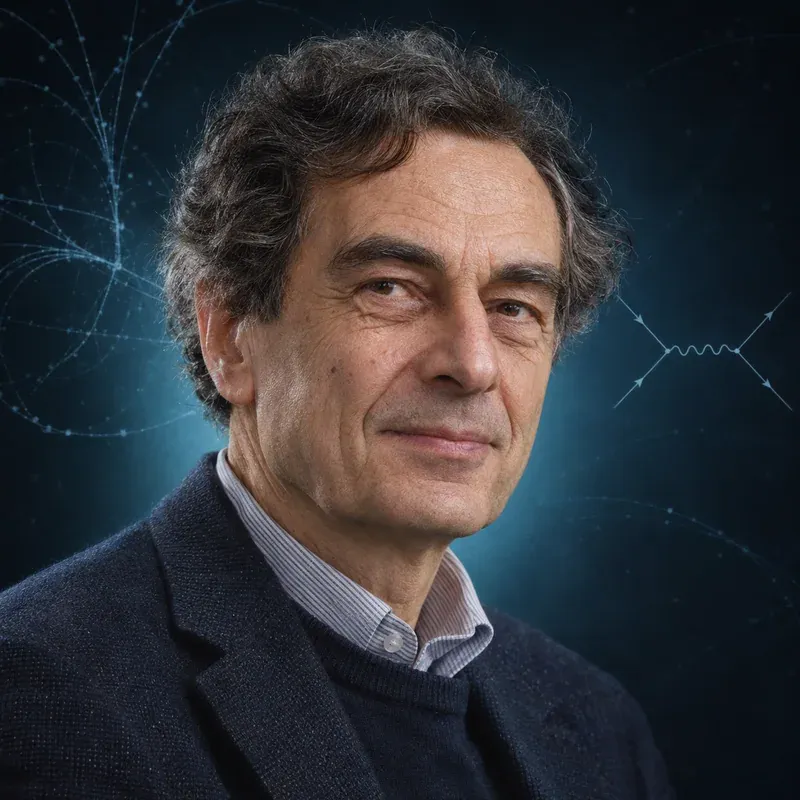
 Illustration
Serguey Todorov Petcov
Petcov co-discovered (with Bilenky and Hošek, 1980) the Majorana CP-violating phases and has studied their effect on neutrinoless double beta decay. He worked on charged-lepton flavour violation (μ → eγ, μ → 3e) induced by massive neutrinos and on matter effects, including the enhancement of oscillations for neutrinos crossing the Earth's core (1998). He received the 2010 Bruno Pontecorvo Prize for work on neutrino propagation in matter, μ → eγ and μ → 3e, and Majorana neutrino properties.
- Nationality
- Bulgarian
- Field
- Neutrino theory and phenomenology
- Institutions
- SISSA / INFN Trieste, Kavli IPMU (joint appointment)
Career
Serguey Todorov Petcov is a Bulgarian theoretical physicist who has worked on neutrino theory and phenomenology since the 1970s. He became a professor in the theoretical particle physics group at SISSA, the International School for Advanced Studies in Trieste, where he is also associated with INFN, and he holds a joint appointment at the Kavli Institute for the Physics and Mathematics of the Universe (Kavli IPMU) in Japan. Many of his doctoral students and postdocs at SISSA went on to careers in neutrino phenomenology.
Key contributions
In 1977 Petcov calculated what neutrino mixing implies for rare muon decays such as μ → eγ and μ → 3e, processes that would violate the separate conservation of electron and muon number. He found that with light neutrinos the rates are suppressed by the tiny ratio of neutrino masses to the W-boson mass and are far too small ever to be observed. The result is still the reference point for charged-lepton flavour violation: any signal in experiments such as MEG would point to physics beyond the Standard Model with massive neutrinos.
In 1980, with Samoil Bilenky and Jiří Hošek, he showed that Majorana neutrinos bring extra CP-violating Majorana phases into the mixing matrix. They do not affect oscillations but do affect neutrinoless double beta decay, and Petcov later studied in detail how the effective Majorana mass depends on these phases and on the mass ordering. His 1987 review with Bilenky in Reviews of Modern Physics became a standard text.
Petcov also worked extensively on matter effects. In 1998 he pointed out that neutrinos crossing both the Earth's mantle and its denser core can undergo an additional enhancement of oscillations, distinct from the ordinary MSW resonance. The same effect was analysed at the time by Evgeny Akhmedov as a parametric resonance, and by Liu, Mikheyev and Smirnov. These Earth matter effects are now part of the strategy of atmospheric neutrino experiments such as Hyper-Kamiokande for determining the mass ordering.
In 2002 Petcov and his PhD student Maurizio Piai proposed measuring the mass ordering with reactor antineutrinos at a distance of tens of kilometres, by resolving the fine interference pattern that the two mass splittings imprint on the energy spectrum. It required a very large detector with unprecedented energy resolution. That concept became JUNO, whose 20-kiloton liquid-scintillator detector in southern China started taking data in 2025.
In his own words
Looking back at the 2002 proposal, Petcov told SISSA: 'It seemed that such a detector could never be built.' The original paper ended with the line 'Only those who wager can win', an echo of Wolfgang Pauli's reasoning when he proposed the neutrino.
Recognition and recent work
Petcov received the Bruno Pontecorvo Prize for 2010, for fundamental contributions to the study of neutrino propagation in matter, the processes μ → eγ and μ → 3e, and the Majorana properties of neutrinos. More recently he has worked on flavour symmetries, including modular invariance, as a way of explaining the observed mixing pattern, and on leptogenesis.
Known for
- Majorana CP phases (1980)
- Neutrino oscillations in matter, Earth-core enhancement
- Neutrino mass ordering and flavour symmetries
Chronology
- 1977μ → eγ from neutrino mixing
- 1980Majorana phases with Bilenky and Hošek
- 1987Bilenky–Petcov review
- 1998Earth-core enhancement of oscillations
- 2010Bruno Pontecorvo Prize
Original papers
- S. M. Bilenky, J. Hošek, S. T. Petcov, On oscillations of neutrinos with Dirac and Majorana masses, Phys. Lett. B 94, 495 (1980)
- S. M. Bilenky, S. T. Petcov, Massive neutrinos and neutrino oscillations, Rev. Mod. Phys. 59, 671 (1987)DOI 10.1103/RevModPhys.59.671
- S. T. Petcov, Diffractive-like (or parametric-resonance-like?) enhancement of the Earth (day-night) effect for solar neutrinos crossing the Earth core, Phys. Lett. B 434, 321 (1998)arXiv:hep-ph/9805262
Experiments
Connected people
- Alexei Yuryevich Smirnov
- Evgeny Kh. Akhmedov
- Samoil Mikhelevich Bilenky
- Boris J. Kayser
- Nicola Cabibbo
- Silvia Pascoli
Frequently asked questions
What is Serguey Petcov known for?
For co-discovering the Majorana CP phases in 1980, for showing that μ → eγ from light-neutrino mixing is unobservably small, for work on matter effects including Earth-core enhancement, and for proposing in 2002 the reactor method that JUNO now uses to determine the neutrino mass ordering.
How is Petcov connected to JUNO?
In 2002 he and Maurizio Piai proposed that a large reactor-antineutrino detector with excellent energy resolution could reveal the mass ordering from the oscillation pattern in the spectrum. JUNO was built on that idea.
Which prize did Petcov receive?
The Bruno Pontecorvo Prize for 2010, awarded by JINR Dubna and announced in 2011.
Mentioned in 14 pages
Lessons 1
People 6
Last updated: · Editorial standard
Cite this page
Text
Neutrino Atlas (2026). “Serguey Todorov Petcov”. Retrieved 22 November 2026, from https://neutrino-atlas.com/people/serguey-petcov/BibTeX
@misc{neutrinoatlas2026peoplesergueypetcov,
  title        = {Serguey Todorov Petcov},
  author       = {{Neutrino Atlas}},
  year         = {2026},
  url          = {https://neutrino-atlas.com/people/serguey-petcov/},
  note         = {Accessed 2026-11-22},
  language     = {english}
}