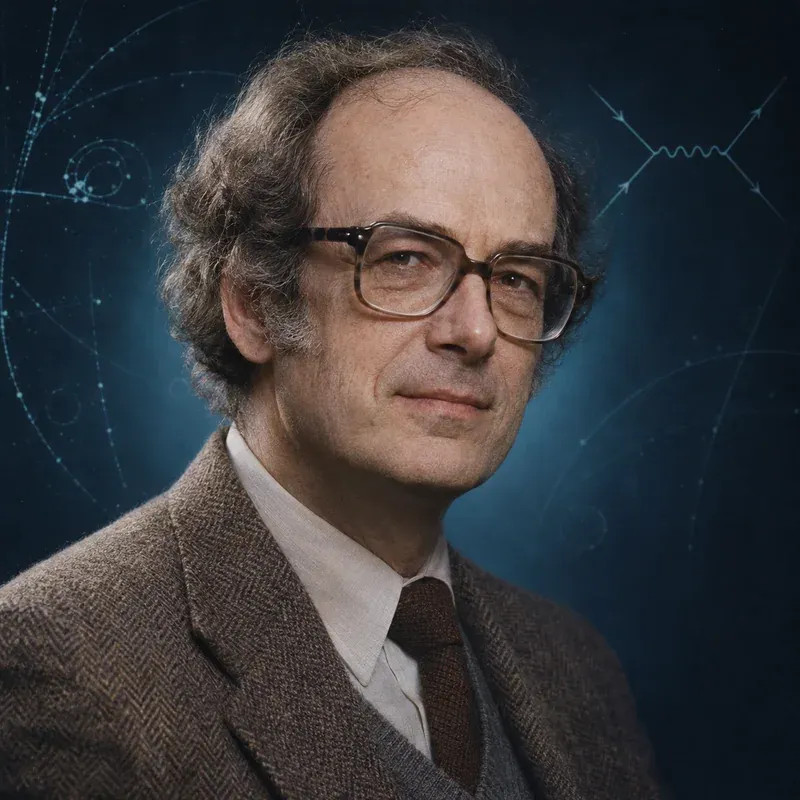
 Illustration
Boris J. Kayser
Kayser's 1981 paper clarified the quantum mechanics of neutrino oscillation using wave packets and the conditions for coherence. In 1982–84 he worked out the electromagnetic properties of Majorana neutrinos and the role of CP and C phases in Majorana processes. He was principal author of 'The Physics of Massive Neutrinos' (1989) and co-led the APS Joint Study on the Future of Neutrino Physics.
- Born
- 2 June 1938
- Died
- 14 April 2024
- Nationality
- American
- Field
- Neutrino theory
- Institutions
- Caltech (PhD 1964), SUNY Stony Brook, Northwestern University, National Science Foundation
Education and career
Boris Jules Kayser grew up on a chicken farm in New Jersey. He graduated from Princeton University in 1960 as valedictorian of his class and earned his PhD in theoretical physics at Caltech in 1964 under Fred Zachariasen. After a postdoctoral position at Berkeley he was an assistant professor at Stony Brook and at Northwestern University. He then spent nearly three decades as Program Director for Theoretical Physics at the US National Science Foundation, where he helped establish the Kavli Institute for Theoretical Physics in Santa Barbara. After retiring from the NSF in 2001 he joined the theory group at Fermilab, where he remained active in research, lecturing and advocacy until his death in April 2024, aged 85.
Key contributions
Kayser’s research concentrated on the foundations of neutrino physics, the questions that textbooks often pass over quickly. His 1981 paper ‘On the quantum mechanics of neutrino oscillation’ asked why a neutrino produced with a definite flavour oscillates at all, when its mass components have different masses and therefore cannot all have the same energy and momentum. Treating the neutrino as a wave packet, he showed under which conditions the mass components remain coherent, and that the standard oscillation formula follows when they do. The analysis also explains why oscillations fade over very long distances, as the packets separate (see wave-packet decoherence).
In 1982 he studied the electromagnetic properties of Majorana neutrinos, particles that are their own antiparticles. He showed that such neutrinos cannot have magnetic or electric dipole moments of their own, only transition moments between different mass states, which matters for the interpretation of searches for a neutrino magnetic moment. In 1984 he analysed the extra CP phases that Majorana neutrinos carry and how they enter processes such as neutrinoless double beta decay (see Majorana phases). With Robert Shrock he also emphasised that the differences between Dirac and Majorana neutrinos vanish as the mass goes to zero, which is why lepton-number-violating processes are so hard to see.
Teaching and community work
Kayser was principal author, with F. Gibrat-Debu and F. Perrier, of ‘The Physics of Massive Neutrinos’ (1989), one of the first textbooks on the subject. His reviews, such as ‘Neutrino mass, mixing, and flavor change’ (2002), and his many lecture courses at summer schools introduced a generation of students to the field. With Stuart Freedman he led the American Physical Society’s Joint Study on the Future of Neutrino Physics, whose 2004 report helped set priorities in the United States, and he contributed to theory white papers and to the physics programme of DUNE, including studies of what its near detector could search for. Colleagues remembered his insistence on fundamentals, his optimism and his humour.
Known for
- Quantum mechanics of neutrino oscillation (1981)
- Majorana neutrino properties and phases
- 'The Physics of Massive Neutrinos' (1989)
- APS neutrino study and 2007 theory white paper
Chronology
- 1972Joins NSF as theory program director
- 1981'On the quantum mechanics of neutrino oscillation'
- 1982'Majorana neutrinos and their electromagnetic properties'
- 1989'The Physics of Massive Neutrinos'
- 2004APS multi-divisional neutrino study
Original papers
- B. Kayser, On the quantum mechanics of neutrino oscillation, Phys. Rev. D 24, 110 (1981)DOI 10.1103/PhysRevD.24.110
- B. Kayser, Majorana neutrinos and their electromagnetic properties, Phys. Rev. D 26, 1662 (1982)DOI 10.1103/PhysRevD.26.1662
- B. Kayser, CPT, CP, and C phases, and their effects, in Majorana-particle processes, Phys. Rev. D 30, 1023 (1984)DOI 10.1103/PhysRevD.30.1023
- B. Kayser, F. Gibrat-Debu, F. Perrier, The Physics of Massive Neutrinos, World Scientific (1989)
Experiments
Connected people
Frequently asked questions
What is Boris Kayser known for?
For clarifying the quantum mechanics of neutrino oscillation, for work on the properties of Majorana neutrinos and their phases, and for the textbook ‘The Physics of Massive Neutrinos’.
Why can a Majorana neutrino not have a magnetic moment?
Because it is its own antiparticle, and the magnetic moment of a particle and its antiparticle have opposite signs; for a Majorana neutrino the two must cancel. Only transition moments between different mass states remain. See neutrino magnetic moment.
Last updated: · Editorial standard
Cite this page
Text
Neutrino Atlas (2026). “Boris J. Kayser”. Retrieved 22 November 2026, from https://neutrino-atlas.com/people/boris-kayser/BibTeX
@misc{neutrinoatlas2026peopleboriskayser,
  title        = {Boris J. Kayser},
  author       = {{Neutrino Atlas}},
  year         = {2026},
  url          = {https://neutrino-atlas.com/people/boris-kayser/},
  note         = {Accessed 2026-11-22},
  language     = {english}
}