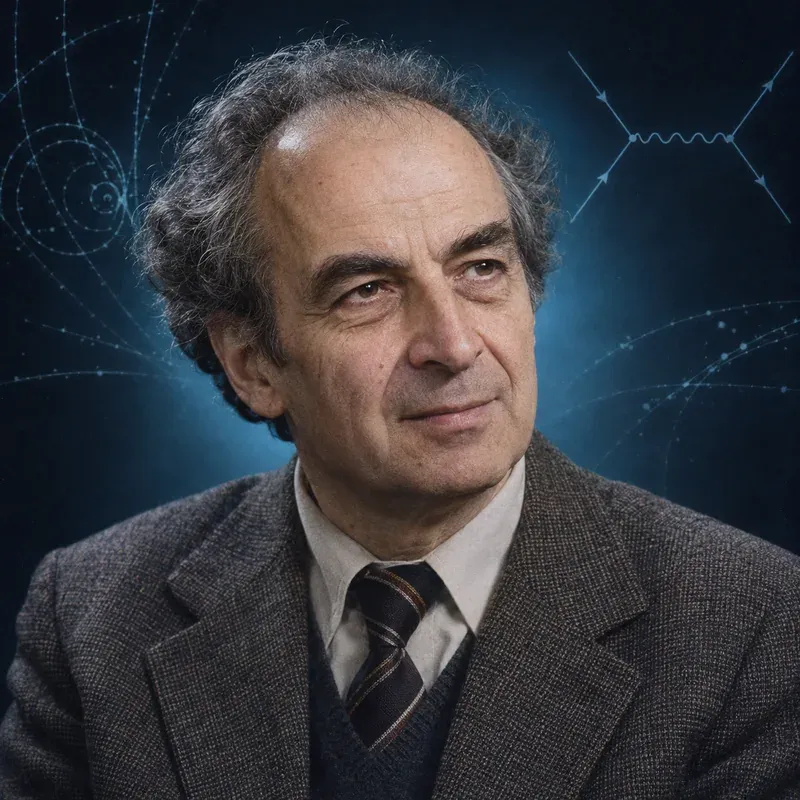
 Illustration
Samoil Mikhelevich Bilenky
From 1970 Bilenky worked with Bruno Pontecorvo on a general theory of neutrino mixing and oscillations and proposed oscillation experiments, summarised in their 1978 Physics Reports review. With Hošek and Petcov (1980) he showed that Majorana neutrinos carry extra CP-violating phases that do not affect oscillations but enter neutrinoless double beta decay. His 1987 review with Petcov on massive neutrinos became a standard reference.
- Born
- 23 May 1928
Zhmerynka, Ukrainian SSR - Died
- 5 November 2020
- Nationality
- Soviet/Russian
- Field
- Theoretical particle physics; neutrino theory
- Institutions
- Joint Institute for Nuclear Research (JINR), Dubna
Early life and education
Samoil Mikhelevich Bilenky was born on 23 May 1928 in Zhmerynka, in Soviet Ukraine. He graduated with honours from the Moscow Engineering Physics Institute in 1952 and the same year moved to Dubna, to the Institute of Nuclear Problems that became part of the Joint Institute for Nuclear Research (JINR) in 1956. He defended his candidate and doctoral dissertations there, working in groups led by Isaak Pomeranchuk and Nikolay Bogoliubov, and was one of the first staff members of JINR's Laboratory of Theoretical Physics.
Path to neutrino physics
Bilenky's early research dealt with polarisation phenomena in nuclear and particle reactions. This work fed into the development of polarised proton targets in the 1960s, and he later studied parity violation in deep-inelastic scattering of polarised muons. In 1970 he began a long collaboration with Bruno Pontecorvo, who had proposed neutrino oscillations in the 1950s and 1960s. From then on electroweak theory and neutrino masses were the centre of his work.
Key contributions
Together, Bilenky and Pontecorvo turned the oscillation idea into a general theory of neutrino mixing. In 1976 they pointed to the analogy with quark mixing and argued that, if quarks mix, leptons should too. Their 1978 Physics Reports review, 'Lepton mixing and neutrino oscillations', laid out the formalism for Dirac and Majorana mass terms, the oscillation probabilities and the types of experiments that could test them, at a time when most physicists still assumed neutrinos were massless.
In 1980, with Jiří Hošek and Serguey Petcov, Bilenky showed that if neutrinos are Majorana particles the mixing matrix contains additional CP-violating Majorana phases. These phases drop out of oscillation probabilities, so oscillation experiments cannot see them, but they enter the rate of neutrinoless double beta decay through the effective Majorana mass. This is why today's PMNS matrix is written with up to three phases. His 1987 Reviews of Modern Physics article with Petcov, 'Massive neutrinos and neutrino oscillations', became a standard reference for a generation of students and experimenters, as did his 1999 review with Carlo Giunti and Walter Grimus on oscillation phenomenology.
Teacher and historian
Bilenky published more than 300 papers. He lectured to the Dubna branch of Moscow State University for over thirty years and taught courses in Prague, Milan, Vienna, Valencia, Barcelona, at the Technion and at ICTP and SISSA in Trieste. His textbooks include 'Introduction to Feynman diagram technique' and 'Introduction to the physics of electroweak interactions'. For about twenty years he organised the Pontecorvo Neutrino Physics School. Late in life he wrote 'Neutrino. History of a unique particle', a widely read survey of the field from Pauli onward.
He received the Bruno Pontecorvo Prize in 2002 for theoretical investigations of neutrino oscillations, as well as a Humboldt Research Award. Bilenky died on 5 November 2020.
Known for
- Theory of neutrino mixing and oscillations with Pontecorvo
- Majorana CP phases (Bilenky–Hošek–Petcov, 1980)
- Influential reviews (1978 with Pontecorvo; 1987 with Petcov)
- Pontecorvo Neutrino Physics School
Chronology
- 1952Joins the Dubna institute (later JINR)
- 1978Bilenky–Pontecorvo review of lepton mixing
- 1980Majorana phases (Bilenky–Hošek–Petcov)
- 1987Bilenky–Petcov review in Rev. Mod. Phys.
- 2002Bruno Pontecorvo Prize
Original papers
- S. M. Bilenky, B. Pontecorvo, Lepton mixing and neutrino oscillations, Phys. Rep. 41, 225 (1978)
- S. M. Bilenky, J. Hošek, S. T. Petcov, On oscillations of neutrinos with Dirac and Majorana masses, Phys. Lett. B 94, 495 (1980)
- S. M. Bilenky, S. T. Petcov, Massive neutrinos and neutrino oscillations, Rev. Mod. Phys. 59, 671 (1987)DOI 10.1103/RevModPhys.59.671
Connected people
Frequently asked questions
What is Samoil Bilenky known for?
For building, with Bruno Pontecorvo, the general theory of neutrino mixing and oscillations in the 1970s, and for showing with Hošek and Petcov in 1980 that Majorana neutrinos carry extra CP-violating phases.
Why can't oscillation experiments measure Majorana phases?
Oscillation probabilities depend only on combinations of the mixing matrix in which these phases cancel. They appear instead in processes that violate lepton number, above all neutrinoless double beta decay.
Which prize did Bilenky receive?
He received the Bruno Pontecorvo Prize of JINR in 2002 and a Humboldt Research Award, among other honours.
Mentioned in 5 pages
Last updated: · Editorial standard
Cite this page
Text
Neutrino Atlas (2026). “Samoil Mikhelevich Bilenky”. Retrieved 22 November 2026, from https://neutrino-atlas.com/people/samoil-bilenky/BibTeX
@misc{neutrinoatlas2026peoplesamoilbilenky,
  title        = {Samoil Mikhelevich Bilenky},
  author       = {{Neutrino Atlas}},
  year         = {2026},
  url          = {https://neutrino-atlas.com/people/samoil-bilenky/},
  note         = {Accessed 2026-11-22},
  language     = {english}
}