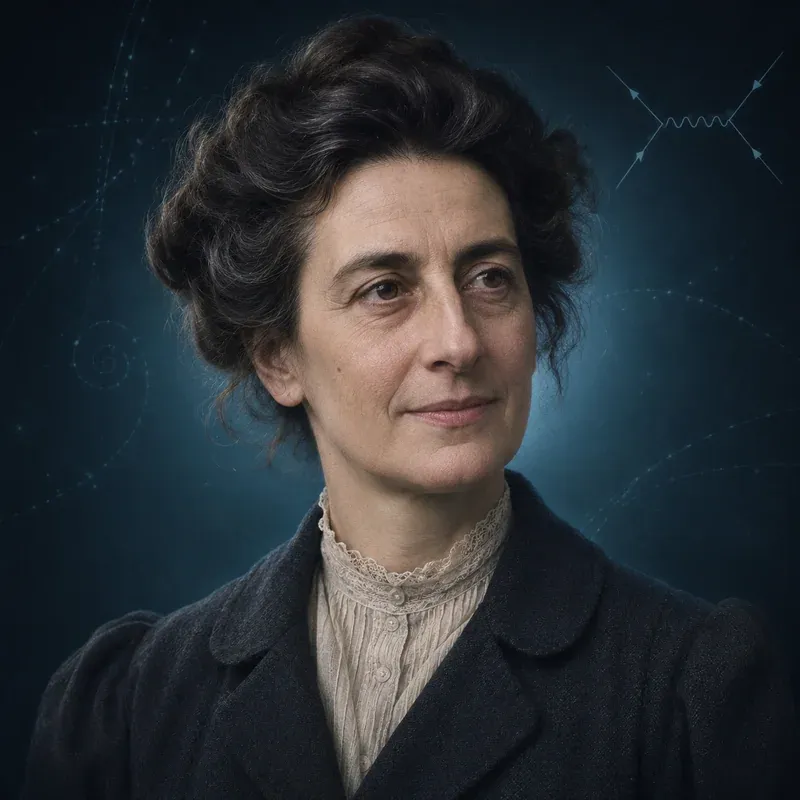
 Illustration
Silvia Pascoli
Pascoli's work connects measurable neutrino properties with questions the experiments cannot answer directly. With Serguey Petcov she showed how the effective Majorana mass in neutrinoless double-beta decay depends on the mass ordering, the absolute mass scale and the Majorana phases, and with Petcov and Antonio Riotto she showed that the CP-violating phases of the PMNS matrix, including the Dirac phase alone, can in principle supply the baryon asymmetry through leptogenesis. She has also worked extensively on the physics reach of long-baseline experiments and on low-scale models of neutrino mass with new light or heavy states.
- Nationality
- Italian
- Field
- Theoretical particle physics (neutrino phenomenology)
- Institutions
- University of Trieste, SISSA, Trieste (PhD 2002), UCLA, CERN
Education and career
Silvia Pascoli graduated in physics from the University of Trieste in 1999 and obtained her PhD in elementary particle physics at SISSA in Trieste in 2002, where much of her early work was done with Serguey Petcov. After postdoctoral positions at UCLA (2002–2004) and as a CERN Fellow (2004–2006) she joined Durham University, rising from lecturer in 2005 to professor in 2012. At Durham's Institute for Particle Physics Phenomenology (IPPP) she was deputy director from 2011 to 2014. Since December 2020 she has been full professor at the University of Bologna, and since 2024 director of the European Consortium for Astroparticle Theory (EuCAPT).
Reading the mass spectrum from double-beta decay
In 2002, soon after the SNO results had narrowed down the solar mixing parameters, Pascoli and Petcov worked out what the observed oscillation parameters imply for neutrinoless double-beta decay. The decay rate depends on the effective Majorana mass, a sum over the three mass states weighted by the squared mixing elements and by the unknown Majorana phases. They showed how its allowed range differs for normal and inverted ordering and for a quasi-degenerate spectrum, and how a measurement or a limit could discriminate between them. Plots of this kind, with bands for the two orderings as a function of the lightest mass, remain the standard way to present the targets of experiments.
CP violation and the matter–antimatter asymmetry
In leptogenesis, heavy right-handed neutrinos of the seesaw mechanism decay asymmetrically in the early universe, and sphalerons convert the resulting lepton asymmetry into baryons. Whether the CP violation that could one day be measured at low energy is connected to this process was long unclear. In 2006–2007 Pascoli, Petcov and Antonio Riotto showed that, once flavour effects in leptogenesis are taken into account, the low-energy phases of the PMNS matrix can be responsible for the whole asymmetry, and that this is possible even if the only source of CP violation is the Dirac phase δCP probed in oscillations.
Long-baseline experiments and new physics
Pascoli has worked extensively on the physics reach of long-baseline experiments: she led the physics work package of the European LAGUNA-LBNO design study from 2011 to 2014, represented Durham on the DUNE institutional board and has co-convened the theory working group of the CERN Neutrino Platform since 2016. With an ERC Consolidator Grant (2014–2021) she studied low-energy extensions of the Standard Model, including heavy neutral leptons and light dark sectors coupled through the neutrino portal. She has also coordinated European training networks, notably HIDDeN from 2020.
In 2013 she received the Occhialini Prize and Medal of the Institute of Physics and the Italian Physical Society for her contributions to and leadership in neutrino phenomenology.
Known for
- Link between low-energy leptonic CP violation and leptogenesis
- Neutrinoless double-beta decay and the neutrino mass spectrum
- Physics case for long-baseline experiments (LAGUNA-LBNO, DUNE)
- Low-scale extensions of the Standard Model and heavy neutral leptons
- Coordinator of the HIDDeN training network; EuCAPT director
Chronology
- 2002PhD in elementary particle physics, SISSA
- 2004CERN Fellow (to 2006)
- 2005Lecturer at Durham University
- 2012Professor at Durham; IPPP deputy director 2011–2014
- 2013Occhialini Prize and Medal (IOP and SIF)
- 2014ERC Consolidator Grant NuMass
- 2020Full professor at the University of Bologna; coordinator of the HIDDeN network
- 2024Director of EuCAPT
Original papers
- S. Pascoli, S. T. Petcov, The SNO solar neutrino data, neutrinoless double beta-decay and neutrino mass spectrum, Phys. Lett. B 544, 239 (2002)DOI 10.1016/S0370-2693(02)02510-8
- S. Pascoli, S. T. Petcov, A. Riotto, Leptogenesis and low energy CP violation in neutrino physics, Nucl. Phys. B 774, 1 (2007)DOI 10.1016/j.nuclphysb.2007.02.019
Experiments
- DUNE
- LAGUNA-LBNO
- Hyper-Kamiokande
Connected people
Frequently asked questions
What is Silvia Pascoli known for?
Theoretical work linking oscillation data to neutrinoless double-beta decay and to leptogenesis, and on the physics case of long-baseline experiments.
Last updated: · Editorial standard
Cite this page
Text
Neutrino Atlas (2026). “Silvia Pascoli”. Retrieved 22 November 2026, from https://neutrino-atlas.com/people/silvia-pascoli/BibTeX
@misc{neutrinoatlas2026peoplesilviapascoli,
  title        = {Silvia Pascoli},
  author       = {{Neutrino Atlas}},
  year         = {2026},
  url          = {https://neutrino-atlas.com/people/silvia-pascoli/},
  note         = {Accessed 2026-11-22},
  language     = {english}
}