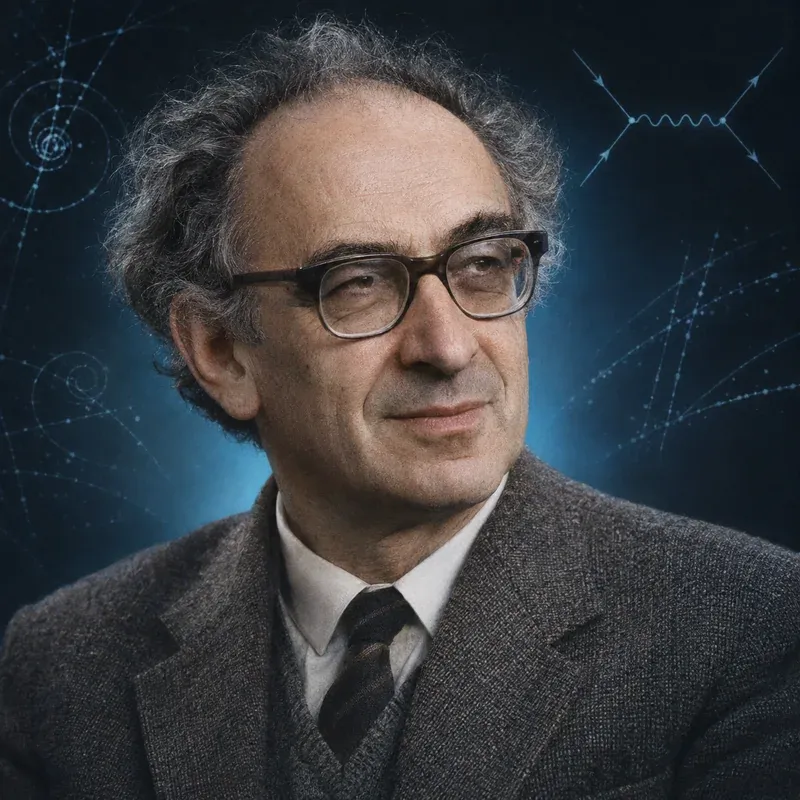
 Illustration
Semyon Solomonovich Gershtein
In 1966 Gershtein and Zeldovich published the first cosmological bound on neutrino masses, showing that relic neutrinos from the hot early universe would over-dominate the cosmic density unless their masses were below roughly 400 eV. This idea, refined by Cowsik and McClelland, underlies today's cosmological limits on the sum of neutrino masses. He received the Bruno Pontecorvo Prize in 1996 for theoretical work on electroweak interactions.
- Born
- 13 July 1929
Harbin, China - Died
- 20 February 2023
Moscow, Russia - Nationality
- Soviet/Russian
- Field
- Theoretical particle physics
- Institutions
- Institute for High Energy Physics (IHEP), Protvino, Moscow Institute of Physics and Technology, Institute for Physical Problems
Early life and education
Semyon Solomonovich Gershtein was born on 13 July 1929 in Harbin, China. He studied in the nuclear physics department of the Faculty of Physics at Moscow State University, where Anatoly Vlasov and Alexei Abrikosov were among his teachers. After graduating he taught at a school in the Kaluga region until 1954. In 1955 he entered graduate school at the Institute for Physical Problems in Moscow, then the centre of Lev Landau's theory school. He received his doctor of sciences degree in 1963.
Key contributions
Gershtein's first major result came in 1955, together with Yakov Zeldovich. They proposed that the vector part of the weak current is conserved in the same way as the electromagnetic current, so that its strength is not changed by the strong interactions inside the nucleon. This conserved vector current (CVC) hypothesis was proposed independently by Richard Feynman and Murray Gell-Mann in 1958 and became part of the V−A theory of the weak interaction. For neutrino physics it matters because it fixes the vector form factors that enter neutrino–nucleon cross-sections from electron-scattering data.
In 1966 Gershtein and Zeldovich published a short paper, 'Rest mass of muonic neutrino and cosmology', that is now regarded as the first cosmological limit on neutrino mass. They reasoned that the hot early universe would have filled with neutrinos in thermal equilibrium, and that after neutrino decoupling these would survive as a relic background with a number density comparable to that of photons. If such relic neutrinos were heavy, their mass would dominate the cosmic density and conflict with the observed expansion rate and the ages of the oldest stars. Requiring that this not happen gave an upper bound of roughly 400 eV on the masses of the electron and muon neutrinos. For the muon neutrino this was about a thousand times stronger than the laboratory limit of the time.
The logic is still used. Ramanath Cowsik and J. McClelland sharpened the bound to a few eV in 1972, and today's cosmological mass bound from the cosmic microwave background and galaxy surveys constrains the sum of neutrino masses to the sub-eV range. The same reasoning also opened the discussion of neutrinos as hot dark matter.
Later work
Gershtein spent most of his career at the Institute for High Energy Physics in Protvino, where he was a senior researcher, and taught as a professor at the Moscow Institute of Physics and Technology. He wrote more than 200 papers on electroweak theory, quantum chromodynamics and hadron spectroscopy, including widely used studies of the Bc meson and of doubly heavy baryons. He received the Bruno Pontecorvo Prize in 1996 for theoretical research on electroweak interactions, was elected a full member of the Russian Academy of Sciences in 2003, received the Pomeranchuk Prize in 2011 and the Landau Gold Medal in 2013. He died in Moscow on 20 February 2023.
Known for
- Cosmological neutrino-mass bound (with Zeldovich, 1966)
- Weak–electromagnetic current analogy (CVC) with Zeldovich
- Electroweak theory research
Chronology
- 1966Gershtein–Zeldovich cosmological neutrino-mass bound
- 1996Bruno Pontecorvo Prize
- 2003Full member of the Russian Academy of Sciences
- 2013Landau Gold Medal
Original papers
- S. S. Gershtein, Ya. B. Zeldovich, Rest mass of muonic neutrino and cosmology, JETP Lett. 4, 120 (1966)
Experiments
- Planck
Connected people
Frequently asked questions
What did Gershtein and Zeldovich show in 1966?
That neutrinos left over from the Big Bang must be lighter than roughly 400 eV, because heavier relic neutrinos would make the universe too dense to match its observed expansion and age. It was the first use of cosmology to limit a neutrino mass.
What is the conserved vector current hypothesis?
The idea, proposed by Gershtein and Zeldovich in 1955 and independently by Feynman and Gell-Mann in 1958, that the vector part of the weak current is conserved like the electromagnetic current, so strong interactions do not renormalise its strength.
How does the 1966 bound compare with today's limits?
Modern cosmological data limit the sum of the three neutrino masses to below roughly a tenth of an eV to an eV, depending on the data set, thousands of times stronger than the original estimate but based on the same idea.
On the timeline
Mentioned in 9 pages
Last updated: · Editorial standard
Cite this page
Text
Neutrino Atlas (2026). “Semyon Solomonovich Gershtein”. Retrieved 22 November 2026, from https://neutrino-atlas.com/people/semyon-gershtein/BibTeX
@misc{neutrinoatlas2026peoplesemyongershtein,
  title        = {Semyon Solomonovich Gershtein},
  author       = {{Neutrino Atlas}},
  year         = {2026},
  url          = {https://neutrino-atlas.com/people/semyon-gershtein/},
  note         = {Accessed 2026-11-22},
  language     = {english}
}