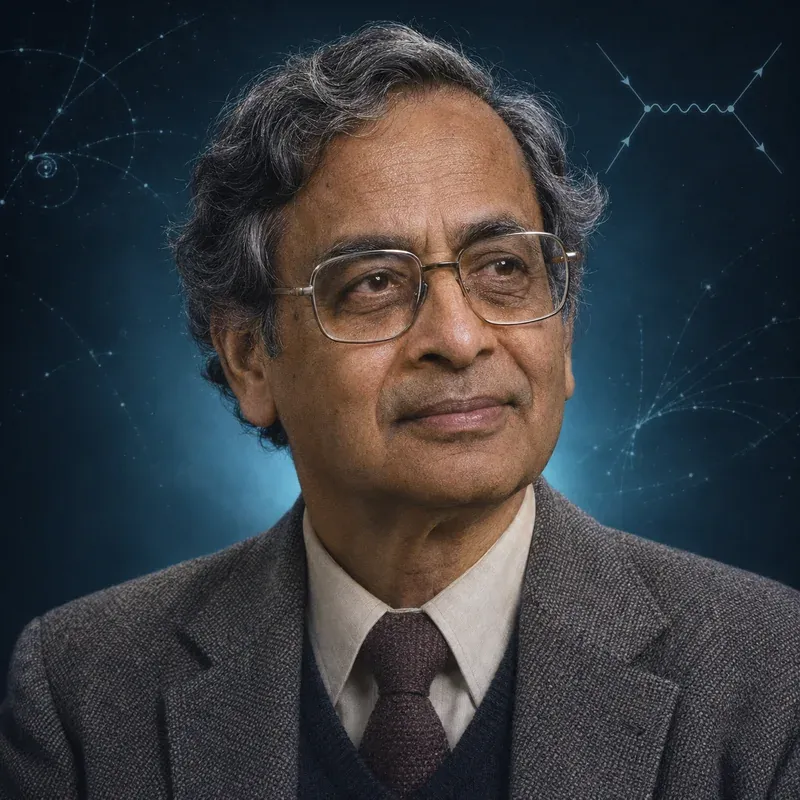
 Illustration
Jogesh C. Pati
With Abdus Salam, Pati proposed in 1973–74 that quarks and leptons are members of the same multiplets, with lepton number acting as a fourth colour. The left–right symmetric gauge group of the Pati–Salam model requires a right-handed neutrino in every generation, the ingredient that the type-I seesaw mechanism later used to explain why neutrino masses are so small. With Rabindra Mohapatra he developed left–right symmetric models in which parity violation of the weak interaction arises from spontaneous symmetry breaking. The same unification ideas imply baryon- and lepton-number violation, including proton decay.
- Born
- 1937
Baripada, Odisha, British India - Nationality
- Indian-born American
- Field
- Theoretical particle physics; grand unification
- Institutions
- Ravenshaw College, Utkal University (BSc 1955), University of Delhi (MSc 1957), University of Maryland, College Park (PhD 1961; professor, later emeritus), SLAC National Accelerator Laboratory
Education and early career
Jogesh Chandra Pati was born in 1937 in Baripada, in today's Indian state of Odisha. He graduated from Ravenshaw College of Utkal University in 1955, took a master's degree at the University of Delhi in 1957 and moved to the United States for his doctorate, which he received from the University of Maryland, College Park, in 1961. Maryland remained his academic home for most of his career; he is now professor emeritus there and has also been associated with the SLAC National Accelerator Laboratory.
Quarks and leptons as one family
In the early 1970s the Standard Model was taking shape, but quarks and leptons appeared as unrelated sets of particles. Working with Abdus Salam, Pati asked whether they could be different faces of the same object. In 1973 the two proposed a unified lepton–hadron symmetry, and in their 1974 paper "Lepton number as the fourth color" they extended the three quark colours of the strong interaction by a fourth one: the lepton. The gauge group SU(2)L × SU(2)R × SU(4)C treats left- and right-handed particles on an equal footing at high energies.
Two consequences proved lasting. First, putting leptons and quarks in common multiplets implies that baryon number and lepton number need not be exactly conserved. Pati and Salam's 1973 letter "Is baryon number conserved?" was among the first to raise the possibility that the proton decays, the question that motivated large underground water detectors such as Kamiokande and IMB, which later became neutrino observatories. Second, the right-handed SU(2)R doublet needs a partner for the right-handed electron: a right-handed neutrino in every generation.
Why it matters for neutrino mass
A right-handed neutrino that is neutral under all Standard Model forces can carry a large Majorana mass. This is the starting point of the type-I seesaw mechanism, developed from 1977 by Peter Minkowski and in left–right models by Rabindra Mohapatra and Goran Senjanović, in which a heavy right-handed state pushes the light neutrino mass down to the sub-eV scale. In 1975 Pati and Mohapatra had already formulated a left–right symmetric model in which parity violation of the weak interaction is not built in but emerges when the right-handed gauge symmetry is broken at a higher energy. Pati–Salam symmetry is also contained in SO(10) grand unification, the framework most often used to connect neutrino masses with leptogenesis.
Recognition
In 2000 Pati shared the Dirac Medal of the International Centre for Theoretical Physics with Howard Georgi and Helen Quinn for pioneering contributions to the quest for a unified theory of quarks and leptons and of the strong, weak and electromagnetic interactions. In 2013 the Government of India awarded him the Padma Bhushan.
Known for
- Pati–Salam model (1973–74)
- Lepton number as the fourth colour (SU(4) colour)
- Early prediction of proton decay in unified gauge theories
- Left–right symmetric models (with R. N. Mohapatra, 1975)
- Dirac Medal of the ICTP (2000)
Chronology
- 1955BSc, Ravenshaw College
- 1957MSc, University of Delhi
- 1961PhD, University of Maryland
- 1973With Salam: unified lepton–hadron symmetry and proton decay
- 1974Pati–Salam paper 'Lepton number as the fourth color'
- 1975Left–right symmetric model with R. N. Mohapatra
- 2000Dirac Medal (with H. Georgi and H. Quinn)
- 2013Padma Bhushan
Original papers
- J. C. Pati, A. Salam, Is Baryon Number Conserved?, Phys. Rev. Lett. 31, 661 (1973)DOI 10.1103/PhysRevLett.31.661
- J. C. Pati, A. Salam, Lepton number as the fourth "color", Phys. Rev. D 10, 275 (1974)DOI 10.1103/PhysRevD.10.275
- R. N. Mohapatra, J. C. Pati, Left-right gauge symmetry and an "isoconjugate" model of CP violation, Phys. Rev. D 11, 566 (1975)DOI 10.1103/PhysRevD.11.566
Experiments
Connected people
Frequently asked questions
What is the Pati–Salam model?
A unified gauge theory from 1973–74 in which leptons are the fourth colour of quarks and the gauge group SU(2)L × SU(2)R × SU(4)C treats left- and right-handed fermions symmetrically.
How is Pati's work connected to neutrino mass?
The model requires a right-handed neutrino in each generation. Such heavy neutral states are the key ingredient of the seesaw mechanism that explains the smallness of neutrino masses.
Did Pati and Salam predict proton decay?
Their 1973 paper was among the first to argue that unifying quarks and leptons implies baryon-number violation and hence a decaying proton. No proton decay has been observed so far.
Mentioned in 2 pages
Terms 1
Last updated: · Editorial standard
Cite this page
Text
Neutrino Atlas (2026). “Jogesh C. Pati”. Retrieved 22 November 2026, from https://neutrino-atlas.com/people/jogesh-pati/BibTeX
@misc{neutrinoatlas2026peoplejogeshpati,
  title        = {Jogesh C. Pati},
  author       = {{Neutrino Atlas}},
  year         = {2026},
  url          = {https://neutrino-atlas.com/people/jogesh-pati/},
  note         = {Accessed 2026-11-22},
  language     = {english}
}