K2K
The first accelerator long-baseline experiment, sending neutrinos 250 km from KEK to Super-Kamiokande.
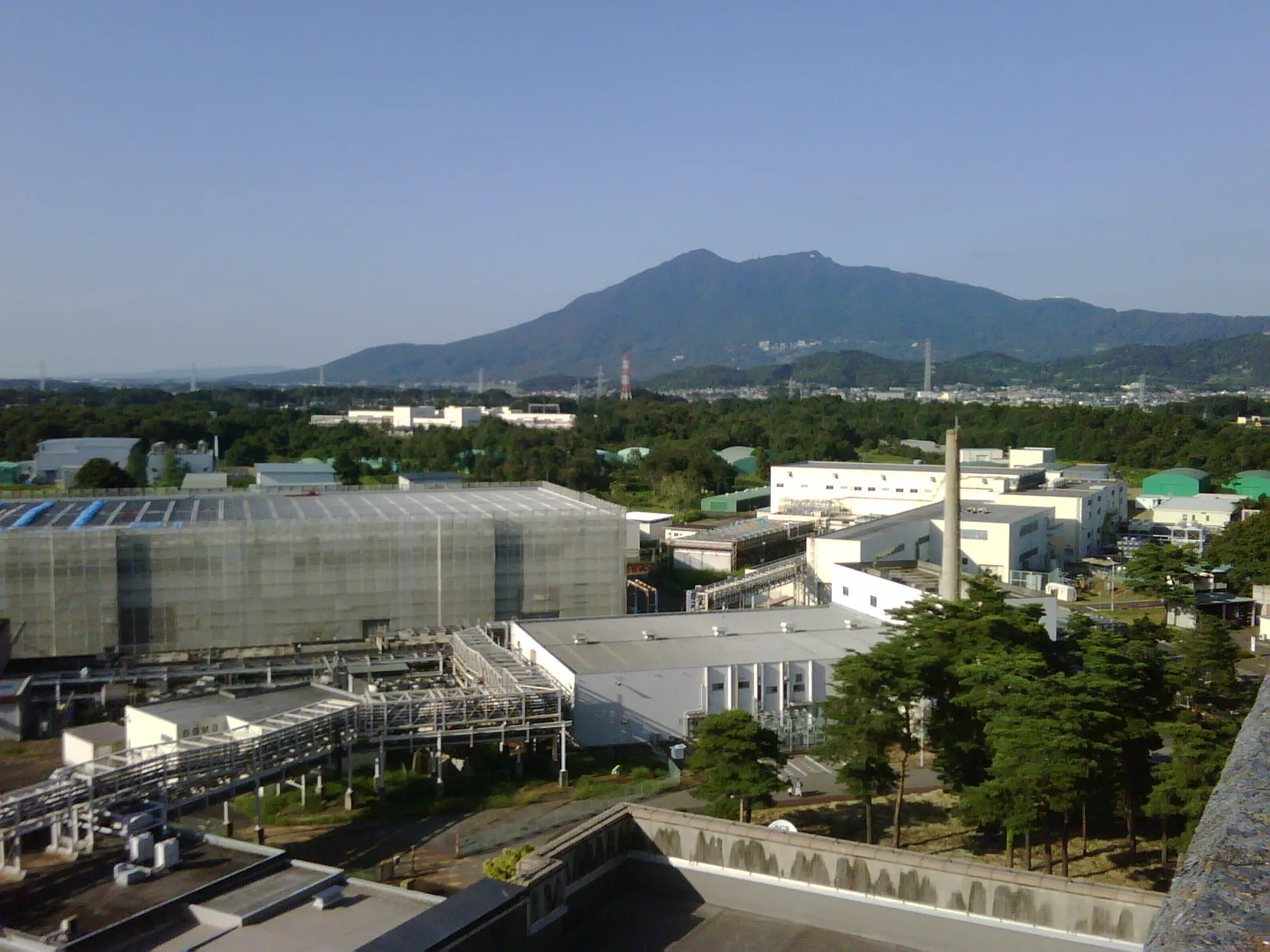
From 1999 to 2004 a 12 GeV proton beam at KEK produced νµ (about 1.3 GeV mean) measured in a near detector complex and at Super-K. K2K observed νµ disappearance and spectral distortion consistent with atmospheric oscillation.
Compare all experiments → · World map →
In plain words
In 1998 Super-Kamiokande reported that muon neutrinos made by cosmic rays go missing over long distances. K2K asked a direct question: does the same happen to muon neutrinos produced on purpose, counted before they leave, and sent 250 km across Japan? It was the first time an accelerator beam was aimed at a detector that far away.
How the experiment worked
Protons from the 12 GeV synchrotron at KEK in Tsukuba struck an aluminium target; magnetic horns focused the pions, whose decays produced a muon-neutrino beam with a mean energy of about 1.3 GeV. About 300 m downstream a near-detector complex, including a one-kilotonne water Cherenkov detector built like a miniature Super-K and, from 2003, the fully active SciBar scintillator tracker, measured the flux and energy spectrum. The far detector was Super-Kamiokande in the Kamioka mine. GPS timing linked beam spills to events at Super-K.
Key results
Beam data were taken from 1999 to 2004, interrupted after the November 2001 Super-Kamiokande PMT accident; the second phase ran with half the photomultiplier density. In total, 112 beam events were observed at Super-K, compared with about 158 expected without oscillation. The deficit and the distortion of the energy spectrum together excluded the no-oscillation hypothesis at about 4.3σ, and the preferred Δm² lay between about 1.9 and 3.5 × 10⁻³ eV² at 90 percent confidence, matching atmospheric data. SciBar also produced early neutrino cross-section results, such as the surprising absence of charged-current coherent pion production near 1 GeV.
Why it matters for neutrino physics
K2K turned the atmospheric anomaly into a controlled measurement and demonstrated the technique on which all later long-baseline experiments rely: near detector, far detector, precise timing. Its leader Koichiro Nishikawa went on to found T2K, which reused Super-K with a much more intense beam. K2K and T2K shared the 2016 Breakthrough Prize in Fundamental Physics with other oscillation experiments.
Frequently asked questions
Why was K2K less precise than atmospheric measurements?
Its beam was weak by modern standards, so Super-K recorded only about a hundred beam events. Its value was independence: a man-made source with a known flux and timing.
What replaced K2K?
T2K, which started in 2010 with a beam from J-PARC in Tokai, 295 km from Super-Kamiokande.
Original papers
- First resultM. H. Ahn et al. (K2K Collaboration), Indications of neutrino oscillation in a 250 km long-baseline experiment, Phys. Rev. Lett. 90, 041801 (2003)DOI 10.1103/PhysRevLett.90.041801arXiv:hep-ex/0212007
- Final resultM. H. Ahn et al. (K2K Collaboration), Measurement of neutrino oscillation by the K2K experiment, Phys. Rev. D 74, 072003 (2006)DOI 10.1103/PhysRevD.74.072003arXiv:hep-ex/0606032
Related terms
People
- Arthur B. McDonald
- Atsuto Suzuki
- Kam-Biu Luk
- Kōichirō Nishikawa
- Takaaki Kajita
- Wang Yifang
- Yoji Totsuka
- John G. Learned
- Yōichirō Suzuki
- Takashi Kobayashi
- Tsuyoshi Nakaya
On the timeline
- 1999K2K starts the first long-baseline experiment
- 2015Breakthrough Prize honours five oscillation experiments
Mentioned in 37 pages
Milestones 10
- 1988 · Nobel Prize for the muon neutrino
- 1996 · Super-Kamiokande begins operation
- 1998 · Super-Kamiokande discovers neutrino oscillation
- 1999 · K2K starts the first long-baseline experiment
- 2001 · Implosion chain destroys most Super-K photomultipliers
- 2004 · Super-K sees the oscillation dip in L/E
- 2006 · MINOS confirms muon-neutrino disappearance
- 2011 · T2K finds hints of electron-neutrino appearance
People 9
- Henry W. Sobel
- John G. Learned
- Kōichirō Nishikawa
- Soo-Bong Kim
- Takaaki Kajita
- Takashi Kobayashi
- Tsuyoshi Nakaya
- Yōichirō Suzuki
1 more
Terms 16
Last updated: · Editorial standard
Cite this page
Text
Neutrino Atlas (2026). “K2K”. Retrieved 22 November 2026, from https://neutrino-atlas.com/terms/k2k/BibTeX
@misc{neutrinoatlas2026termsk2k,
  title        = {K2K},
  author       = {{Neutrino Atlas}},
  year         = {2026},
  url          = {https://neutrino-atlas.com/terms/k2k/},
  note         = {Accessed 2026-11-22},
  language     = {english}
}