2011Discovery
T2K finds hints of electron-neutrino appearance
T2K, sending an off-axis beam from J-PARC in Tokai 295 km to Super-Kamiokande, announced on 15 June 2011 six electron-neutrino candidate events where 1.5 were expected without θ₁₃. It was the first indication, at 2.5σ, that muon neutrinos oscillate into electron neutrinos and that θ₁₃ is not zero. Data taking was interrupted by the March 2011 earthquake. T2K established electron appearance at more than 7σ in 2013.
- Date
- 15 June 2011
- Kind of event
- Discovery
- People involved
- Takashi Kobayashi, Kōichirō Nishikawa
- Experiments
- T2K, J-PARC Neutrino Beam, Super-Kamiokande
The situation before
By 2010 two of the three mixing angles were well measured, but the third, θ13, was known only to be small. The reactor experiment CHOOZ had set an upper limit of sin²2θ13 < 0.15 in the late 1990s, and some theorists expected it to be exactly zero. The question mattered beyond completeness. Only if θ13 is non-zero can neutrinos show leptonic CP violation in oscillations, and only then can long-baseline experiments measure it. An accelerator beam offered a direct test: a small fraction of muon neutrinos should turn into electron neutrinos over a few hundred kilometres, with a probability roughly proportional to sin²2θ13.
The experiment
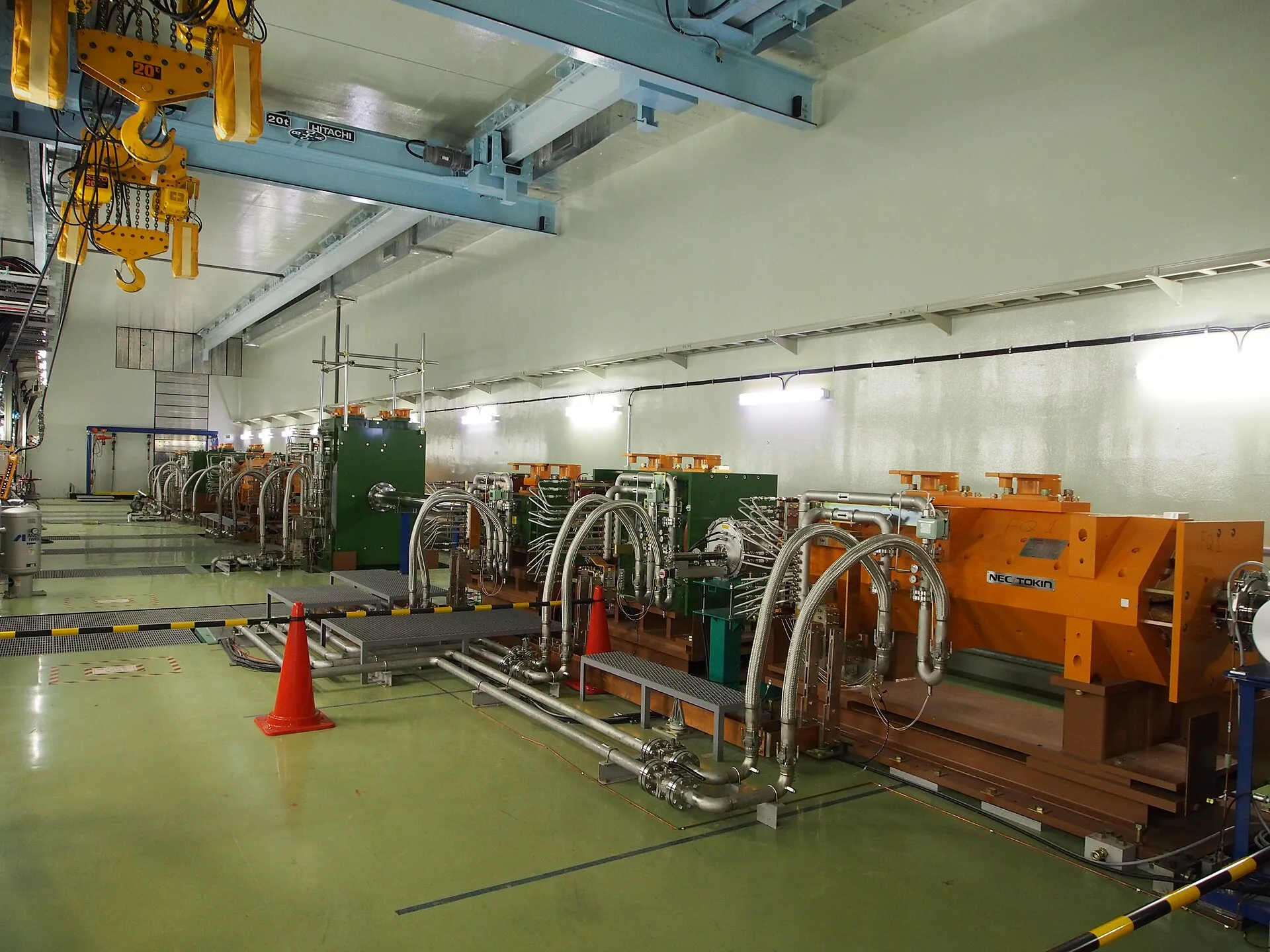
T2K, founded by Koichiro Nishikawa after the success of K2K, used the new proton accelerator complex J-PARC at Tokai on Japan's east coast. Its muon-neutrino beam was aimed 2.5 degrees away from Super-Kamiokande, 295 km to the west. This off-axis geometry produces a narrow energy peak near 0.6 GeV, at the first oscillation maximum, and reduces high-energy backgrounds. A near detector complex 280 m from the target measured the beam before oscillation. Takashi Kobayashi, who had led construction of the beamline, was spokesperson of a collaboration of over 500 physicists from twelve countries.
What happened
Physics data taking began in January 2010. On 11 March 2011 the Great East Japan earthquake struck; the Tokai site was damaged and the beam stopped. With the data collected until then, about 2 percent of the planned total, the collaboration completed its analysis and announced the result on 15 June 2011.
- Exposure: 1.43 × 10²⁰ protons on target.
- Six events at Super-Kamiokande passed all electron-neutrino selection criteria.
- Expected if θ13 = 0: 1.5 ± 0.3 events from background and the small solar-term contribution.
- Probability of a fluctuation: 0.7 percent, equivalent to 2.5σ.
- Allowed range at 90 percent confidence: 0.03 < sin²2θ13 < 0.28 for normal ordering and δCP = 0.
The paper „Indication of electron neutrino appearance from an accelerator-produced off-axis muon neutrino beam“ was published in Physical Review Letters 107, 041801 (2011).
Reaction
Although the significance was modest, the result changed expectations almost overnight. It was the first indication of electron-neutrino appearance in a muon-neutrino beam and suggested that θ13 was near the upper end of the allowed range, which meant the reactor experiments then starting would see it quickly. Within months the picture filled in: MINOS reported a weaker hint in June 2011, Double Chooz an indication in November 2011, and in March 2012 Daya Bay measured a non-zero θ13 at 5.2σ, followed by RENO.
Consequences
J-PARC resumed operation in early 2012 after repairs. In July 2013 T2K reported 28 electron-neutrino events with about 5 expected, establishing electron-neutrino appearance at 7.3σ. With θ13 known, T2K turned to comparing neutrinos and antineutrinos; in 2020 it published in Nature constraints on the CP phase δCP that disfavour large regions of parameter space. The 2011 indication is thus the starting point of the search for CP violation that Hyper-Kamiokande and DUNE will continue.
Frequently asked questions
What did T2K announce on 15 June 2011?
Six electron-neutrino candidates at Super-Kamiokande where 1.5 were expected if θ13 were zero, the first indication, at 2.5σ, that muon neutrinos oscillate into electron neutrinos.
How did the 2011 earthquake affect T2K?
The earthquake of 11 March 2011 damaged J-PARC and stopped the beam. T2K published its result with the data taken until then, and the beam resumed in 2012.
When was electron-neutrino appearance firmly established?
In 2013, when T2K observed 28 events with about 5 expected, a significance of 7.3σ.
Original papers
- DiscoveryK. Abe et al. (T2K), Indication of Electron Neutrino Appearance from an Accelerator-produced Off-axis Muon Neutrino Beam, Phys. Rev. Lett. 107, 041801 (2011)DOI 10.1103/PhysRevLett.107.041801arXiv:1106.2822
- MeasurementK. Abe et al. (T2K), Observation of Electron Neutrino Appearance in a Muon Neutrino Beam, Phys. Rev. Lett. 112, 061802 (2014)DOI 10.1103/PhysRevLett.112.061802
Concepts
Mentioned in 2 pages
Last updated: · Editorial standard
Cite this page
Text
Neutrino Atlas (2026). “2011: T2K finds hints of electron-neutrino appearance”. Retrieved 22 November 2026, from https://neutrino-atlas.com/timeline/2011-t2k-electron-appearance/BibTeX
@misc{neutrinoatlas2026011t2kelectronappearance,
  title        = {2011: T2K finds hints of electron-neutrino appearance},
  author       = {{Neutrino Atlas}},
  year         = {2026},
  url          = {https://neutrino-atlas.com/timeline/2011-t2k-electron-appearance/},
  note         = {Accessed 2026-11-22},
  language     = {english}
}