J-PARC Neutrino Beam
Japan's 30 GeV proton-driven neutrino beam sending νµ 295 km to Kamioka.
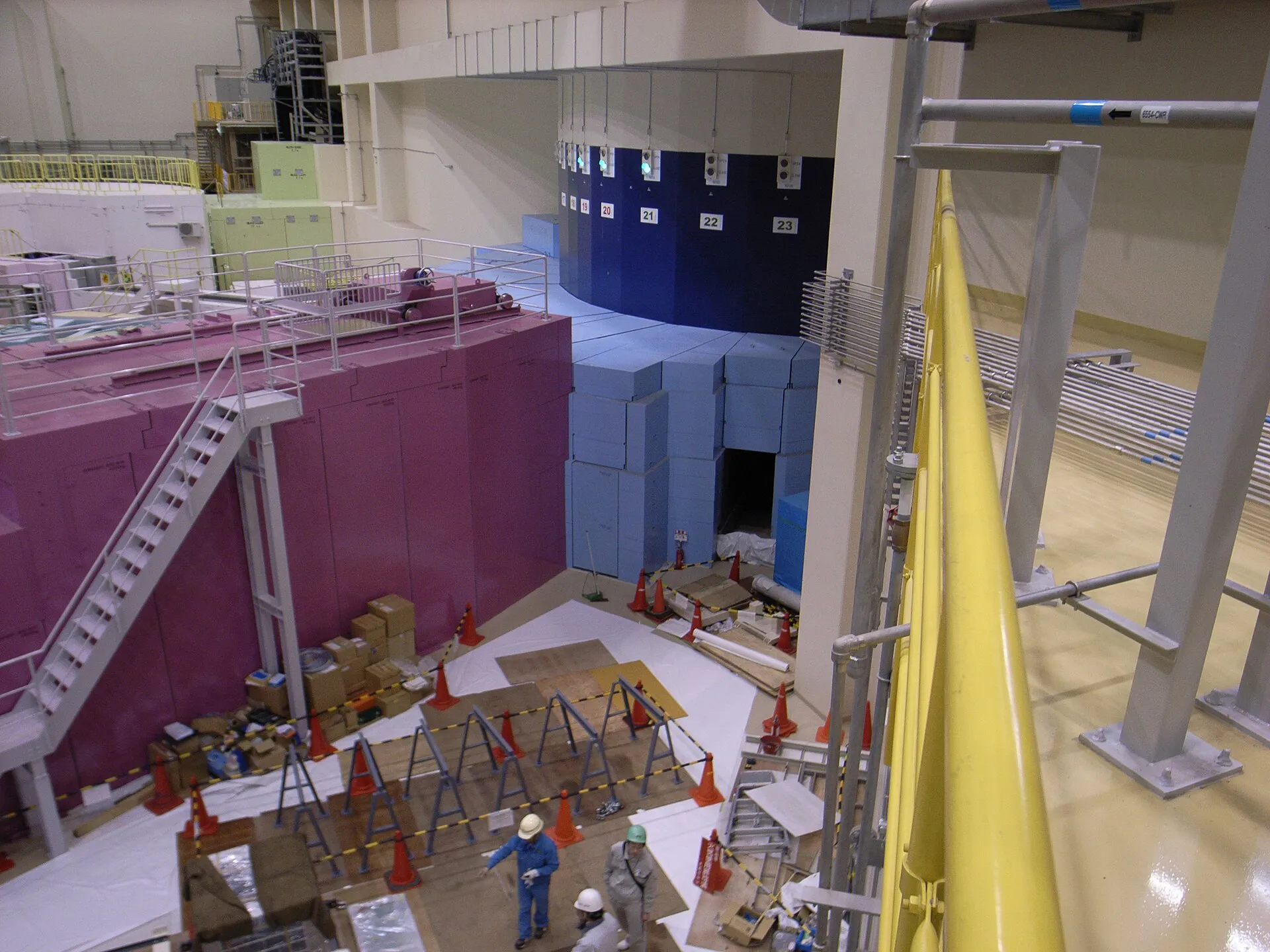
The J-PARC Main Ring delivers 30 GeV protons to a graphite target with three horns, producing an off-axis beam (2.5°) peaked near 0.6 GeV for T2K and future Hyper-Kamiokande. A power upgrade towards 1.3 MW is under way.
Compare all experiments → · World map →
In plain words
On Japan's Pacific coast at Tokai, the J-PARC accelerator complex fires protons into a graphite target and sends the resulting muon neutrinos under the island to Super-Kamiokande, 295 km to the west. The beam is aimed slightly beside the detector, which gives a sharply peaked energy spectrum tuned exactly to the oscillation maximum.
In detail
The 30 GeV Main Ring delivers fast-extracted spills onto a 91 cm graphite target. Three magnetic horns focus the pions into a 96 m decay volume. The beam axis points 2.5° away from Super-Kamiokande, so the off-axis beam peaks near 0.6 GeV, where the first oscillation maximum lies for 295 km. A near-detector complex 280 m from the target, including ND280 on the off-axis direction and INGRID on axis, measures the unoscillated beam. Operation started in 2010. After a Main Ring power supply upgrade, stable running at a record of about 800 kW was reported in 2024, and the goal for Hyper-Kamiokande is 1.3 MW.
Key results
In 2011 T2K saw the first indication of electron-neutrino appearance, pointing to a non-zero θ₁₃, and in 2013 it established appearance at more than 7σ. Running with both horn polarities, T2K later reported the first constraints disfavouring CP conservation in the lepton sector (Nature, 2020).
Why it matters
The same beam, upgraded, will drive Hyper-Kamiokande's search for leptonic CP violation, complementary to LBNF and DUNE with a shorter baseline and smaller matter effects.
Frequently asked questions
Why is the J-PARC beam aimed 2.5° off axis?
At an angle, pion decay kinematics give nearly the same neutrino energy for a wide range of pion energies, so the spectrum becomes narrow and sits at the oscillation maximum, with fewer high-energy background events.
How far does the beam travel?
295 km from Tokai to the Kamioka mine, passing up to about 10 km below the surface.
Original papers
- ProposalK. Abe et al. (T2K Collaboration), The T2K Experiment, Nucl. Instrum. Meth. A 659, 106 (2011)DOI 10.1016/j.nima.2011.06.067
- MeasurementK. Abe et al. (T2K Collaboration), T2K neutrino flux prediction, Phys. Rev. D 87, 012001 (2013)DOI 10.1103/PhysRevD.87.012001arXiv:1211.0469
Related terms
People
Latest research on this topic
- T2K Status and Prospect with J-PARC Neutrino Beam and Near Detector UpgradesVladisavljevic, Tomislav · 2026
On the timeline
Mentioned in 20 pages
Comparisons 1
Milestones 2
People 7
Last updated: · Editorial standard
Cite this page
Text
Neutrino Atlas (2026). “J-PARC Neutrino Beam”. Retrieved 22 November 2026, from https://neutrino-atlas.com/terms/j-parc-beam/BibTeX
@misc{neutrinoatlas2026termsjparcbeam,
  title        = {J-PARC Neutrino Beam},
  author       = {{Neutrino Atlas}},
  year         = {2026},
  url          = {https://neutrino-atlas.com/terms/j-parc-beam/},
  note         = {Accessed 2026-11-22},
  language     = {english}
}