NA61/SHINE
A hadron spectrometer at the CERN SPS that measures particle production in targets used by accelerator neutrino beams.
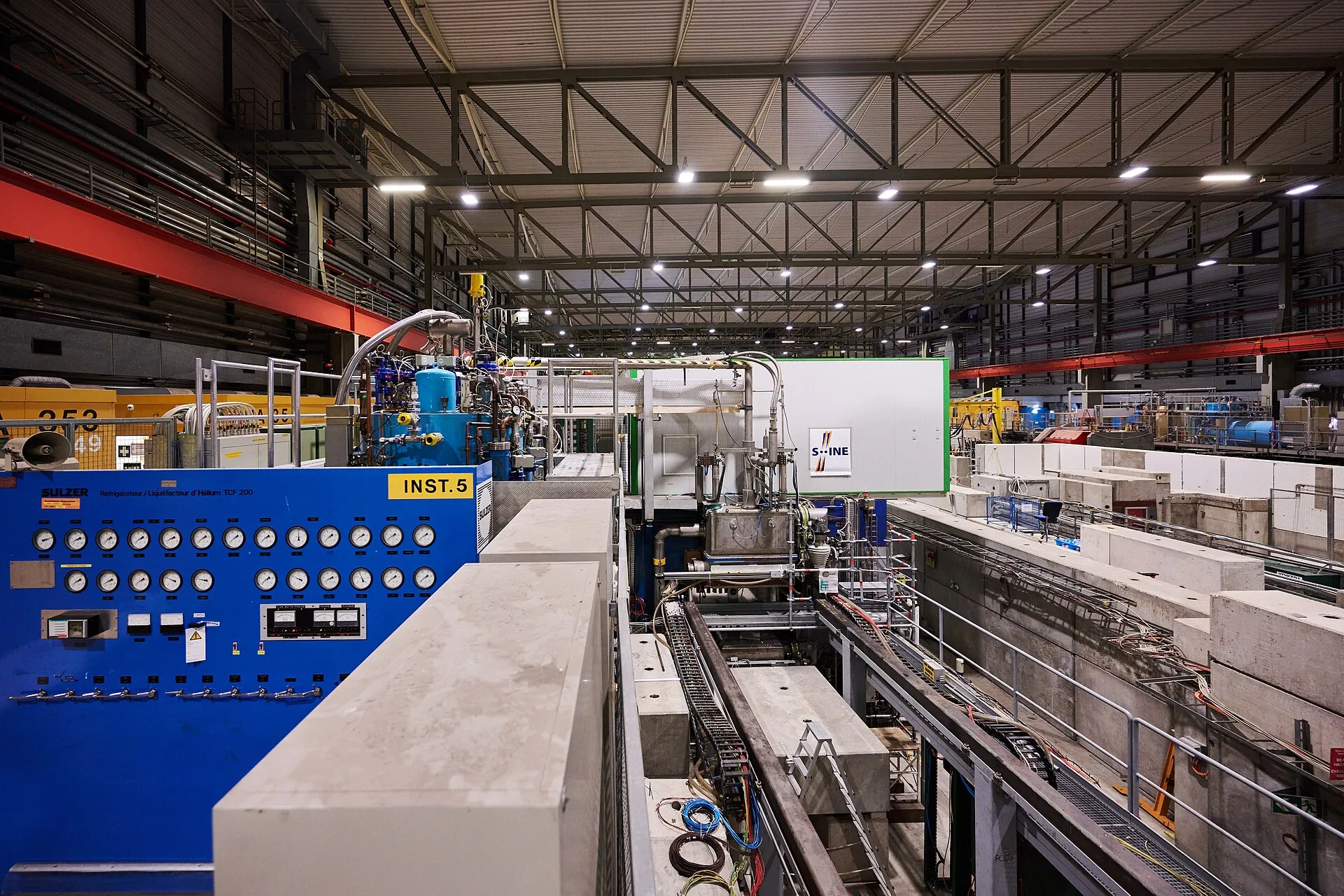
NA61/SHINE is a large-acceptance spectrometer built around time projection chambers on CERN's H2 beamline, in data taking since a 2007 pilot run. It has measured π±, K± and proton yields from thin targets and from a replica of the 90 cm T2K graphite target with 31 GeV/c protons, and 120 GeV/c proton–carbon data for NuMI and LBNF, sharply reducing hadron-production uncertainties in neutrino flux predictions.
Compare all experiments → · World map →
In plain words
An accelerator neutrino beam starts with protons striking a target. The collision sprays out pions and kaons, which are focused by a magnetic horn and decay into neutrinos. To predict how many neutrinos of each energy a beam contains, physicists must know how many pions and kaons the target produces, at which angles and momenta. Simulations alone cannot supply this to the precision oscillation experiments need. NA61/SHINE measures it directly.
How the experiment works
NA61/SHINE, the SPS Heavy Ion and Neutrino Experiment, reuses and upgrades the large time projection chambers of its predecessor NA49 in CERN's North Area. Charged particles leaving the target curve in magnetic fields; their tracks give the momentum, and their energy loss and time of flight identify them as pions, kaons or protons. The experiment studies two kinds of targets. Thin targets give the basic production cross-sections. Replica targets copy the real beam target exactly, so the measured yields already include particles produced in secondary interactions inside the long target, which are otherwise hard to model.
Key results for neutrino physics
- For T2K, NA61/SHINE took data with 31 GeV/c protons on a thin carbon target and on a replica of the 90 cm graphite T2K target in 2007, 2009 and 2010. Using these data roughly halved the hadron-interaction part of the T2K flux uncertainty, bringing it to the level of a few percent.
- Replica-target data from the 2010 run gave the first measured K± and proton yields from the surface of the T2K target (Eur. Phys. J. C, 2019).
- For the Fermilab beams NuMI and LBNF, the collaboration measured 120 GeV/c proton–carbon interactions recorded in 2016 and 2017, along with other beam particles and target materials.
Why it matters
Oscillation analyses compare the neutrinos seen in a far detector with a prediction of the unoscillated flux. Near detectors cancel part of the uncertainty, but not all of it, since the near and far fluxes differ. Hadron-production data such as those from NA61/SHINE therefore remain an input to DUNE and Hyper-Kamiokande, alongside the experiment's programmes on heavy-ion collisions and cosmic-ray air showers.
Frequently asked questions
Why is a replica target needed?
In a long target many neutrino parents come from secondary interactions of the produced hadrons. A replica captures these effects in the measurement itself instead of relying on models.
Is NA61/SHINE a neutrino detector?
No. It detects no neutrinos at all; it measures the hadrons whose decays produce neutrino beams.
Original papers
- First resultN. Abgrall et al. (NA61/SHINE Collaboration), Measurements of Cross Sections and Charged Pion Spectra in Proton-Carbon Interactions at 31 GeV/c, Phys. Rev. C 84, 034604 (2011)DOI 10.1103/PhysRevC.84.034604arXiv:1102.0983
- MeasurementN. Abgrall et al. (NA61/SHINE Collaboration), Measurements of π±, K± and proton yields from the surface of the T2K replica target for incoming 31 GeV/c protons with the NA61/SHINE spectrometer at the CERN SPS, Eur. Phys. J. C 79, 100 (2019)arXiv:1808.04927
Related terms
Latest research on this topic
- Unexpectedly large violation of isospin symmetry in nucleus-nucleus collisions at CERN SPS energiesNA61/SHINE Collaboration · 16 October 2026
- Overview of the NA61/SHINE ExperimentDalmazzone, Claire · October 2026
- News from NA61/SHINENA61/SHINE Collaboration · 8 September 2026
- News on charged and neutral hadron production from NA61/SHINEBalkova, Yuliia, Lewicki, Maciej P. · 5 August 2026
- K*(892)0 production and the time between freeze-outs in 40Ar+45Sc collisions by NA61/SHINE at the CERN SPSNA61/SHINE Collaboration · 6 July 2026
- Investigation of the onset of deconfinement with the NA61/SHINE experimentBazgir, A. · 30 May 2026
Mentioned in 5 pages
Last updated: · Editorial standard
Cite this page
Text
Neutrino Atlas (2026). “NA61/SHINE”. Retrieved 22 November 2026, from https://neutrino-atlas.com/terms/na61-shine/BibTeX
@misc{neutrinoatlas2026termsna61shine,
  title        = {NA61/SHINE},
  author       = {{Neutrino Atlas}},
  year         = {2026},
  url          = {https://neutrino-atlas.com/terms/na61-shine/},
  note         = {Accessed 2026-11-22},
  language     = {english}
}