2011Experiment
OPERA neutrino-speed anomaly and its resolution
On 23 September 2011 OPERA reported that CNGS neutrinos appeared to arrive about 60 nanoseconds earlier than light would over the 730 km from CERN, suggesting faster-than-light travel. The collaboration asked for independent scrutiny. In early 2012 the effect was traced to a loose fibre-optic connector and a clock oscillator problem, and ICARUS measured a speed consistent with that of light. Coordinator Antonio Ereditato stepped down in March 2012.
- Date
- 23 September 2011
- Kind of event
- Experiment
- People involved
- Antonio Ereditato
- Experiments
- OPERA, ICARUS, CNGS (CERN Neutrinos to Gran Sasso)
The situation before
Measuring neutrino speed was a side project for OPERA, whose main goal was tau appearance. The CNGS beam came in short proton extractions from CERN, so the arrival times of neutrinos at Gran Sasso could be compared with the departure times, given a precise distance and synchronised clocks. Earlier measurements, by MINOS in 2007 and from supernova SN 1987A, had found no significant deviation from the speed of light. SN 1987A was especially strong: its neutrinos arrived within hours of the light after 168,000 years of travel, limiting any speed excess to roughly a part in a billion.
What happened
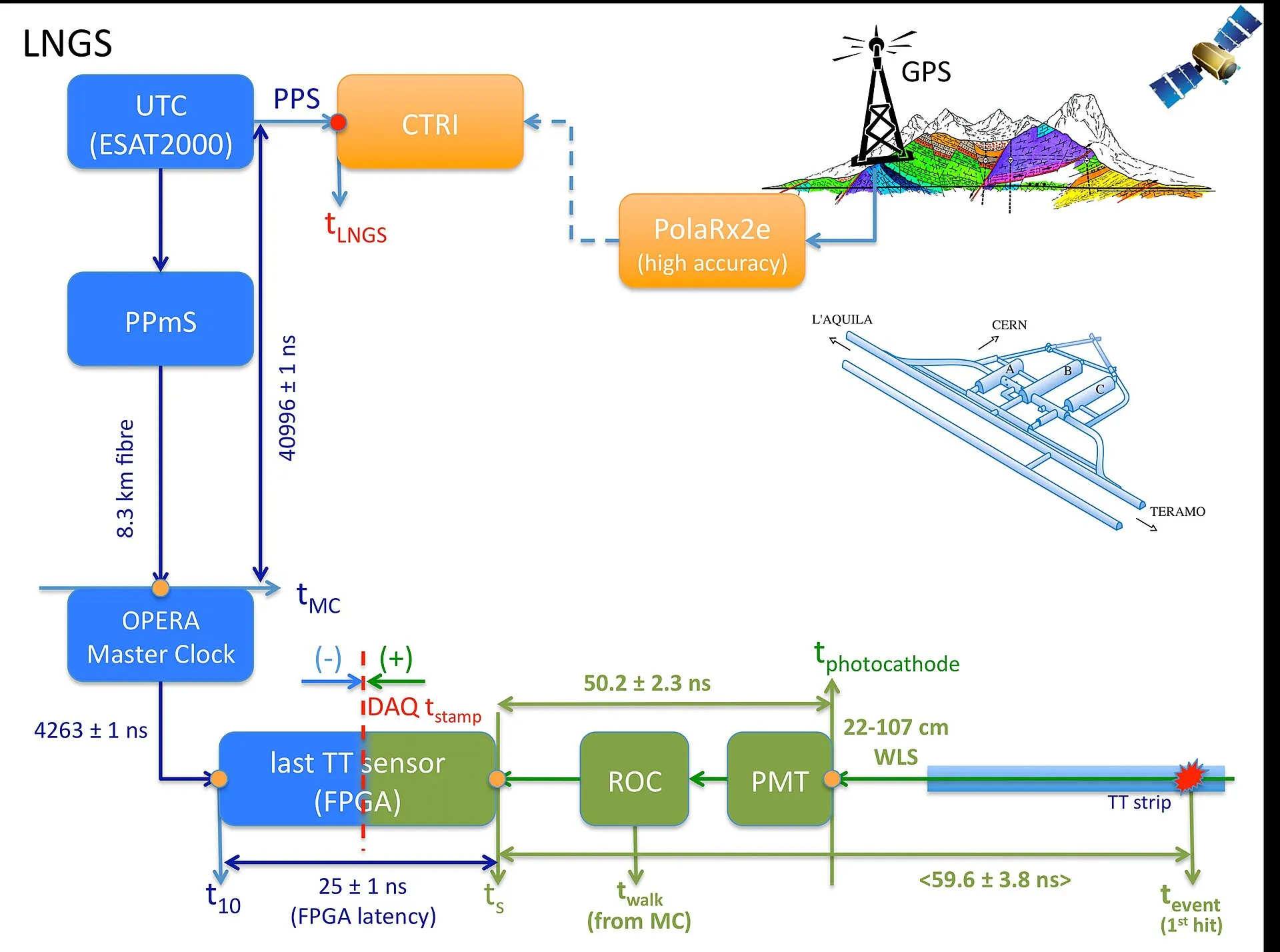
OPERA upgraded its timing with GPS receivers and atomic clocks, and geodesists measured the 730 km baseline to about 20 cm. Analysing about 16,000 events from 2009 to 2011, the collaboration found that neutrinos arrived (60.7 ± 6.9 stat ± 7.4 syst) nanoseconds earlier than light would have, a 6σ effect corresponding to (v − c)/c ≈ 2.5 × 10⁻⁵. The analysis is described on the page for the OPERA anomaly.
The collaboration posted its paper on arXiv on 22 September 2011, and on 23 September physics coordinator Dario Autiero presented it at a CERN seminar webcast worldwide. The team said it had found no explanation and asked for independent scrutiny. Spokesperson Antonio Ereditato stressed that the collaboration was not claiming a discovery. Several members declined to sign the paper, arguing that more checks were needed.
Reaction
- Media worldwide reported possible faster-than-light neutrinos; most physicists expected a hidden error.
- Sheldon Glashow and Andrew Cohen showed that superluminal neutrinos should lose energy by emitting electron–positron pairs; ICARUS, at the same laboratory, found no such energy loss in the CNGS beam.
- In November 2011 OPERA repeated the measurement with very short beam bunches and saw the same early arrival in 20 events, ruling out a statistical artefact of the pulse shape.
Resolution
In February 2012 OPERA reported two possible instrumental problems: a fibre-optic cable between the GPS receiver and the master clock was not fully connected, which delayed the reference signal, and a clock oscillator ran slightly off frequency. In March 2012 ICARUS measured the speed of seven CNGS neutrinos and found it consistent with light. On 30 March 2012 Ereditato resigned as spokesperson after a vote in the collaboration, and Autiero gave up his coordination role. In June 2012, at the Neutrino 2012 conference in Kyoto, OPERA, ICARUS, Borexino and LVD all presented results consistent with the speed of light; OPERA's corrected value was compatible with zero deviation.
Why it matters
The episode became a widely cited case study of a systematic uncertainty hidden in hardware, and of how open publication, replication by competing experiments and sober communication can settle a sensational claim within months.
Frequently asked questions
Did neutrinos travel faster than light at OPERA?
No. The early arrival of about 60 ns was caused by a loosely connected fibre-optic cable and a clock problem. Corrected measurements and those of other experiments agree with the speed of light.
Why did Antonio Ereditato resign?
He stepped down as OPERA spokesperson on 30 March 2012 after a vote in the collaboration, following criticism of how the anomaly had been communicated.
Original papers
- MeasurementT. Adam et al. (OPERA), Measurement of the neutrino velocity with the OPERA detector in the CNGS beam, JHEP 10, 093 (2012)arXiv:1109.4897
- MeasurementM. Antonello et al. (ICARUS), Measurement of the neutrino velocity with the ICARUS detector at the CNGS beam, Phys. Lett. B 713, 17 (2012)arXiv:1203.3433
Concepts
Mentioned in 1 page
Lessons 1
Last updated: · Editorial standard
Cite this page
Text
Neutrino Atlas (2026). “2011: OPERA neutrino-speed anomaly and its resolution”. Retrieved 22 November 2026, from https://neutrino-atlas.com/timeline/2011-opera-speed-anomaly/BibTeX
@misc{neutrinoatlas2026ine2011operaspeedanomaly,
  title        = {2011: OPERA neutrino-speed anomaly and its resolution},
  author       = {{Neutrino Atlas}},
  year         = {2026},
  url          = {https://neutrino-atlas.com/timeline/2011-opera-speed-anomaly/},
  note         = {Accessed 2026-11-22},
  language     = {english}
}