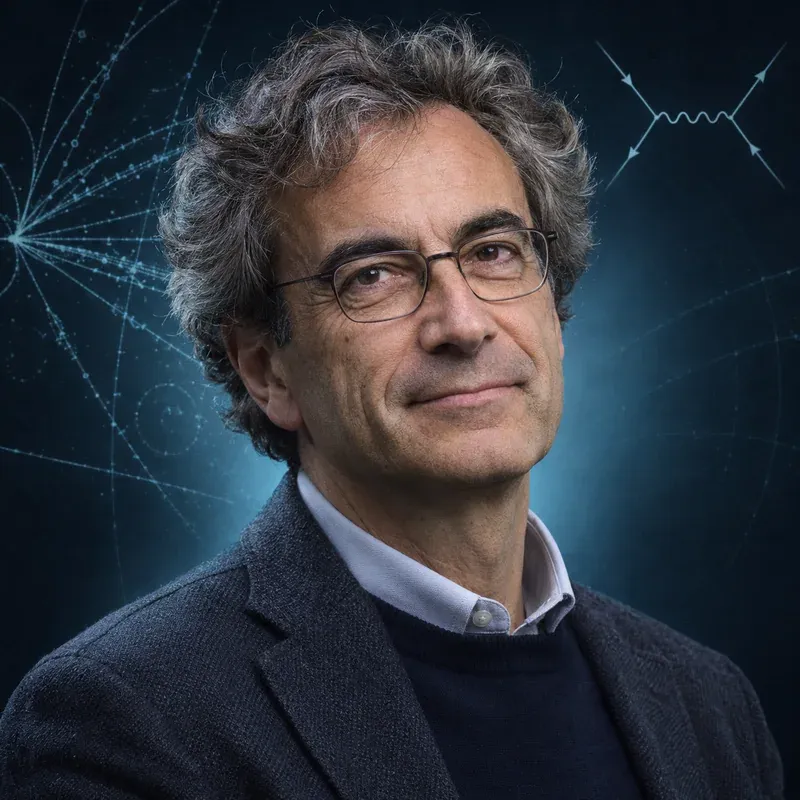
 Illustration
Antonio Ereditato
Ereditato coordinated OPERA, which used the CNGS muon-neutrino beam from CERN to Gran Sasso (about 730 km) to search directly for tau-neutrino appearance. In September 2011 OPERA reported neutrinos arriving about 60 ns earlier than light would; the anomaly was traced to technical problems, and Ereditato stepped down at the end of March 2012 ahead of a no-confidence vote.
- Nationality
- Italian
- Field
- Experimental particle physics
- Institutions
- INFN, University of Bern
Education and early career
Antonio Ereditato was born in Naples on 2 June 1955. He studied physics at the University of Naples Federico II, graduating in 1981 and completing his PhD in 1987. He worked at CNRS in Strasbourg, at CERN and at INFN in Naples, where he became director of research in 1998.
Emulsions and tau neutrinos
Much of Ereditato's work centred on nuclear emulsion, a photographic technique that records particle tracks with micrometre precision. In the CHORUS experiment at CERN he proposed and led detector innovations. In 1997, together with Kimio Niwa and Paolo Strolin, he co-proposed OPERA, designed to catch muon neutrinos from the CNGS beam turning into tau neutrinos on their 730 km path from CERN to the Gran Sasso laboratory. Such direct appearance of a new flavour is the most explicit proof of oscillation. Ereditato was OPERA's spokesperson from 2008 and on 31 May 2010 announced its first tau-neutrino candidate.
The faster-than-light anomaly
In September 2011 OPERA reported that neutrinos appeared to reach Gran Sasso about 60 nanoseconds earlier than light would. The collaboration presented the result as an unexplained anomaly and asked others to check it. It was later traced to instrumental problems, including a loose fibre-optic connector in the timing chain, and the ICARUS experiment measured a neutrino speed consistent with that of light; the episode is described under OPERA faster-than-light anomaly. Amid the fallout, Ereditato stepped down as spokesperson at the end of March 2012. OPERA continued and by 2015 had collected enough tau candidates to claim discovery of muon-to-tau oscillation.
Later work
From 2006 to 2020 Ereditato was professor of experimental particle physics at the University of Bern, where he directed the Laboratory for High Energy Physics and later the Albert Einstein Center for Fundamental Physics. His group took part in T2K, contributed to liquid-argon detector development for MicroBooNE and was among the founders of DUNE. He later held visiting professorships at Yale and the University of Chicago and has written several books on particle physics, among them Ever Smaller (MIT Press, 2020).
Known for
- Spokesperson of OPERA
- 2011 'faster-than-light' neutrino anomaly
- Resignation as OPERA coordinator (March 2012)
Chronology
- 2011OPERA neutrino-velocity anomaly announced (September)
- 2012Steps down as OPERA coordinator (30 March)
Experiments
Connected people
Frequently asked questions
Why did Antonio Ereditato resign from OPERA?
He stepped down as spokesperson in March 2012 after the 2011 faster-than-light result was traced to instrumental faults and the collaboration's handling of the announcement had been criticised.
Did OPERA find tau neutrinos?
Yes. It announced the first candidate in 2010 and by 2015 had enough events to establish the appearance of tau neutrinos in a muon-neutrino beam.
On the timeline
Mentioned in 6 pages
Last updated: · Editorial standard
Cite this page
Text
Neutrino Atlas (2026). “Antonio Ereditato”. Retrieved 22 November 2026, from https://neutrino-atlas.com/people/antonio-ereditato/BibTeX
@misc{neutrinoatlas2026peopleantonioereditato,
  title        = {Antonio Ereditato},
  author       = {{Neutrino Atlas}},
  year         = {2026},
  url          = {https://neutrino-atlas.com/people/antonio-ereditato/},
  note         = {Accessed 2026-11-22},
  language     = {english}
}