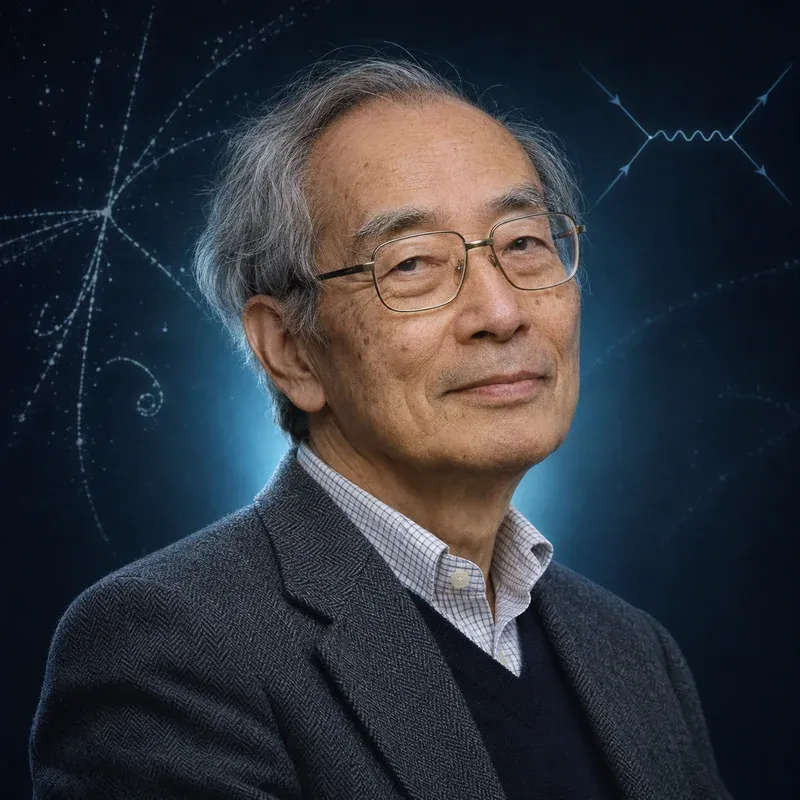
 Illustration
Kimio Niwa
Niwa led the Nagoya emulsion group in DONUT at Fermilab, whose computer-controlled scanning stations reconstructed particle tracks in the emulsion–iron target. This made possible the first direct observation of tau-neutrino charged-current interactions, announced in July 2000 (four events on an expected background of 0.34). He shared the 2022 Panofsky Prize with Lundberg, Rameika and Paolone.
- Nationality
- Japanese
- Field
- Experimental particle physics, nuclear emulsion techniques
- Institutions
- Nagoya University
Background
Kimio Niwa is a Japanese experimental physicist and professor emeritus of Nagoya University, long one of the world centres of nuclear emulsion physics. Emulsion is the oldest particle detector still in use: a gel of silver-halide crystals in which a charged particle leaves a latent trail of grains that becomes visible after development. Its spatial resolution of under a micrometre is unmatched by electronic detectors, which makes it ideal for seeing the decays of particles that live for only a fraction of a picosecond. Its weakness was always speed: until the 1970s every track had to be found by people looking through microscopes.
Automated emulsion scanning
Niwa's central contribution was to remove that bottleneck. Starting with work published in 1974, he and his Nagoya colleagues developed the Track Selector, a computer-controlled microscope system that takes images at many focal depths through an emulsion layer and automatically recognises straight track segments pointing in a given direction. Successive generations of the system were used in hadron experiments at CERN and Fermilab (WA75, E653) and in the CHORUS neutrino oscillation search at CERN. The JINR jury that awarded him the Bruno Pontecorvo Prize in 2020 cited him ‘for the development of the high-resolution nuclear emulsion technique’.
DONUT and the tau neutrino
The technique proved decisive for the last missing lepton of the Standard Model. The tau neutrino was expected since the discovery of the τ lepton in 1975, but its direct detection is hard: when a ντ interacts through the charged current it produces a τ lepton that travels only about a millimetre before decaying, so the signature is a track with a small kink or a short track followed by a decay vertex. The DONUT experiment at Fermilab, in which Byron Lundberg, Regina Rameika, Vittorio Paolone and Niwa's group played leading roles, produced a beam rich in tau neutrinos by dumping 800 GeV Tevatron protons into a tungsten target, where charmed Ds mesons decay into τ and ντ. The target consisted of iron plates interleaved with emulsion sheets and was exposed in 1997.
The Japanese emulsion physicists – Niwa's Nagoya group together with colleagues such as Koichi Kodama, first author of the DONUT papers – located the interaction vertices in the emulsion with automated scanning guided by the electronic spectrometer behind it. In July 2000 the collaboration announced four tau-neutrino events against an expected background of 0.34, among 203 located neutrino interactions – the first direct observation of the tau neutrino. The final analysis in 2008 raised the sample to nine events. Niwa shared the 2022 Panofsky Prize of the American Physical Society with Lundberg, Rameika and Paolone ‘for the first direct observation of the tau neutrino through its charged-current interactions in an emulsion detector’.
OPERA and legacy
Nagoya's scanning systems were scaled up again for OPERA, which exposed about 150,000 emulsion–lead bricks to the CNGS beam from CERN to Gran Sasso. Readout systems built in this tradition covered around 100 m² of emulsion and helped OPERA observe the appearance of tau neutrinos in a muon-neutrino beam, reaching 5.1σ significance with five events in 2015. Its successor, the Hyper Track Selector, now serves experiments such as FASERν at the LHC (see FASER).
Known for
- Automated nuclear-emulsion scanning
- DONUT first direct observation of the tau neutrino
- Bruno Pontecorvo Prize 2020
- Panofsky Prize 2022
Chronology
- 1997DONUT exposure in Tevatron neutrino beam
- 2000Tau neutrino observation announced (21 July)
- 2020Bruno Pontecorvo Prize
- 2022Panofsky Prize
Original papers
- K. Kodama et al. (DONUT), Observation of tau neutrino interactions, Phys. Lett. B 504, 218 (2001)DOI 10.1016/S0370-2693(01)00307-0
Experiments
Connected people
Frequently asked questions
What did Kimio Niwa contribute to the discovery of the tau neutrino?
He developed the automated emulsion scanning technology and led the Nagoya group in DONUT, which found the millimetre-scale tau decays in the emulsion target and so made the first direct observation of the tau neutrino in 2000.
Why use photographic emulsion in a modern experiment?
Because no electronic detector matches its sub-micrometre resolution, which is needed to see the short tau decay track. Automated scanning made it possible to read out large volumes.
Which prizes did Niwa receive?
The Bruno Pontecorvo Prize (2020) and the APS Panofsky Prize in Experimental Particle Physics (2022).
On the timeline
Mentioned in 15 pages
Lessons 1
Milestones 3
People 7
Last updated: · Editorial standard
Cite this page
Text
Neutrino Atlas (2026). “Kimio Niwa”. Retrieved 22 November 2026, from https://neutrino-atlas.com/people/kimio-niwa/BibTeX
@misc{neutrinoatlas2026peoplekimioniwa,
  title        = {Kimio Niwa},
  author       = {{Neutrino Atlas}},
  year         = {2026},
  url          = {https://neutrino-atlas.com/people/kimio-niwa/},
  note         = {Accessed 2026-11-22},
  language     = {english}
}