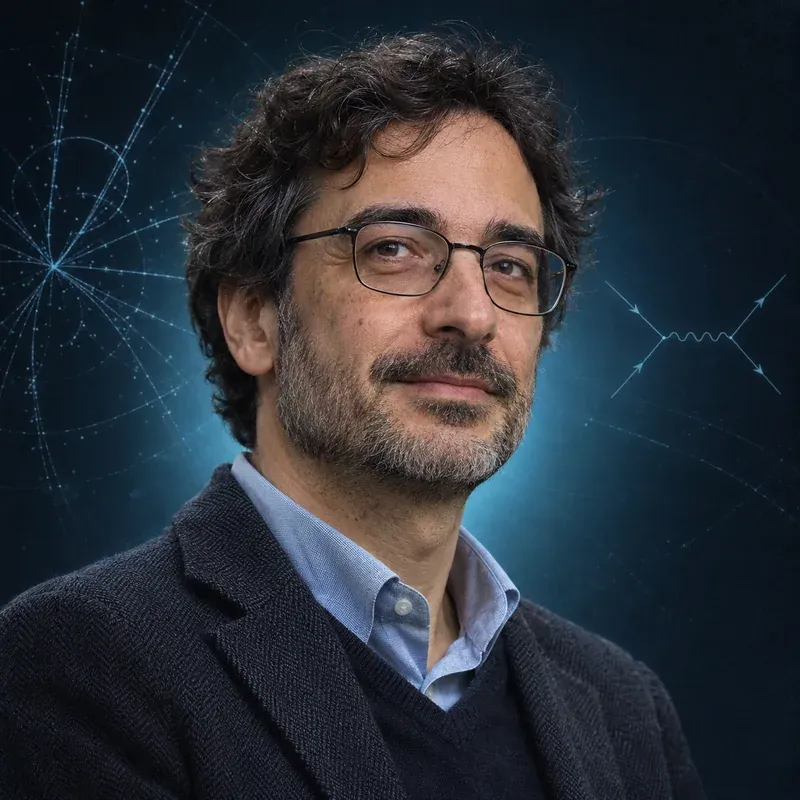
 Illustration
Vittorio Paolone
Paolone, of the University of Pittsburgh, was co-spokesperson of DONUT at Fermilab, which reported the first direct evidence of tau-neutrino charged-current interactions in 2000. He shared the 2022 Panofsky Prize for this observation.
- Field
- Experimental particle physics
- Institutions
- University of Pittsburgh
Background
Vittorio Paolone is an experimental particle physicist and professor in the Department of Physics and Astronomy at the University of Pittsburgh. His research has concentrated on neutrinos and on the short-lived particles that hybrid emulsion experiments are uniquely able to see. Before the tau-neutrino search he worked on Fermilab experiment E653, which combined a nuclear emulsion target with an electronic spectrometer to study the decays of charm and beauty hadrons; in 1996 it published a measurement of the Ds decay constant. That experience with emulsion–electronics hybrids prepared the ground for DONUT. He received a DOE Outstanding Junior Investigator Award in 1997.
DONUT
Paolone was spokesperson of DONUT (Fermilab E872), together with Byron Lundberg. The goal was to observe the tau neutrino directly, the last lepton of the Standard Model not yet seen interacting. Tevatron protons were stopped in a tungsten beam dump, where charmed Ds mesons decay to a tau lepton and a tau neutrino; magnets and shielding removed most other particles. Downstream, the neutrinos crossed stacks of iron and emulsion. When a tau neutrino interacts through the charged current, it produces a tau lepton that decays after about a millimetre. In Paolone's words at the time, the main signature of a tau lepton is a track with a kink.
Of roughly six million triggers, about a thousand candidate interactions were selected and located in the emulsion by the Nagoya group of Kimio Niwa and Koichi Kodama. On 21 July 2000 the collaboration announced four tau-neutrino events, the first direct observation of the particle. A final analysis in 2008 raised the number to nine. With Lundberg and Niwa, Paolone summarised the experiment in the 2003 Annual Review of Nuclear and Particle Science article 'Observation of the tau neutrino'. He received the University of Pittsburgh Chancellor's Distinguished Research Award in 2001 and shared the 2022 Panofsky Prize with Lundberg, Regina Rameika and Niwa.
Later work
Paolone went on to work on the long-baseline oscillation experiment MINOS in the NuMI beam and on MINERvA, which measures neutrino–nucleus cross sections needed by oscillation experiments, as well as on the ATLAS experiment at CERN's Large Hadron Collider.
Known for
- Co-spokesperson of DONUT
- First direct observation of the tau neutrino (2000)
- Panofsky Prize 2022
Chronology
- 2000DONUT announces tau neutrino observation
- 2022Panofsky Prize
Original papers
- K. Kodama et al. (DONUT), Observation of tau neutrino interactions, Phys. Lett. B 504, 218 (2001)DOI 10.1016/S0370-2693(01)00307-0
Experiments
Connected people
Frequently asked questions
What did Vittorio Paolone discover?
As co-spokesperson of DONUT he led the experiment that in 2000 made the first direct observation of tau-neutrino interactions.
How many tau neutrinos did DONUT see?
Four events at the July 2000 announcement, nine in the final 2008 analysis.
On the timeline
Mentioned in 8 pages
Lessons 1
Milestones 1
Terms 1
Last updated: · Editorial standard
Cite this page
Text
Neutrino Atlas (2026). “Vittorio Paolone”. Retrieved 22 November 2026, from https://neutrino-atlas.com/people/vittorio-paolone/BibTeX
@misc{neutrinoatlas2026peoplevittoriopaolone,
  title        = {Vittorio Paolone},
  author       = {{Neutrino Atlas}},
  year         = {2026},
  url          = {https://neutrino-atlas.com/people/vittorio-paolone/},
  note         = {Accessed 2026-11-22},
  language     = {english}
}