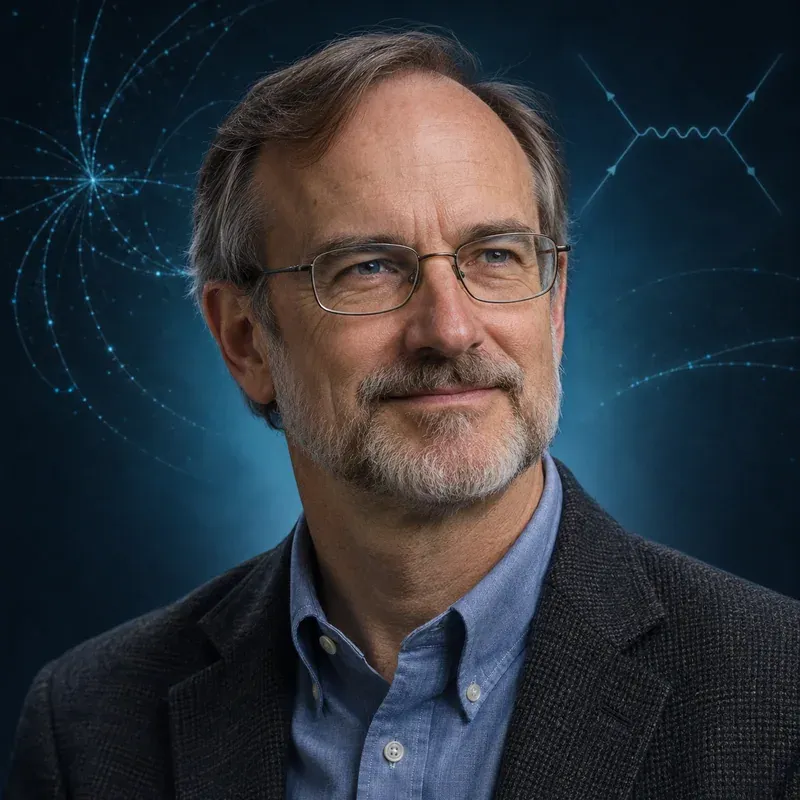
 Illustration
Daniel D. Stancil
Stancil led a 2012 demonstration in which a binary message was encoded in the pulsed NuMI neutrino beam at Fermilab and decoded with the MINERvA detector 1.035 km away, through a path including 240 m of earth, at about 0.1 bit/s with a 1% bit-error rate. It was the first demonstration of digital communication using neutrinos.
- Nationality
- American
- Field
- Electrical engineering
- Institutions
- North Carolina State University
Career
Daniel D. Stancil is an American electrical engineer. After early appointments that included MIT Lincoln Laboratory, Caltech and Applied Electro-Optics Corporation, and a first faculty post at North Carolina State University, he joined Carnegie Mellon University in 1986, where he became professor of electrical and computer engineering and later associate department head and associate dean. In 2009 he returned to NC State as head of the Department of Electrical and Computer Engineering and Alcoa Distinguished Professor, a post he held until 2023. His research covers microwave magnetics, wireless communications and nano-photonics, and he has written two textbooks.
Communication with neutrinos
Stancil's link to neutrino physics came from an engineer's question: could a weakly interacting particle carry a message where radio waves fail? Radio and light are blocked by rock and seawater, so communicating with a submarine deep underwater or through the Earth is hard. Neutrinos pass almost unhindered through any amount of matter. He had been thinking about signalling with hypothetical axions when a former student suggested testing the principle with a real neutrino beam at Fermilab.
In 2012 a team led by Stancil and his NC State colleague Brian Hughes, working with physicists of the MINERvA experiment, including Vittorio Paolone, and engineers from NASA's Glenn Research Center, carried out the test. Fermilab's NuMI beam comes in short pulses, so the team encoded binary data by sending or suppressing groups of pulses. The detector, 1.035 km away and shielded by about 240 m of rock, counted the neutrino interactions. The transmitted word was 'neutrino'. The link reached about 0.1 bit per second with an error rate of about 1 per cent, and the result was published in Modern Physics Letters A.
Significance
The data rate was tiny and the equipment – a high-power accelerator and a detector of several tonnes – enormous, so nobody expects a practical system soon. The experiment nevertheless turned neutrino communication from a thought experiment into a demonstrated technique and quantified what would be needed to improve it: more intense beams and much larger detectors. Physics World named it one of its top ten breakthroughs of 2012.
Known for
- First demonstration of communication using neutrinos (2012)
Chronology
- 2012Neutrino communication demonstration at Fermilab
Original papers
- D. D. Stancil et al., Demonstration of communication using neutrinos, Mod. Phys. Lett. A 27, 1250077 (2012)DOI 10.1142/S0217732312500770
Experiments
Frequently asked questions
Who first sent a message with neutrinos?
A team led by Daniel Stancil, using Fermilab's NuMI beam and the MINERvA detector, in 2012. They transmitted the word 'neutrino' through about 240 m of rock.
Why use neutrinos for communication?
Because they pass straight through the Earth and water, they could in principle reach places radio cannot, such as submerged submarines or the far side of the planet. Today's beams and detectors make the data rate far too low for practical use.
On the timeline
Mentioned in 4 pages
Lessons 1
Milestones 1
Terms 1
Last updated: · Editorial standard
Cite this page
Text
Neutrino Atlas (2026). “Daniel D. Stancil”. Retrieved 22 November 2026, from https://neutrino-atlas.com/people/daniel-stancil/BibTeX
@misc{neutrinoatlas2026peopledanielstancil,
  title        = {Daniel D. Stancil},
  author       = {{Neutrino Atlas}},
  year         = {2026},
  url          = {https://neutrino-atlas.com/people/daniel-stancil/},
  note         = {Accessed 2026-11-22},
  language     = {english}
}