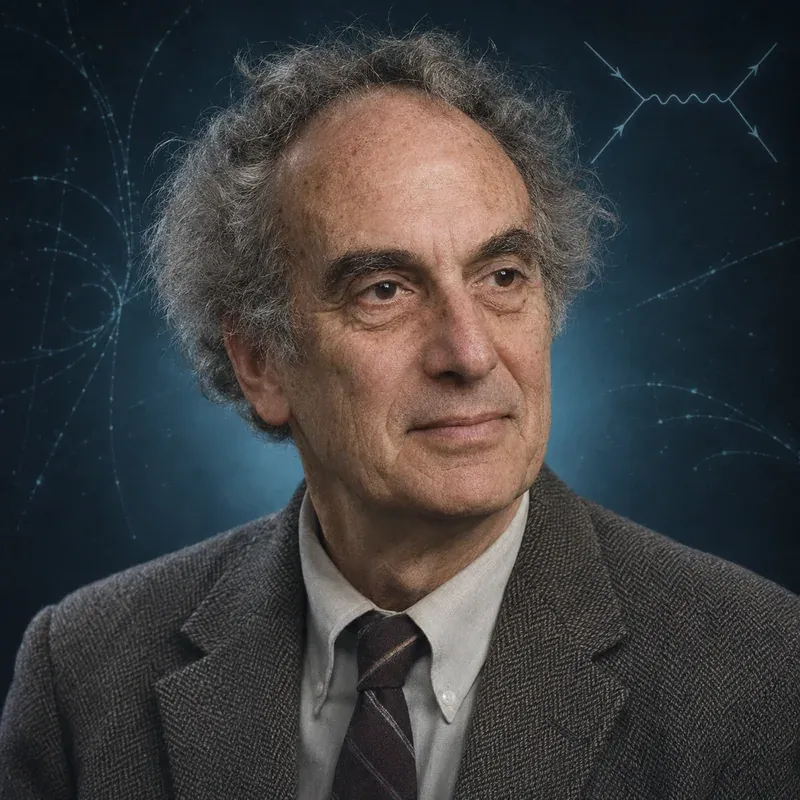
 Illustration
Martin Lewis Perl
Perl led the SLAC-LBL group that found the tau lepton in electron-positron collisions at SPEAR, reported in 1975 as anomalous events containing one electron, one muon and missing energy. The missing energy was carried by neutrinos, and the tau's decays showed that it comes with a partner neutrino of its own. The discovery therefore implied a third neutrino flavour, the tau neutrino, which was finally observed directly by DONUT in 2000. It also opened the third generation of the Standard Model, which the LEP measurement of three light neutrino species later confirmed.
- Born
- 24 June 1927
New York City, USA - Died
- 30 September 2014
Palo Alto, California, USA - Nationality
- American
- Field
- Experimental particle physics
- Nobel Prize
- Physics 1995 (shared with Frederick Reines) – for pioneering experimental contributions to lepton physics; Perl's half for the discovery of the tau lepton
- Institutions
- Columbia University, University of Michigan, Stanford Linear Accelerator Center (SLAC), Stanford University
Early life and education
Martin Lewis Perl was born in New York City in 1927. He first trained as a chemical engineer, graduating from the Brooklyn Polytechnic Institute in 1948, and worked for a time at General Electric before turning to physics. At Columbia University he completed a doctorate in 1955 under I. I. Rabi, in the field of atomic and molecular beams. He then spent about eight years at the University of Michigan, where he moved into high-energy physics, and in 1963 he joined the newly founded Stanford Linear Accelerator Center (SLAC).
The search for a heavier lepton
In the 1960s two charged leptons were known, the electron and the muon, each paired with its own neutrino after the Brookhaven two-neutrino experiment of 1962. Nothing in theory required the list to stop there, and Perl made the search for a further, heavier lepton his long-term programme. A first attempt with SLAC's linear accelerator in the 1960s found nothing. The right tool arrived with SPEAR, SLAC's electron-positron storage ring, and the Mark I detector, built by a joint SLAC and Lawrence Berkeley Laboratory group.
Discovery of the tau
Perl's idea was to look for collisions in which a pair of new heavy leptons is produced and each decays at once. If one decays to an electron and the other to a muon, the final state shows just two charged particles of different type and a large amount of missing energy and momentum, carried away by undetected neutrinos. Ordinary processes rarely give such 'e-mu events'. In 1975 the group reported 24 of them in a paper titled 'Evidence for anomalous lepton production in e+e− annihilation'; later analyses of the full 1974–1977 data used a larger sample. In a 2013 interview Perl recalled the pressure for caution and summed up the approach: 'We eventually eliminated every other explanation.'
The claim was not accepted overnight, because the same collider was producing charmed particles that could imitate parts of the signal. Experiments at DESY in Hamburg and the DELCO detector at SPEAR confirmed the result and fixed the new particle's mass at about 1.78 GeV, roughly 3,500 times the electron mass, and its spin of one half. The particle was named tau, from the Greek word for 'third'.
Why it mattered for neutrinos
The energy missing in tau decays could only be explained if the tau emits a neutrino of its own. The tau therefore implied a third neutrino flavour, the tau neutrino, and a third lepton generation. Together with the bottom quark, found at Fermilab in 1977, it confirmed the three-generation pattern that Kobayashi and Maskawa had proposed to explain CP violation. In 1989 the electron-positron colliders SLC and LEP measured the number of light neutrinos from the width of the Z boson and found three. The tau neutrino itself was observed directly in 2000 by the DONUT experiment at Fermilab, and tau neutrinos produced by oscillation were later identified by OPERA and Super-Kamiokande.
Recognition and later work
Perl shared the 1982 Wolf Prize in Physics with Leon Lederman, and in 1995 he received half of the Nobel Prize in Physics for the discovery of the tau lepton; the other half went to Frederick Reines for the detection of the neutrino. The pairing honoured both ends of lepton physics: the first neutrino and the third charged lepton.
In his later career at SLAC he led automated versions of Millikan's oil-drop experiment to look for isolated particles with fractional electric charge, and found none. He also wrote on how experimental science is done, notably in 'Reflections on Experimental Science' (1996), and his last project, after formal retirement, was a NASA-funded study related to dark energy. He died at Stanford Hospital in Palo Alto in 2014, aged 87.
Known for
- Discovery of the tau lepton (1975)
- Evidence for a third generation of leptons
- Lepton physics at the SPEAR electron-positron collider
- Searches for fractionally charged particles
Chronology
- 1955PhD at Columbia University under I. I. Rabi
- 1963Joins the newly founded Stanford Linear Accelerator Center
- 1975SLAC-LBL group reports anomalous e-mu events, the first evidence for the tau lepton
- 1982Wolf Prize in Physics, shared with Leon Lederman
- 1995Nobel Prize in Physics for the discovery of the tau lepton
- 2014Dies in Palo Alto at the age of 87
Original papers
- M. L. Perl et al., Evidence for anomalous lepton production in e+e− annihilation, Phys. Rev. Lett. 35, 1489 (1975)DOI 10.1103/PhysRevLett.35.1489
Experiments
- SLAC-LBL Mark I detector at SPEAR
- DONUT
Connected people
Frequently asked questions
What did Martin Perl discover?
The tau lepton, the heaviest of the three charged leptons, found in 1974–1977 at SLAC's SPEAR collider and first reported in 1975. Its discovery implied the existence of the tau neutrino.
Did Perl discover the tau neutrino?
No. He inferred that the tau must have a partner neutrino, because energy went missing in its decays. The tau neutrino was observed directly only in 2000 by the DONUT experiment.
Why did Perl share the 1995 Nobel Prize with Frederick Reines?
The Nobel Committee honoured 'pioneering experimental contributions to lepton physics'. Reines received his half for detecting the neutrino in 1956, Perl his half for the tau lepton.
Mentioned in 1 page
Last updated: · Editorial standard
Cite this page
Text
Neutrino Atlas (2026). “Martin Lewis Perl”. Retrieved 22 November 2026, from https://neutrino-atlas.com/people/martin-perl/BibTeX
@misc{neutrinoatlas2026peoplemartinperl,
  title        = {Martin Lewis Perl},
  author       = {{Neutrino Atlas}},
  year         = {2026},
  url          = {https://neutrino-atlas.com/people/martin-perl/},
  note         = {Accessed 2026-11-22},
  language     = {english}
}