2008Experiment
ANTARES completes the first deep-sea telescope
In May 2008 the ANTARES collaboration completed its twelfth detection line at a depth of about 2,475 m in the Mediterranean Sea off Toulon, France. With about 900 photomultipliers, it was the first operational neutrino telescope in the deep sea and the largest in the Northern Hemisphere. Its view of the southern sky, including the Galactic Centre, complemented IceCube. It ran until 2022 and paved the way for KM3NeT.
- Date
- 2008
- Kind of event
- Experiment
The situation before
The idea of using natural water as a neutrino telescope dates from the 1960s, when Moisey Markov proposed instrumenting a lake or the deep sea. The first serious attempt, DUMAND off Hawaii, was cancelled in 1995 after technical problems with its deep-sea cables and connectors. Lake Baikal in Siberia had a working detector by the late 1990s, and AMANDA showed that Antarctic ice works too. The deep Mediterranean promised clear water, a view of the southern sky including the centre of the Galaxy, and access by ship year-round, but it also meant salt water, high pressure, biofouling and bioluminescent background light.
What happened
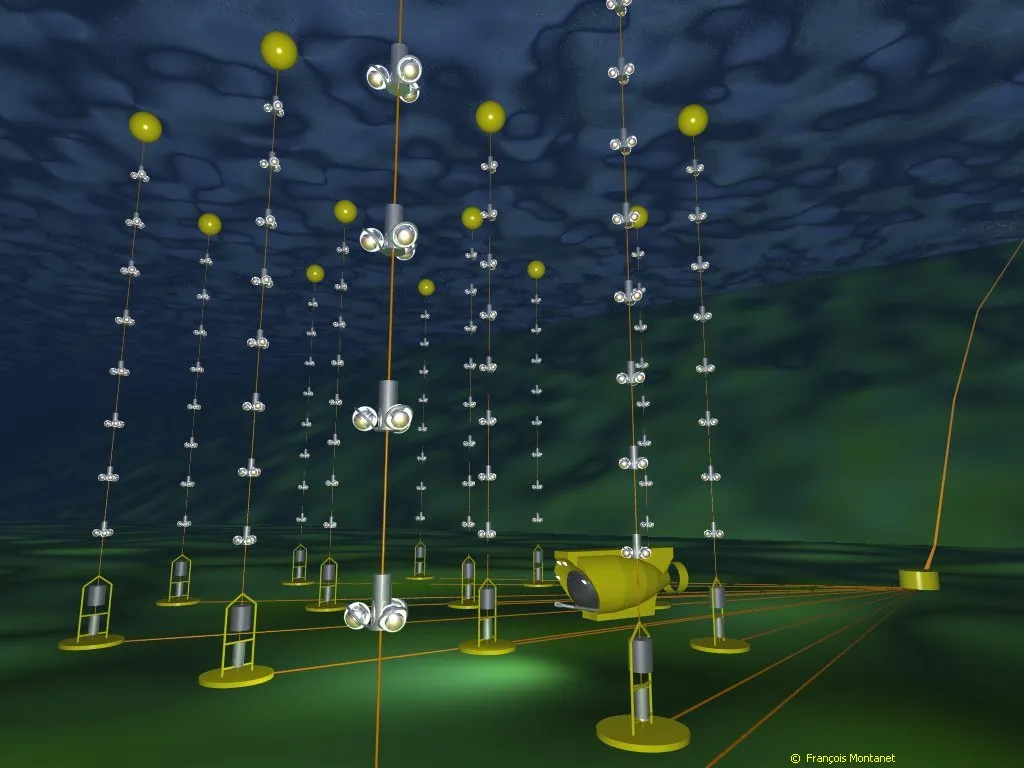
The ANTARES collaboration, formed in 1996 by groups mainly from France, Italy, the Netherlands, Germany and Spain, chose a site 40 km off Toulon at a depth of about 2,475 m. A long electro-optical cable linked it to the shore at La Seyne-sur-Mer. The detector consisted of vertical lines about 450 m tall, anchored to the seabed and held upright by buoys. Each line carried up to 25 storeys with three 10-inch photomultipliers in glass spheres, looking downward at 45 degrees to catch the Cherenkov light of upgoing muons.
- March 2006: the first complete line was connected by a remotely operated submarine.
- 2007: five, then ten lines were operating and already taking physics data.
- 30 May 2008: the last two lines were connected, completing twelve detection lines with 885 optical modules.
Each connection was made by a submersible on the seabed, which plugged the line's cable into a junction box. The first year of operation showed that the deep-sea background, mostly from potassium-40 in sea water and from bioluminescence, varied strongly with the season but could be handled with local coincidences.
Results
ANTARES was the first neutrino telescope operated in the deep sea and the largest in the Northern Hemisphere. With an instrumented volume of roughly 0.01 km³ it was far smaller than IceCube, but it had better angular resolution for muon tracks, because water scatters light less than ice. Over its lifetime it searched for point sources and for neutrinos from the Galactic plane, set limits on dark-matter annihilation in the Sun and Galactic Centre, and ran joint analyses with IceCube. It also served as a platform for marine science, recording bioluminescence, currents and the sounds of sperm whales. ANTARES was switched off in February 2022 after more than 15 years.
Why it matters
ANTARES proved that a neutrino telescope can be built, connected and operated for years at great depth in the sea. Its technology and its team led directly to KM3NeT, whose ARCA and ORCA detectors off Sicily and Toulon are being built on the same principles, and whose ARCA array recorded the record-energy event KM3-230213A in 2023.
Frequently asked questions
When was ANTARES completed?
Its twelfth and last detection line was connected on 30 May 2008, at a depth of about 2,475 m off Toulon.
Why build a neutrino telescope in the Mediterranean?
From the Northern Hemisphere a detector looking for upgoing neutrinos sees most of the southern sky, including the Galactic Centre, which complements IceCube at the South Pole.
Original papers
- MeasurementM. Ageron et al. (ANTARES), ANTARES: the first undersea neutrino telescope, Nucl. Instrum. Meth. A 656, 11 (2011)
Concepts
Last updated: · Editorial standard
Cite this page
Text
Neutrino Atlas (2026). “2008: ANTARES completes the first deep-sea telescope”. Retrieved 22 November 2026, from https://neutrino-atlas.com/timeline/2008-antares-completed/BibTeX
@misc{neutrinoatlas2026line2008antarescompleted,
  title        = {2008: ANTARES completes the first deep-sea telescope},
  author       = {{Neutrino Atlas}},
  year         = {2026},
  url          = {https://neutrino-atlas.com/timeline/2008-antares-completed/},
  note         = {Accessed 2026-11-22},
  language     = {english}
}