2007Experiment
MiniBooNE tests LSND and finds a low-energy excess
MiniBooNE, a mineral-oil Cherenkov detector in Fermilab's Booster Neutrino Beam, announced on 11 April 2007 that it saw no LSND-like electron-neutrino appearance in its main analysis region. However, it observed an unexplained excess of electron-like events at lower energies. Later data with antineutrinos and neutrinos strengthened the excess. Its origin, whether new physics or an unmodelled background, is still debated.
- Date
- 11 April 2007
- Kind of event
- Experiment
- People involved
- Janet M. Conrad, William C. Louis
- Experiments
- MiniBooNE, Booster Neutrino Beam (BNB)
The situation before
In the 1990s the LSND experiment at Los Alamos reported an excess of electron antineutrinos in a beam of muon antineutrinos over just 30 m. Interpreted as oscillation, it required a mass-squared difference near 1 eV², far larger than the solar and atmospheric values. Three such splittings cannot fit into a three-neutrino scheme, so LSND, if correct, implied at least one sterile neutrino. No other experiment had confirmed or excluded it in the same parameter region.
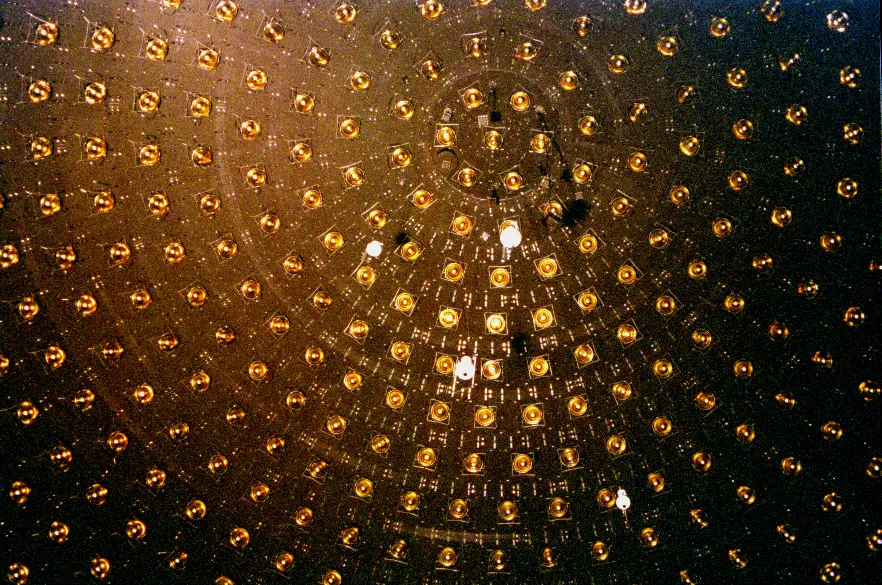
MiniBooNE at Fermilab was designed to test LSND with different systematics: a higher energy (around 700 MeV) and a longer baseline (541 m), keeping L/E similar. Its detector was a 12 m sphere filled with 800 tonnes of mineral oil and lined with 1,280 photomultipliers, placed in the Booster Neutrino Beam. Janet Conrad and William Louis, a member of LSND, were the spokespersons.
What happened
MiniBooNE ran a blind analysis: the electron-like event sample stayed hidden until all selection criteria and background estimates were fixed. The data were unblinded shortly before 11 April 2007, when the collaboration presented the result at Fermilab, based on 5.6 × 10²⁰ protons on target.
- In the pre-defined analysis region from 475 MeV to 1.25 GeV the event count agreed with the expected background; no LSND-like appearance signal was seen.
- A simple two-neutrino oscillation explanation of LSND was excluded at 98 percent confidence.
- Below 475 MeV, however, there was an excess of electron-like events of the order of a hundred, which the expected backgrounds did not explain.
The paper „A search for electron neutrino appearance at the Δm² ~ 1 eV² scale“ appeared in Physical Review Letters 98, 231801 (2007).
Reaction
The headline was a null result for LSND, and many physicists read it as closing the case. The low-energy excess was treated cautiously, because it lay where backgrounds, especially single photons from neutral-current interactions, are hardest to model in a Cherenkov detector that cannot distinguish electrons from photons.
What followed
The excess did not go away. Running with antineutrinos and then again with neutrinos, MiniBooNE reported in 2018 a combined excess of 4.8σ. It became a central part of the short-baseline anomalies. To resolve it, Fermilab built MicroBooNE, a liquid-argon detector able to separate electrons from photons. Its first results in 2021 found no electron-neutrino excess of the kind required, and later analyses also limited single-photon explanations, but no interpretation has been agreed. The origin of MiniBooNE's excess, whether new physics or an unmodelled background, remains open, and the SBND and ICARUS detectors on the same beam are expected to help settle it.
Frequently asked questions
Did MiniBooNE confirm LSND?
Not in its main 2007 analysis. In the energy range designed to test LSND it saw no oscillation signal, and a simple two-neutrino explanation was excluded at 98 percent confidence.
What is the MiniBooNE low-energy excess?
An unexplained surplus of electron-like events below 475 MeV, first seen in 2007 and later strengthened to 4.8σ. Whether it comes from new particles or from a poorly modelled background is still debated.
Original papers
- First resultA. A. Aguilar-Arevalo et al. (MiniBooNE), A Search for electron neutrino appearance at the Δm² ~ 1 eV² scale, Phys. Rev. Lett. 98, 231801 (2007)DOI 10.1103/PhysRevLett.98.231801arXiv:0704.1500
- MeasurementA. A. Aguilar-Arevalo et al. (MiniBooNE), Significant Excess of Electron-Like Events in the MiniBooNE Short-Baseline Neutrino Experiment, Phys. Rev. Lett. 121, 221801 (2018)DOI 10.1103/PhysRevLett.121.221801arXiv:1805.12028
Concepts
Mentioned in 1 page
Lessons 1
Last updated: · Editorial standard
Cite this page
Text
Neutrino Atlas (2026). “2007: MiniBooNE tests LSND and finds a low-energy excess”. Retrieved 22 November 2026, from https://neutrino-atlas.com/timeline/2007-miniboone-first-result/BibTeX
@misc{neutrinoatlas20262007miniboonefirstresult,
  title        = {2007: MiniBooNE tests LSND and finds a low-energy excess},
  author       = {{Neutrino Atlas}},
  year         = {2026},
  url          = {https://neutrino-atlas.com/timeline/2007-miniboone-first-result/},
  note         = {Accessed 2026-11-22},
  language     = {english}
}