2004Experiment
Super-K sees the oscillation dip in L/E
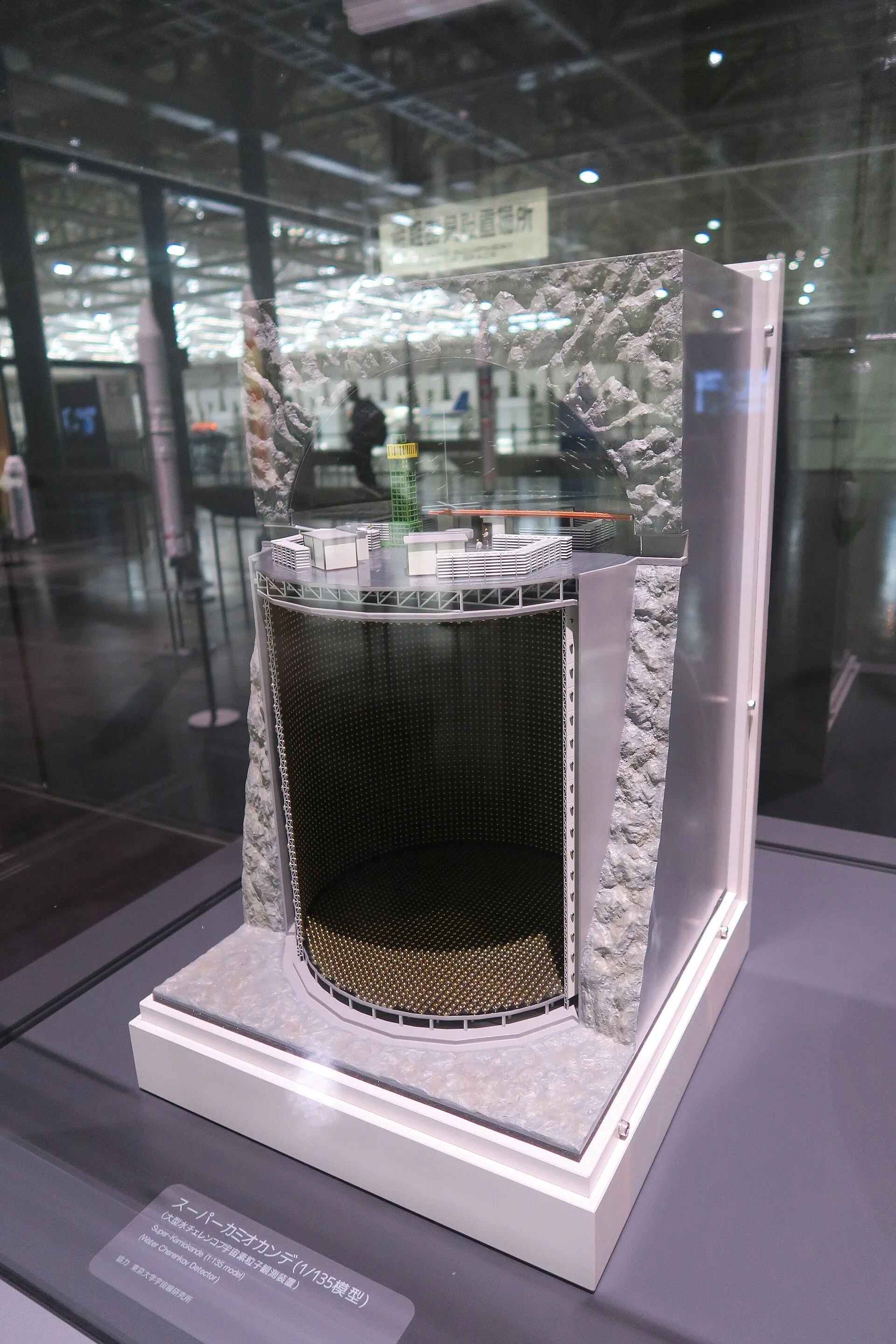
Selecting atmospheric muon-neutrino events with good resolution in path length L and energy E, Super-Kamiokande found a dip in the event rate as a function of L/E. This first oscillatory feature favoured oscillation over alternative explanations such as neutrino decay or decoherence. It fixed the atmospheric mass-squared difference to roughly 2 × 10⁻³ eV².
- Date
- 2004
- Kind of event
- Experiment
- People involved
- Takaaki Kajita
- Experiments
- Super-Kamiokande
The situation before
In 1998 Super-Kamiokande had shown that upward-going atmospheric muon neutrinos, which cross the Earth, are depleted relative to downward-going ones. Oscillation explained the deficit very well, but the evidence was a deficit, not an oscillation. Several alternatives could also remove muon neutrinos over long paths: neutrino decay, quantum decoherence, or exotic effects that do not produce a periodic pattern. A true oscillation should do something the others do not: the survival probability should fall, rise again and fall again as a function of path length divided by energy, L/E.
What happened
Seeing this pattern in atmospheric data is hard. Neutrino energies are only partly measured, because the outgoing muon carries an unknown share of the energy, and the flight distance is inferred from the reconstructed direction, which is smeared near the horizon where L changes rapidly. A group around Takaaki Kajita therefore selected only events whose L/E could be reconstructed with a resolution better than about 70 percent, discarding horizontal and low-energy events. The analysis used 1,489 live days of SK-I data (1996–2001).
Plotted against L/E, the ratio of observed to expected events showed a dip near 500 km/GeV followed by a partial recovery. This is where the first oscillation minimum should appear for the atmospheric parameters. Beyond it, the experimental resolution washes out further wiggles and the ratio settles at about one half.
- Neutrino decay was disfavoured at 3.4σ and decoherence at 3.8σ, because neither predicts a dip with recovery.
- The oscillation fit gave 1.9 × 10⁻³ < Δm² < 3.0 × 10⁻³ eV² and sin²2θ > 0.90 at 90 percent confidence.
- The result appeared as „Evidence for an oscillatory signature in atmospheric neutrino oscillations“ in Physical Review Letters 93, 101801 (2004).
Why it matters
The L/E dip turned the atmospheric anomaly into a measured oscillation, with a mass-squared difference that later became Δm²₃₁ in the three-flavour picture. It also gave accelerator experiments a clear target. K2K reported an energy-dependent deficit at 250 km in the same period, and MINOS confirmed and sharpened the result from 2006. The analysis was part of the body of work for which Kajita received the 2015 Nobel Prize in Physics.
Frequently asked questions
What did the Super-Kamiokande L/E analysis show?
It found a dip in the rate of atmospheric muon neutrinos at L/E of about 500 km/GeV, the first direct sign of the periodic behaviour expected from oscillation, published in 2004.
Why not just count the missing neutrinos?
A deficit alone could also come from neutrino decay or decoherence. Only oscillation predicts a minimum followed by a partial recovery, so seeing the dip ruled those alternatives out at more than 3σ.
Original papers
- DiscoveryY. Ashie et al. (Super-Kamiokande), Evidence for an oscillatory signature in atmospheric neutrino oscillation, Phys. Rev. Lett. 93, 101801 (2004)DOI 10.1103/PhysRevLett.93.101801arXiv:hep-ex/0404034
Concepts
Mentioned in 1 page
Lessons 1
Last updated: · Editorial standard
Cite this page
Text
Neutrino Atlas (2026). “2004: Super-K sees the oscillation dip in L/E”. Retrieved 22 November 2026, from https://neutrino-atlas.com/timeline/2004-super-k-l-over-e/BibTeX
@misc{neutrinoatlas2026timeline2004superklovere,
  title        = {2004: Super-K sees the oscillation dip in L/E},
  author       = {{Neutrino Atlas}},
  year         = {2026},
  url          = {https://neutrino-atlas.com/timeline/2004-super-k-l-over-e/},
  note         = {Accessed 2026-11-22},
  language     = {english}
}