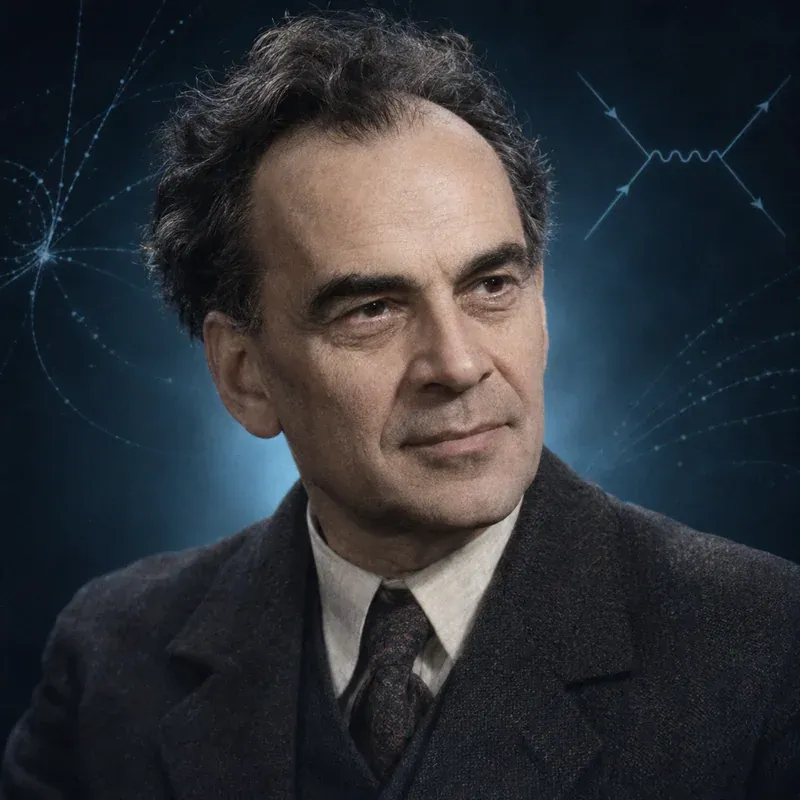
 Illustration
Moisey Alexandrovich Markov
At the 1960 Rochester conference Markov proposed installing detectors deep in a lake or sea to detect muons from neutrino interactions via their Cherenkov light, building on his student Igor Zheleznykh's work. This idea underlies DUMAND, Baikal, AMANDA, ANTARES and IceCube. The Lake Baikal telescope was begun in the 1980s on his proposal.
- Born
- 13 May 1908
Rasskazovo, Tambov Governorate, Russian Empire - Died
- 1 November 1994
Moscow, Russia - Nationality
- Soviet
- Field
- Theoretical physics, neutrino physics
- Institutions
- Moscow State University, Lebedev Physical Institute, Institute for Nuclear Research (INR), Moscow
Early life and education
Moisey Alexandrovich Markov was born in 1908 in Rasskazovo, in the Tambov region of the Russian Empire. He graduated from the physics faculty of Moscow University in 1930, studied at the Institute of Red Professors from 1931 to 1933 and taught briefly at Moscow State University. In 1934 he joined the Lebedev Physical Institute (FIAN) of the Academy of Sciences, which remained his scientific home for decades.
Markov was a theorist with unusually wide interests. His work ranged over the foundations of quantum mechanics and quantum field theory, the physics of elementary particles, the early universe and gravity in strong fields. He became a corresponding member of the USSR Academy of Sciences in 1953 and a full member in 1966.
Path to neutrino physics
In the 1950s Markov turned increasingly to the neutrino, which he saw as the cleanest probe of the weak interaction. From 1956 to 1962 he headed a laboratory of neutrino physics, in 1963 the Lebedev Institute set up a new neutrino laboratory at his suggestion, and he was among the first in the Soviet Union to draw up programmes of fundamental particle physics at accelerators. In the same years Bruno Pontecorvo in Dubna was developing the idea of accelerator neutrino beams. Markov's monograph ‘The Neutrino’, published in Dubna in 1963 and in English translation in 1964, summarised the state of the field for a generation of Soviet physicists.
Key contributions
Markov's lasting contribution to experimental neutrino physics is a single, far-reaching idea. At the 1960 International Conference on High Energy Physics in Rochester he proposed to detect high-energy neutrinos deep in a lake or the sea. The concept had been worked out in the diploma thesis of his student Igor Zheleznykh. When a neutrino interacts in the rock or water below a detector, it can produce a muon that travels in nearly the same direction. In clear water such a muon emits Cherenkov radiation, a faint cone of blue light. A large three-dimensional array of light sensors spread through the water could record this light, reconstruct the muon track and so point back to the neutrino's origin.
The idea solved two problems at once. High-energy cosmic neutrinos are so rare that only a detector of enormous volume can catch them, and natural water provides that volume cheaply. Deep water also acts as a shield: by looking for upward-going muons, which can only have been produced by neutrinos that crossed the Earth, the detector rejects the much more numerous cosmic-ray muons arriving from above. This principle, the ice and water Cherenkov telescope with optical modules, underlies every large neutrino telescope built since.
From idea to telescopes
Realising Markov's proposal took decades. The American DUMAND project off Hawaii pioneered the technique from the 1970s but was cancelled in the 1990s. In the Soviet Union, Markov and Alexander Chudakov encouraged the young physicist Grigory Domogatsky to consider Lake Baikal, whose deep, clear fresh water and thick winter ice, which serves as a platform for deploying strings of detectors, make it an unusually practical site. This led to a laboratory of high-energy neutrino astrophysics at the Institute for Nuclear Research (INR) in Moscow, an institute Markov had helped to found, and to the Baikal neutrino telescope, whose early arrays in the 1990s were the first to record neutrinos underwater.
The same concept was transferred to the Antarctic ice in AMANDA and IceCube, developed by Francis Halzen and others, and to the Mediterranean in ANTARES and KM3NeT. Its successor in Siberia, Baikal-GVD, began operating as a cubic-kilometre-scale detector in 2021. When IceCube reported the first high-energy astrophysical neutrinos in 2013, the detection method was essentially the one Markov had described half a century earlier.
Later work and legacy
From 1968 to 1988 Markov served as academician-secretary of the Nuclear Physics Department of the Academy of Sciences, a key position for organising Soviet particle physics. As a theorist he continued to explore speculative questions about the limits of physics, including hypothetical particles at the Planck scale. He was named Hero of Socialist Labour and received three Orders of Lenin. Markov died in Moscow in November 1994.
Known for
- 1960 proposal of deep underwater/lake neutrino telescopes
- Book 'The Neutrino' (1963)
- Initiated the Baikal neutrino telescope
Chronology
- 1956Head of Neutrino Physics Laboratory (to 1962)
- 1960Proposes underwater neutrino telescope (Rochester)
- 1966Full member, USSR Academy of Sciences
- 1968Secretary of Nuclear Physics Department (to 1988)
Original papers
- M. A. Markov, On high energy neutrino physics, Proc. 1960 Annual Int. Conf. on High Energy Physics, Rochester, p. 578 (1960)
- M. A. Markov, The Neutrino (1963)
Experiments
- Baikal Neutrino Telescope
- DUMAND
Connected people
- Alexander Yevgenievich Chudakov
- Francis Halzen
- Grigory Vladimirovich Domogatsky
- Gurgen Askaryan
- Kenneth Ingvard Greisen
Frequently asked questions
What did Moisey Markov propose in 1960?
He proposed detecting high-energy neutrinos with light sensors placed deep in a lake or the sea, recording the Cherenkov light of muons produced by neutrino interactions. This is the principle of all modern neutrino telescopes.
How is Markov connected to Lake Baikal?
With Alexander Chudakov he encouraged Grigory Domogatsky to develop a neutrino detector in Lake Baikal. This grew into the Baikal telescope and today's Baikal-GVD.
Was Markov an experimentalist?
No. He was a theoretical physicist; his influence on experiment came through ideas, his book ‘The Neutrino’ and his role in organising Soviet physics.
On the timeline
Mentioned in 15 pages
Lessons 1
Milestones 4
People 6
Last updated: · Editorial standard
Cite this page
Text
Neutrino Atlas (2026). “Moisey Alexandrovich Markov”. Retrieved 22 November 2026, from https://neutrino-atlas.com/people/moisey-markov/BibTeX
@misc{neutrinoatlas2026peoplemoiseymarkov,
  title        = {Moisey Alexandrovich Markov},
  author       = {{Neutrino Atlas}},
  year         = {2026},
  url          = {https://neutrino-atlas.com/people/moisey-markov/},
  note         = {Accessed 2026-11-22},
  language     = {english}
}